
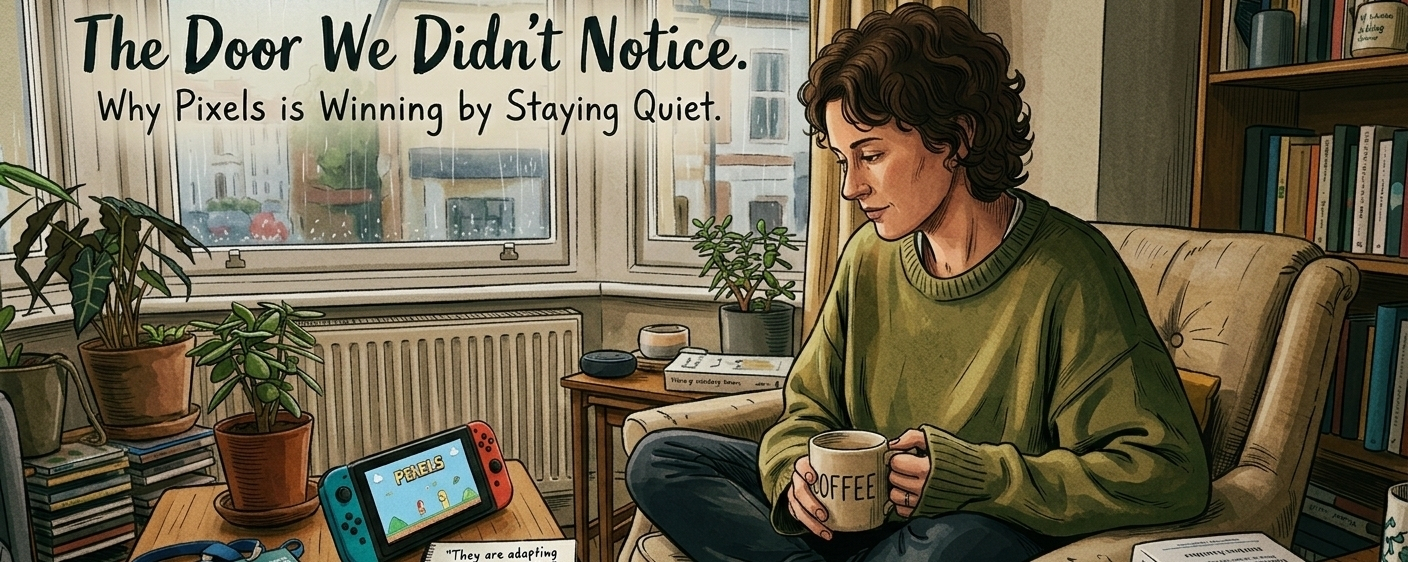
I will be honest when I first saw Pixels, I almost dismissed it entirely. It didn’t look like the kind of project that demanded a deep dive or a thousand-word analysis. In an industry that usually screams about its own ambition,Pixels looked almost too simple to matter. It was just farming, small tasks, and familiar loops. There was no loud innovation, no complex whitepaper jargon just a game that looked like a thousand other things I’d seen before. But that’s exactly where I got it wrong. I was looking for a technical breakthrough, but I missed the psychological one.
The reality is that Pixels doesnot try to convince people to join Web3 by selling them on the virtues of decentralization. It does something much quieter, and arguably more powerful: it lets people walk through the door without ever realizing they have crossed a threshold. We talk so much about onboarding in tech, but most projects fail before they even start because they make the entry feel like homework. We force people through wallet setups, network switches, and seed phrase storage tiny frictions that kill momentum in real life. We claim we want mass adoption, yet we design experiences that feel like filling out tax forms.
Pixels avoids this trap by effectively pretending it isn’t part of that world. You start with the game, not the infrastructure. By the time you are interacting with assets or tokens, your brain has already categorized the experience as entertainment rather than Web3 training. It taps into the fact that while people tend to resist new systems, they rarely resist routines. This is where it gets a bit uncomfortable for me. We are seeing a form of behavioral normalization where the system is teaching users how to live inside an ecosystem while they think they are just tending to a virtual farm. It’s the same way digital payments became normal we didnot wake up one day and decide to trust the tech we just eventually stopped reaching for cash. Behavior changed long before our beliefs did.
There is a certain invisibility to this success that makes it hard to measure. We can look at player counts or retention charts, but the deeper metric is how many people have stopped feeling like blockchain usersand started behaving like they have always been there. However, that lack of friction is a doubleedged sword. If you enter a room because the door was already open, you might leave just as casually.Low friction helps you grow, but it doesn't guarantee loyalty. We saw this with other projects when the incentives dried up, the community evaporated because the attachment was based on a mechanic, not a meaning.
Ultimately, Pixels feels softer and less extractive than its predecessors, but it still faces the ultimate test of any digital space. Once the front door is solved and the entry is seamless the harder question remains why stay? Convenience can create access, but it does not create value. As we move forward, we have to wonder if the game will become a genuine anchor for these people.