
There is a version of Pixels that works. Most people who followed the project in its early days could see it the land economy compounding, the token moving with real purpose, a marketplace where both sides actually had reason to show up. That version was coherent. The problem is that what exists on-chain looks different from what was described, and the gap between the two has been widening quietly ever since.
Players earn PIXEL by playing. They spend it on crafting, items, and in-game activity. The team calls this an economy, and on the surface it resembles one. But an economy requires balance between what enters circulation and what permanently leaves it. In Pixels, those two flows have never been equal. That is not a temporary condition waiting to be corrected. It is the system operating within the boundaries its structure allows.
The common explanation is that sink mechanics take time. Building them properly is hard, and no game launches with a perfect economic model. That argument holds weight. What it does not fully account for is that emissions began reaching players at scale before any sink mechanism existed that could absorb them at the same rate. The sequence created a structural gap that compounds with each passing emission cycle not because of any single decision, but because token economies are sensitive to the order in which their components go live.
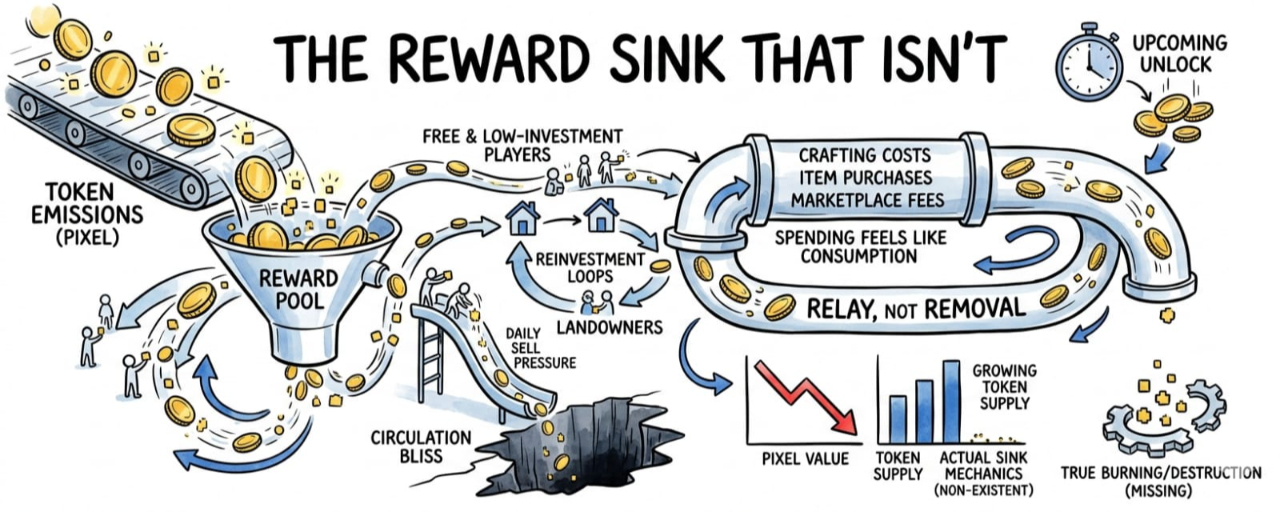
A real sink does not just move tokens around. It removes them permanently. The distinction matters more than it appears. When a player spends PIXEL to craft a tool, that token does not leave the system it moves to a treasury that feeds back into the reward pool that pays the next player. The crafting cost feels like consumption. Economically, it is a relay. The same dynamic applies to marketplace fees, energy mechanics, and most in-game expenditure categories. Each one creates visible friction without creating actual removal. The supply curve does not register the difference. It keeps moving in one direction regardless of how much activity the in-game economy generates around it.
This is not an economy. It is a scheduled dilution event with gameplay attached.
The player base makes this dynamic sharper. Landowners behave differently from everyone else. They reinvest, they build, they hold productive positions that give them reason to keep tokens moving within the system. Their behavior partially offsets the sell pressure their emissions create. But landowners are a small and concentrated group. The majority of people playing Pixels are free or low-investment players, and their relationship with PIXEL follows simpler logic earn it, sell it, move on. They are not being irrational. They are responding correctly to a token whose purchasing power has been declining for an extended period. The two groups are not just different types of players. They are pulling the token in opposite directions, and the larger group exerts that pull every single day.
The price history makes this readable without needing a model to explain it. PIXEL has lost more than 99% of its value from its all-time high of $1.02. That did not happen in one event. It happened gradually, through a sustained bleed punctuated by short-lived spikes around announcements and content drops. Those spikes resemble recovery. They are not. They are the market trading the news cycle, not the underlying system. Each one fades because the structural pressure underneath it never changes.
The supply data adds weight that is difficult to argue with. Roughly 2.74 billion PIXEL tokens are already in circulation. Another 2.26 billion remain locked meaning the sell pressure the market absorbs today exists before nearly half the total supply has arrived. An upcoming unlock will introduce a further 91 million tokens into that same pool. This is not a market waiting for better sentiment. It is a system carrying significant future supply against sink mechanics that were not scaled to match it.
The path forward requires demand that does not depend on new players arriving to create it. Sinks that function whether the game is growing or contracting. Mechanisms that make holding or burning PIXEL more economically rational than converting it not marginally, but decisively. Land upgrade costs that permanently destroy tokens rather than recycle them. Governance structures that require meaningful lockup rather than passive holding. Fee models where destruction is the default rather than the exception. Each of these shifts the incentive calculation at the margin. None of them work in isolation. Together, at sufficient scale, they represent the difference between a token that circulates and a token that holds value.
The reward system in Pixels is not collapsing. There is no crisis, no scandal, no visible moment of failure. It is facing the arithmetic consequence of an emission structure that preceded the infrastructure designed to balance it. The flywheel exists and it functions in one direction. The mechanism that completes the loop is a scaling problem, not an impossibility. How quickly that gap closes will determine whether PIXEL finds a sustainable equilibrium or continues drifting toward one set by supply alone.
