
There’s a pattern I’ve noticed in almost every successful farming-style game, and it’s not about rewards. It’s about where the game hides its friction. At first glance, Pixels feels peaceful. You log in, do your tasks, harvest, craft, explore, repeat. Nothing screams urgency. No flashing countdowns. No aggressive popups telling you to spend. It almost feels like the game is saying, “Relax. Progress will come naturally.”
But the longer you watch real players inside the ecosystem, the more you realize something important: Pixels isn’t slow. It’s selective. Some players stay in the same loop for days—grinding steadily, moving forward at a predictable pace. Others seem to break out of that loop early and start progressing like the game has a hidden fast lane. At first, you assume it’s skill, strategy, or simply more hours spent.
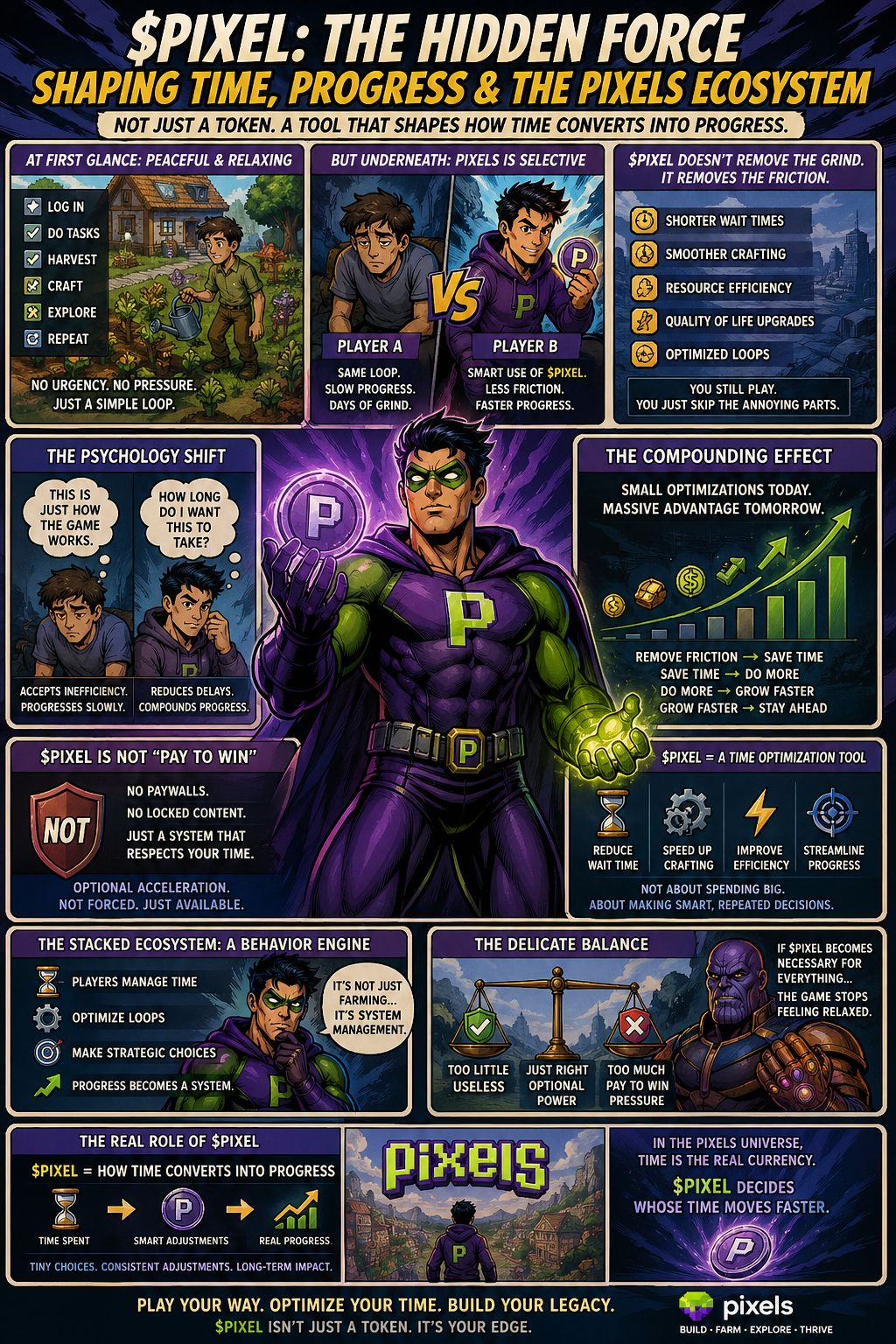
But it isn’t always. The difference often comes down to one thing: how they interact with $PIXEL. Not in a loud “pay-to-win” way. More like a quiet system-level influence that most people don’t notice until it’s already happening. That’s what makes it interesting.
Because $PIXEL doesn’t behave like a normal “premium currency” where you just buy boosts and speed everything up. Instead, it feels like strolls something deeper—almost like it determines which parts of the game are allowed to become efficient. And that’s a different kind of power. In Pixels, the grind isn’t removed. The work still exists. But the token introduces an invisible question at certain moments: “How long do you want this to take?”
That question changes player psychology completely. A new player might spend hours doing early progression manually. They’ll craft slowly, wait longer, and accept inefficiency because they assume that’s just how the game works. Meanwhile, another player doesn’t necessarily spend a lot—but they use ethically. They smooth out the slow parts. They reduce the most annoying delays. They don’t skip the game… they skip the friction.
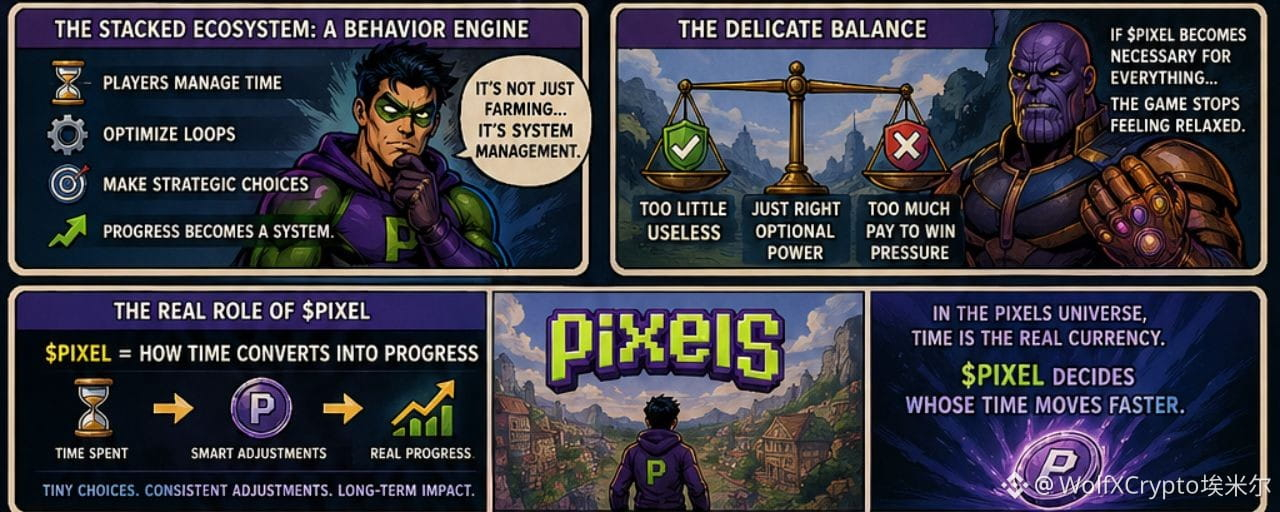
And once friction is removed even slightly, progress doesn’t just improve—it compounds. That compounding effect is where the Stacked ecosystem becomes more than just a token economy. It becomes a behaviour engine. The player isn’t only farming resources anymore—they’re managing time, optimizing loops, and treating gameplay like a system that can be tuned. What’s clever is how subtle the design feels.
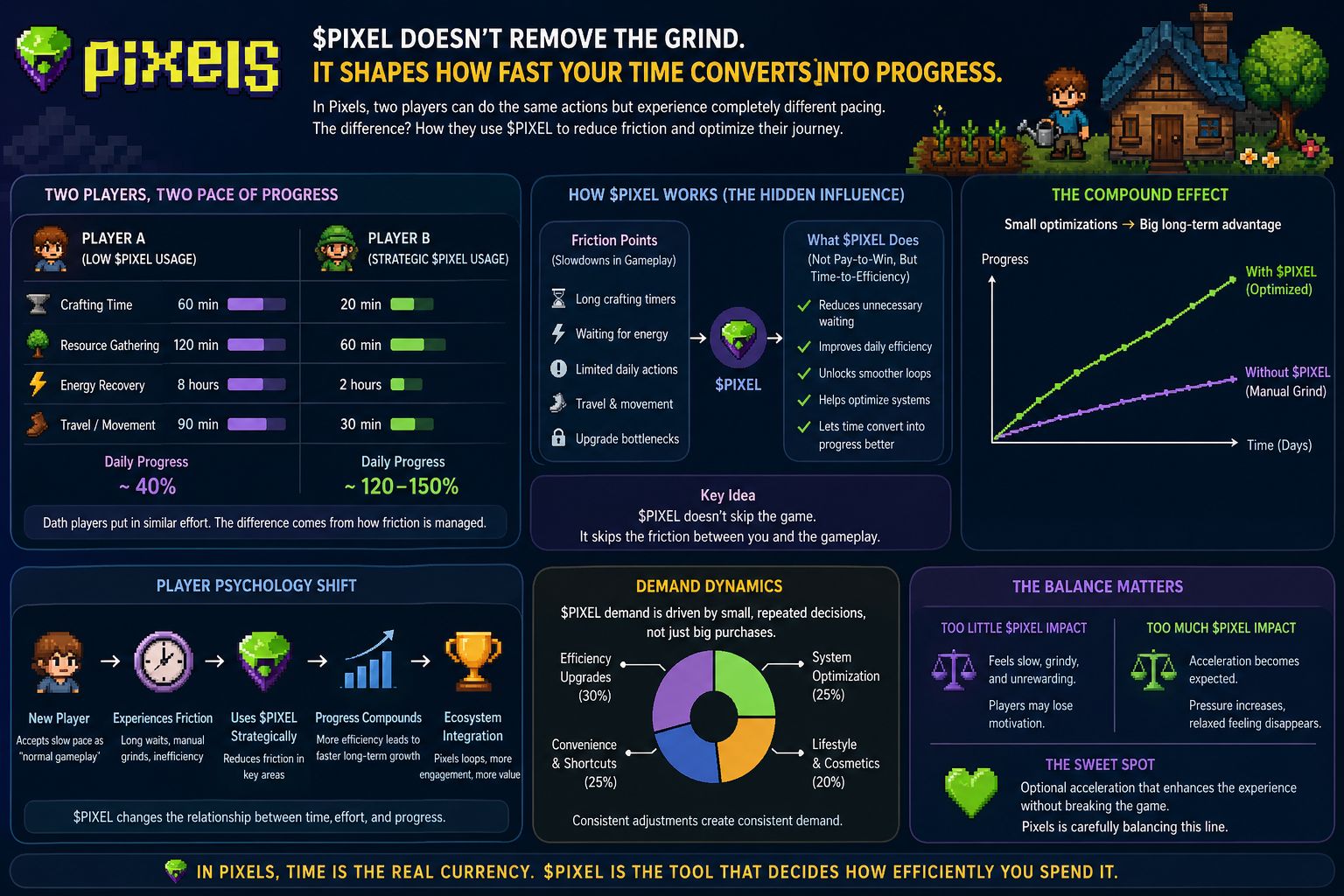
Pixels doesn’t force you. It doesn’t lock content behind payment walls. It just creates a structure where two players can do similar actions, yet experience completely different pacing over time. And that pacing gap slowly becomes permanent. That’s why the real role of just “spend to upgrade.” It’s closer to: that shapes how time converts into progress.
And once you see that, you start understanding why demand for come from big purchases, but from small repeated decisions. Tiny optimizations. Minor upgrades. A little efficiency here, a shortcut there. Not dramatic spending—just consistent adjustment. Still, it’s a delicate balance. If too much of the experience starts depending on the, then optional acceleration becomes expected behaviour. And once a system reaches that point, the pressure becomes visible—and the “relaxed” atmosphere starts to disappear.
But right now, Pixels seems to be playing that line carefully.
The game feels calm on the surface, but underneath it’s quietly shaping player movement, retention, and long-term ecosystem flow. And maybe that’s the most interesting part of @Pixels: it doesn’t just reward players—it subtly decides whose time moves faster.
And in any economy-based game, time is the real currency.