
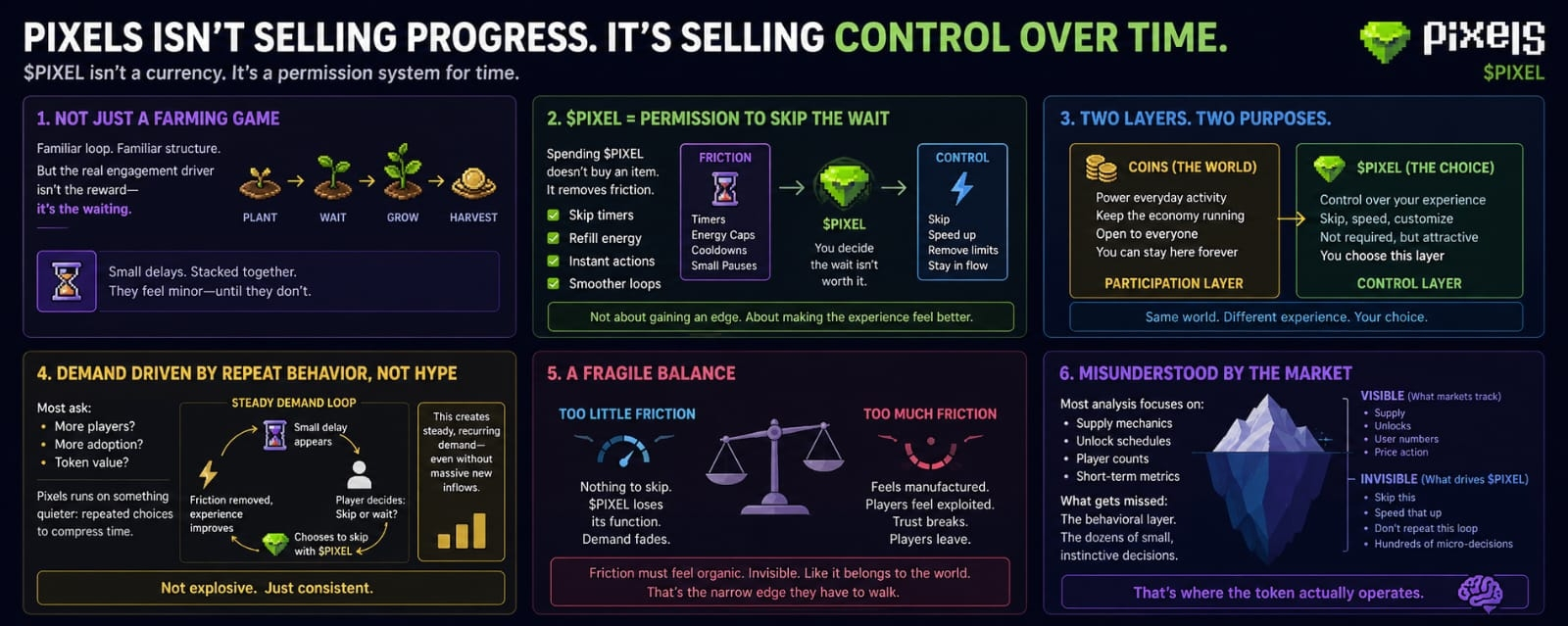
It didn't register immediately. Pixels read like another farming loop wrapped around a token — the familiar structure. Plant, wait, harvest, repeat. I've watched enough of these to feel like I already knew the ending. But after observing how real players actually engage with it, something started feeling slightly out of place. Not broken. Just… not quite what the usual "progress economy" story would predict.
What players actually respond to isn't what they're earning. It's how long everything takes to arrive.
That sounds simple, but it reframes everything. Most GameFi tokens are selling advancement. Better equipment, quicker yields, bigger output. Pixels does some of that too, but the real pressure point isn't the reward sitting at the end. It's the waiting wrapped around it. Growth timers, energy caps, small pauses scattered throughout. Each one seems minor. Together, they accumulate into something heavier than they appear.
That's where $PIXEL quietly positions itself.
I don't think it functions as a currency in any traditional sense. It operates more like a permission system for time. When you spend it, you're not really purchasing an item. You're deciding the wait is no longer acceptable. Or that running the same loop one more time isn't worth the effort. That decision surfaces more often than you'd expect.
I've watched players who had no real interest in optimizing their output still reach for pixel just to reduce friction. Not to gain an edge. Just to make the experience smoother. That's a completely different kind of demand. Quieter. Harder to quantify. But it keeps appearing.
There's also a split running through the system that tends to get ignored. Coins handle the majority of everyday activity. They keep the economy breathing, keep the world functional. You can stay in that layer indefinitely. Nothing pushes you out. But the moment you want control over your experience rather than just participation in it, you drift toward $PIXEL. That boundary feels deliberate.
It's reminiscent of how certain platforms separate standard access from priority access. Same underlying system, different experience depending on how much control over time you're willing to claim. Pixels never states this explicitly, but it operates that way.
What's interesting is how this reshapes the standard "adoption" conversation. Most people ask whether more players are coming, whether user numbers can grow, whether token value holds through expansion. I'm not sure that's the primary driver here. The more I study it, the more it seems like repetition carries more weight than growth.
If players keep running into small delays that feel worth skipping, demand can sustain itself even without major new inflows. Not explosive demand. Just steady, recurring choices to compress time. That doesn't show up cleanly on any chart.
But it's fragile.
If the game becomes too frictionless, if delays stop registering, then $PIXEL loses its function. Nothing left to skip. But if the friction starts feeling manufactured — like it only exists to extract spending — players pick up on that quickly. And they rarely stay quiet.
So the system ends up balancing on a narrow edge. Friction has to feel organic. Almost invisible. Like it belongs to the world rather than something placed there intentionally. That's more difficult than it sounds. Especially as the player base grows.
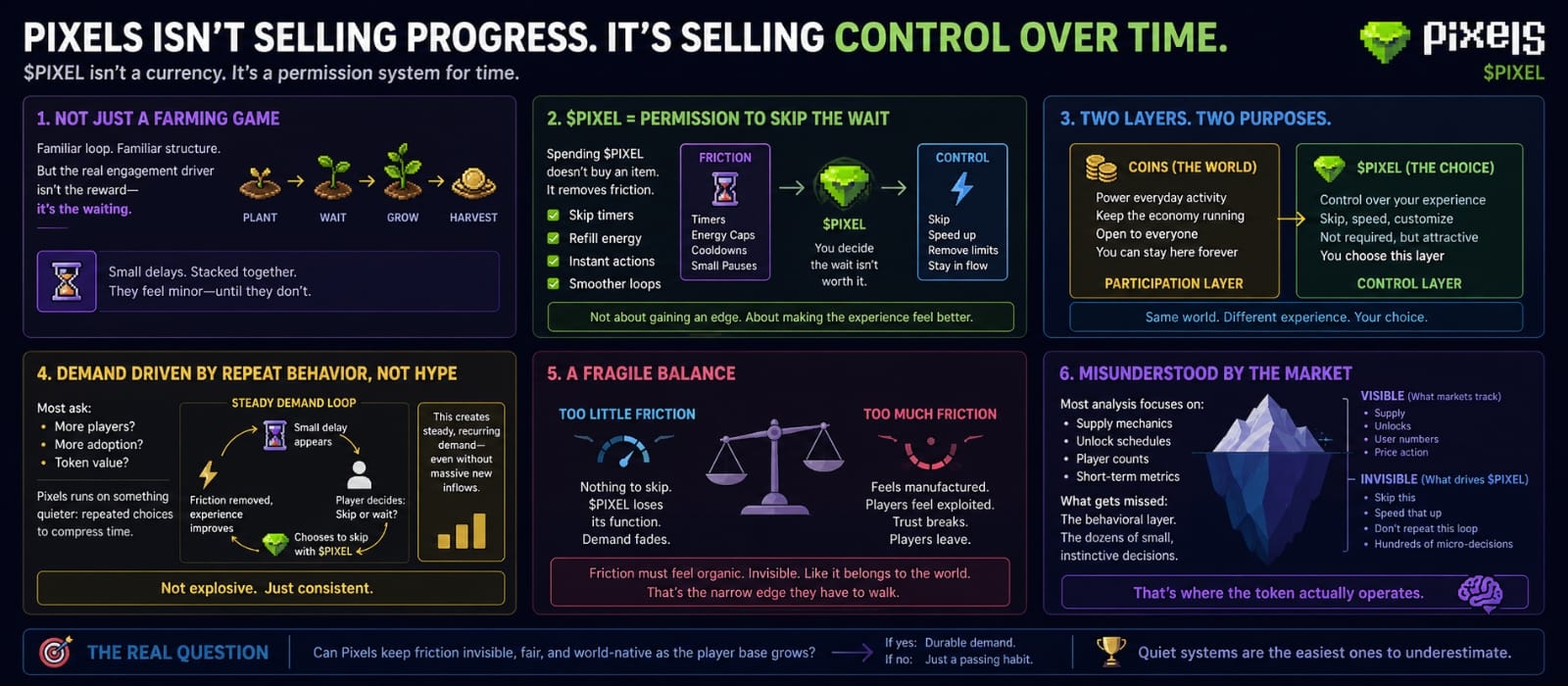
I also think the market is still misreading this. Most analysis I've come across focuses on supply mechanics, unlock schedules, maybe player counts. Those are trackable. Cleaner to model. But they skip the behavioral layer entirely. The quiet, instinctive choices players make dozens of times without consciously registering them. Skip this. Speed that up. Don't repeat this loop again.
That's where the token actually operates.
And there's no guarantee players keep making that choice. Some people prefer the grind. Others just quit rather than pay to remove friction. I've done that myself in other games — closed the app instead of spending. That option is always available.
So I'm not fully sold on this model holding long term. But I don't think it's being valued correctly right now either.
Pixels isn't really selling progress. It's shaping how time feels inside the experience. Slower in some places, faster in others, optional depending on what you want. Pixels simply sits at the point where that feeling becomes adjustable. Whether that translates into durable demand or just a passing habit probably comes down to how invisible they can keep the whole thing.
And quiet systems are the easiest ones to underestimate.