
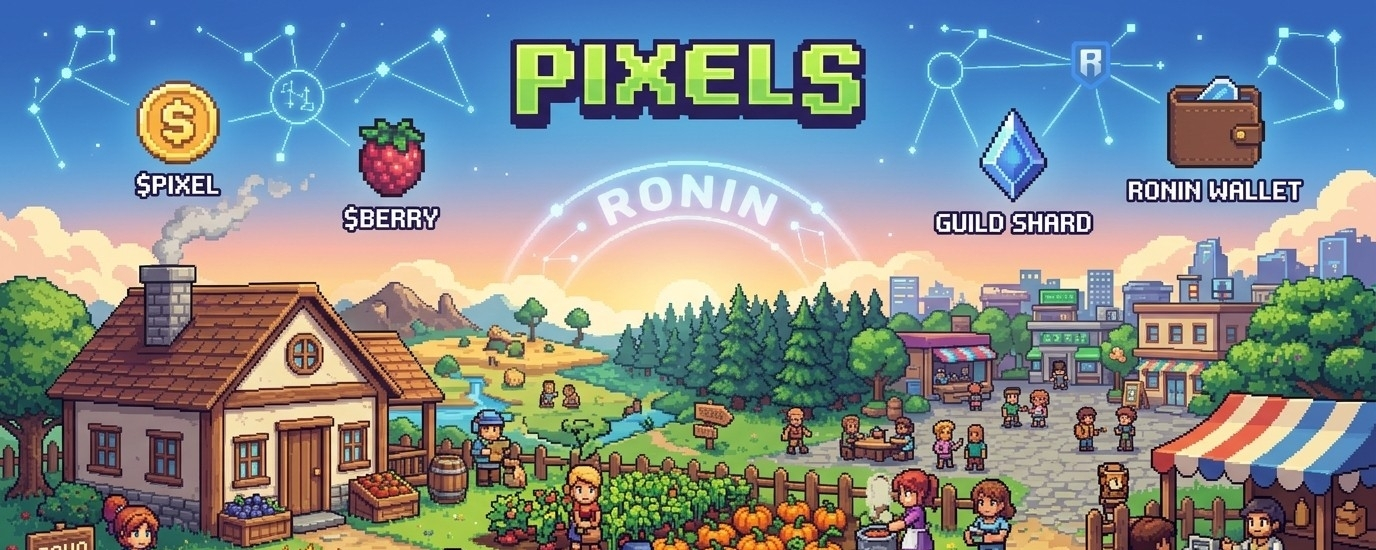
A lot of Web3 games make the same promise: ownership, rewards, community, freedom. Then you log in, spend ten minutes clicking through menus, and realize the “world” is really just a spreadsheet with nicer lighting. Pixels is trying to be something else. At its core, it is a farming-and-exploration game built around gathering, crafting, progression, and social play, but the bigger ambition is even more interesting: Pixels also describes itself as a platform for building games that natively integrate digital collectibles, not just a single title with a token attached to it. That dual identity is what makes it worth a closer look
What Pixels actually is
The official lite paper describes Pixels as “an open-ended world of farming and exploration,” where players gather resources, advance skills, build relationships, and move through quests inside the Pixels universe. The tone of the project matters here. The team frames the game as “fun” first, with blockchain ownership layered into progress rather than shoved in front of it. That is a meaningful design choice, because the strongest criticism of early play-to-earn games was never the token itself; it was that the game underneath the token often felt thin. Pixels seems to have learned that lesson
That same idea shows up on the main website, which leans heavily into a slower, more communal kind of play: make a home, master skills, play with friends, and build new communities. The site also says what you build is yours to own, and that ownership can be tied to rewards backed by the blockchain. In other words, Pixels is not just selling a fantasy world; it is selling a loop where effort, creativity, and digital property are all supposed to reinforce one another
The real appeal: it feels social before it feels financial
What separates Pixels from a lot of crypto games is the way it keeps returning to social life. The game site emphasizes playing with friends, cooperation, and community-building, while also leaving room for competition and mischief. That may sound like marketing fluff, but in practice it matters. Games built around farming, resource generation, and land management can become lonely fast unless the social layer feels alive. Pixels is clearly trying to avoid that trap by making social interaction part of the core loop, not a side activity
The project’s own wording is revealing. It talks about “communities” coming to life, guilds, avatars, and other identity-based layers. Even where the website still uses placeholder text in a few spots, the direction is obvious: Pixels wants players to treat their in-game identity as something they grow, not something they simply equip. That is a subtle but important difference. A lot of games let you own assets; fewer games make ownership feel like it belongs to a living social world
Farming is the foundation, but it is not the whole story
The first thing most players notice about Pixels is the farming loop. The official documentation describes a world built around gathering resources, advancing skills, and managing a living environment. The main site adds more texture: you raise animals, harvest energy, and use that energy to expand your world. That means farming is not just a relaxed background activity. It is a progression engine, a source of resources, and a way to unlock more of the game
What is smart about that structure is that it gives the game a slower heartbeat. Not everything has to be explosive, competitive, or flashy to be engaging. Some of the most satisfying games are built on routines: check your crops, manage your land, improve a skill, make something useful, and return later to see the world changed. Pixels leans into that rhythm. It is a game that seems to understand that “cozy” does not mean “empty.” It means the player has room to care about the small things
Why Ronin matters so much here
Pixels did not just pick any chain; it moved to Ronin, a blockchain Ronin describes as purpose-built for gaming and designed for player-owned economies. Ronin’s broader pitch is about scale, gaming-native infrastructure, and smoother onboarding for game users. That matters because a game like Pixels depends on the chain feeling invisible most of the time. If every action feels like a wallet headache, the fantasy collapses
Ronin’s own Pixels announcement says the game can now be played with a Ronin wallet, and that gameplay on Ronin is the same as it was on Polygon, just with Ronin wallet connection instead of an Ethereum wallet. That is a useful detail because it tells you the migration was not presented as a redesign of the game; it was presented as an infrastructure move. In plain English: keep the game, improve the plumbing. That approach fits Pixels’ broader philosophy pretty well
Ronin also frames itself as a serious gaming ecosystem, not a generic chain with a game section bolted on. That ecosystem logic shows up again in its own blog coverage of Pixels, where the chain published a RON/PIXEL liquidity pool on Katana and explained how holders could swap or provide liquidity directly through Ronin-native tools. The point is not just that Pixels lives on Ronin; it is that the two systems are meant to support each other
The PIXEL token is more than a reward badge
The $PIXEL token sits at the center of the game’s economy, but the official materials are careful to define it as an in-game and ecosystem asset rather than a simple “earn and cash out” reward. Ronin’s announcement about the token says PIXEL is the on-chain digital asset powering Pixels, used for in-game items, upgrades, and cosmetic enhancements. It also lays out a broader role for the token: future NFT mints, VIP battle passes, guild participation, premium quality-of-life features, and eventually governance tied to a community treasury
The official docs also describe Pixels as a two-token system, built around $BERRY and $PIXEL, with different utility and acquisition paths. That matters because it suggests the game is trying to separate routine in-game activity from deeper ecosystem value. In a lot of Web3 projects, every action feeds into the same token loop, which can create awkward pressure. Pixels appears to be trying to split the economy into more manageable pieces. Whether that works long-term is a different question, but the design intent is clear
The company has also added staking pathways for $PIXEL. Its help center explains that users can stake in-game or externally through the dashboard, with rewards and potential future benefits tied to the project they support. That gives the token another layer of purpose beyond simple spending. Tokens that can be used, staked, and woven into gameplay usually have a better chance of feeling alive than tokens that only exist for speculation
Reputation, land, pets, and the quiet machinery of progression
One of Pixels’ more interesting systems is reputation. The help center explains that the score is built from multiple data points such as account age, quest completion, trading history, gameplay, and status checks. It also lists several ways to improve reputation, including owning land, buying VIP, owning pets, connecting socials, taking part in guilds, and participating in live events. That is not just an anti-bot measure. It is a design philosophy. Pixels is rewarding evidence that a player is rooted in the world, not just passing through it
This is where the game starts to feel more layered than a simple farm sim. Land is not just decoration. Pets are not just collectibles. VIP is not just a paid upgrade. Each of these pieces ties back into progression, status, and access. The game’s documentation and updates show a world that keeps adding texture: land limits, task board changes, event systems, reputation thresholds, and quality-of-life upgrades all sit inside a broader economy that is still being tuned. That kind of constant adjustment can be annoying for players, but it also suggests a team that is still actively shaping the world rather than freezing it into a finished museum piece
Pixels is thinking beyond one game
The most ambitious part of Pixels may be the part people overlook: it is trying to become a platform. The official homepage says the project is building a platform where users can build games that natively integrate digital collectibles. That is a bigger bet than making one successful farm game. It is a bet on repeatable tooling, reusable identity systems, and a broader ecosystem where the same kind of player ownership can travel across experiences
That ambition is echoed in Ronin’s recent cross-game event with Forgotten Runiverse, where Pixels’ token was used across another Ronin title through special events, rewards, and in-game spending. That kind of collaboration matters because it turns PIXEL from a single-game currency into a piece of networked game culture. If the token only works inside one title, its reach is narrow. If it starts appearing in other games, rewards systems, and events, it begins to look more like ecosystem infrastructure
The bigger question: can a game like this stay fun
That is the real test. Pixels has the ingredients that many Web3 projects envy: a recognizable game loop, an active economy, chain-native support, social features, token utility, and a clear push toward platform thinking. It even claims a community of over 10 million players on its website, which, if nothing else, shows how strongly the project sees itself as a scale story rather than a niche experiment
But scale alone is never enough. The hard part is balance. A farming game has to stay relaxing without becoming dull. A token economy has to be useful without turning the game into a grind. Social systems have to deepen the world without making it feel like work. Pixels is interesting precisely because it seems to understand those tensions and is still trying to design around them. Whether it will fully solve them is still an open question, but the attempt is more thoughtful than most.
Conclusion
Pixels is not memorable because it uses crypto. It is memorable because it keeps circling back to something older and more human: the pleasure of building a place, sharing it with other people, and watching that place grow into a community. The farming, the exploration, the land, the pets, the reputation score, the token economy, and the Ronin infrastructure all matter, but they matter because they serve that central feeling of inhabiting a world that remembers you. That is the real promise behind Pixels. Not just ownership. Not just earning. Not just Web3. A world that feels lived in
