
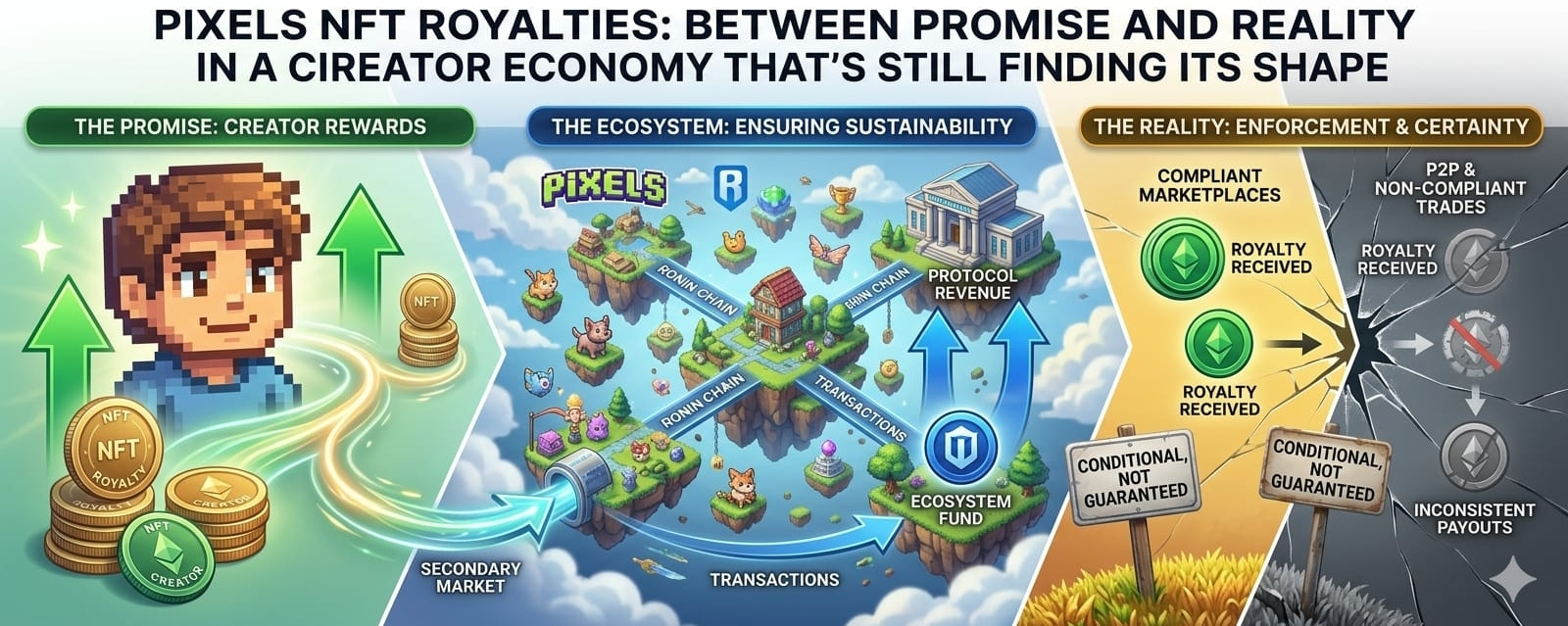

I didn’t come into Pixels NFT royalties with a blank slate, and that probably shaped how I read everything that followed. The larger NFT space had already trained a lot of creators to be cautious, especially when it came to royalties. At one point, the idea felt almost revolutionary. You create something once, release it into the world, and every time it gets resold, you receive a percentage. It sounded less like a feature and more like a correction to a long-standing imbalance, where creators were often cut out of the long-term value of their own work. For a while, it felt like that promise might actually hold. But then marketplaces started adjusting the rules, some made royalties optional, others deprioritized them altogether, and suddenly something that was presented as guaranteed started to feel conditional. So when I started looking at how royalties function inside Pixels, I wasn’t just reading what was written, I was paying attention to what might not be fully said.
At a surface level, the structure inside Pixels is straightforward enough to understand. When NFTs within the ecosystem, whether land, pets, or cosmetic items, are bought and sold on secondary markets, a percentage of those transactions can be directed back either to the original creator or to the protocol itself. That percentage is not something added later; it is embedded at the contract level when the asset is minted. On paper, that creates a sense of permanence. It suggests that royalties are part of the asset’s DNA rather than an optional layer on top. And compared to the broader NFT landscape, Pixels benefits from being on Ronin, which operates within a more contained ecosystem. That containment matters because it reduces some of the fragmentation seen on multi-chain environments where assets bounce between marketplaces that each follow their own rules. In theory, that makes enforcement more consistent here than in most other places.
But the more you look at it, the more important it becomes to separate two ideas that often get blended together: creator royalties and protocol royalties. They sound similar, but they serve very different purposes. Creator royalties are what most people imagine when they think about NFTs, a way for the person who made the asset to keep earning as it changes hands. Protocol royalties, on the other hand, are directed back into the system itself. They support development, maintenance, and the long-term sustainability of the ecosystem. In Pixels, a large share of valuable assets originates from the protocol rather than individual creators, which shifts the conversation in a subtle but important way. When royalties are collected, they often reinforce the ecosystem first, and individual creators only occasionally sit at the center of that flow.
For creators who are working within player-generated frameworks or experimenting with building their own assets, the conversation becomes more personal and less abstract. This is where expectations need to be handled carefully. The royalty percentage you are entitled to is one part of the story, but enforcement is another entirely. It is possible to have a clearly defined royalty written into a contract and still receive less than expected in practice. Not every trade moves through a system that respects those rules. Some transactions happen through compliant marketplaces, where royalties are honored exactly as designed. Others move through peer-to-peer trades, alternative platforms, or workarounds that bypass those mechanisms entirely. In those cases, what exists on-chain as a right does not always translate into a consistent payout.
Even within Ronin, where things are more controlled, that gap still exists. The environment improves the odds, but it does not eliminate the problem. And this is where the difference between expectation and reality starts to matter in a practical way. If you approach Pixels believing that royalties will function as a stable, ongoing income stream, you are building on an assumption that may not hold under all conditions. If instead you see royalties as a potential upside, something that can add value over time without being the sole reason you create, the system starts to make more sense. It becomes a bonus layered onto your work rather than the foundation of it.
There is also a broader dynamic at play that is easy to overlook. Ecosystems like Pixels depend on creators to stay active, engaged, and motivated. That creates an incentive for the platform to maintain systems that feel fair, or at least more reliable than what exists elsewhere. Ronin’s structure, combined with Sky Mavis’s interest in keeping the ecosystem healthy, gives royalties more weight than they tend to have in open environments where enforcement is nearly impossible. That alignment doesn’t remove risk, but it does create a more stable baseline than what many creators have experienced in the wider NFT market.
Still, stability is not the same as certainty. The most grounded way to think about royalties in Pixels is somewhere in the middle, not as broken as the worst examples in Web3, but not as perfect as early narratives made them sound. They work, often enough to matter, but not consistently enough to be treated as guaranteed. And that distinction shapes how a creator should approach the ecosystem. If you are here because you enjoy the game, understand the culture, and want to build something that people genuinely value, royalties can enhance that experience. They can reward you when your work continues to circulate and hold attention. But if you are here primarily because someone framed royalties as a path to passive income, it is worth pausing and reassessing that expectation with a bit more realism.
In the end, Pixels offers a version of NFT royalties that feels more functional than most, but still grounded in the same limitations that define the space as a whole. It is a system that can support creators, but not one that removes uncertainty or guarantees outcomes. And maybe that is where the most honest understanding lands. Royalties are not a promise of future income, they are a possibility shaped by how people choose to trade, where they choose to trade, and how the ecosystem continues to evolve around them.
