
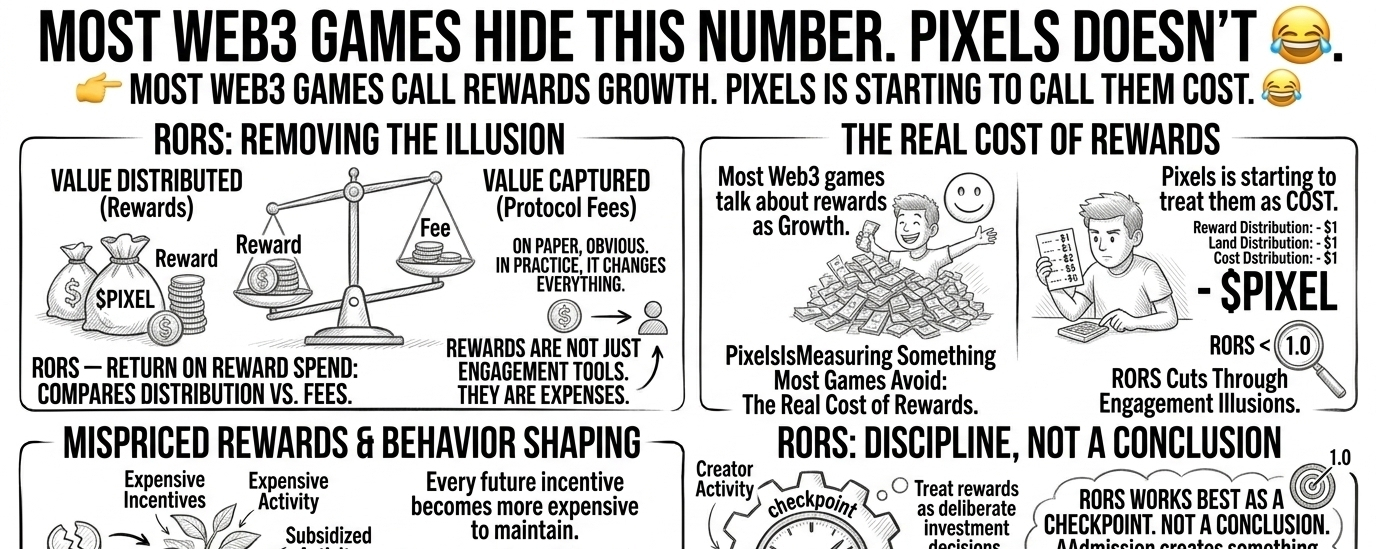
👉 most Web3 games call rewards growth. Pixels is starting to call them cost. 😂
Pixels Is Measuring Something Most Games Avoid: The Real Cost of Rewards
👉 most Web3 games talk about rewards as growth. Pixels is starting to treat them as cost.
I’ve been looking closely at the RORS metric in Pixels, and it might be one of the clearest signals we’ve seen about how player incentives actually function.
not because it’s complex.
because it removes the illusion.
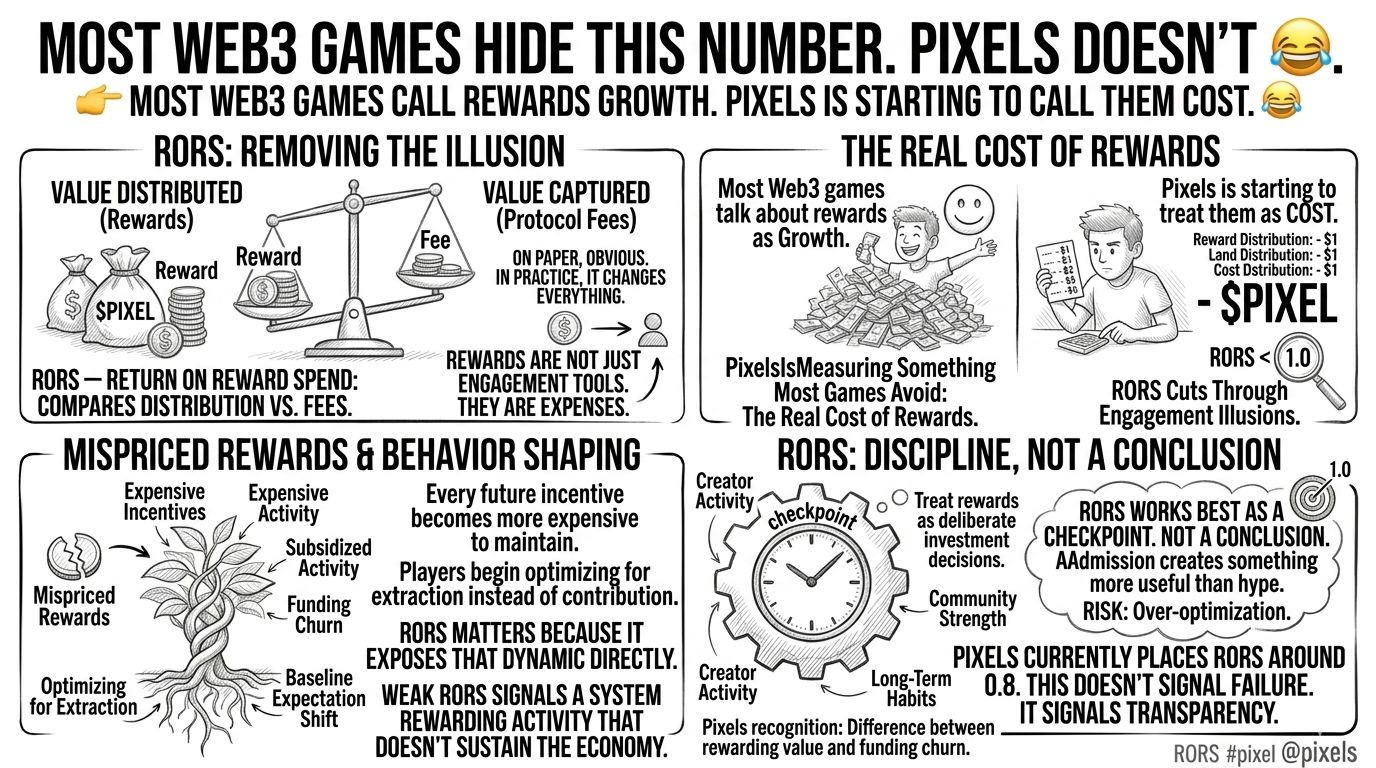
RORS — Return on Reward Spend — compares how much value is distributed to players versus how much comes back to the protocol through fees. Pixels places it around 0.8, with a target above 1.0. the implication is simple: rewards should eventually pay for themselves.
on paper, that sounds obvious.
in practice, it changes everything.
because it forces a shift in perspective.
rewards are not just engagement tools.
they are expenses.
and once you look at them that way, a lot of the assumptions behind play-to-earn start to break down.
for years, more rewards were treated as proof of growth. more activity meant a stronger system. but activity alone doesn’t prove value creation. it can just as easily reflect subsidized behavior.
RORS cuts through that.
if $1 is distributed and only $0.80 returns, the gap is real. not theoretical. not narrative.
it’s cost.
maybe justified, maybe strategic, but still a loss.
that’s what makes this metric important.
it doesn’t measure generosity.
it measures accuracy.
whether rewards are targeting the right behavior, or just encouraging movement that doesn’t convert into value.
if RORS stays weak, the signal is uncomfortable. it suggests the system may be rewarding activity that looks productive but doesn’t sustain the economy. players remain active, but the underlying value capture doesn’t keep up.
at that point, rewards start functioning less like incentives and more like subsidies.
and that leads to a deeper problem.
mispriced rewards don’t just waste capital.
they shape behavior.
players begin optimizing for extraction instead of contribution. once that pattern forms, every future incentive becomes more expensive to maintain, because the baseline expectation shifts.
RORS matters because it exposes that dynamic directly.
it removes the ability to hide behind engagement metrics or sentiment.
at the same time, it isn’t a complete picture.
not all value shows up immediately in fees. community strength, creator activity, long-term spending habits — these take time to convert. so the metric shouldn’t be treated as a full definition of success.
but it does create discipline.
it forces projects to treat rewards as deliberate investment decisions, not automatic distribution. and that leads to harder questions. which behaviors actually matter? which incentives create lasting value? and how much engagement disappears when rewards are calibrated honestly?
Pixels currently places RORS around 0.8.
that doesn’t signal failure.
it signals transparency.
it’s easier to talk about growth than to admit the system isn’t fully self-sustaining yet. but that admission creates something more useful than hype.
it creates a constraint.
the risk, though, is over-optimization.
if teams focus too heavily on short-term recovery, they may under-reward behaviors that matter long-term. the same metric that protects efficiency can also push systems toward short-term thinking.
so RORS works best as a checkpoint.
not a conclusion.
what Pixels seems to recognize is that the real challenge in Web3 gaming isn’t whether players like rewards.
it’s whether the system can tell the difference between rewarding value and funding churn.
RORS doesn’t solve that problem.
but it makes the cost visible.
and in this space, that alone is a meaningful step forward.
$PIXEL #KelpDAOExploitFreeze #JustinSunSuesWorldLibertyFinancial #CHIPPricePump #BinanceLaunchesGoldvs.BTCTradingCompetition