
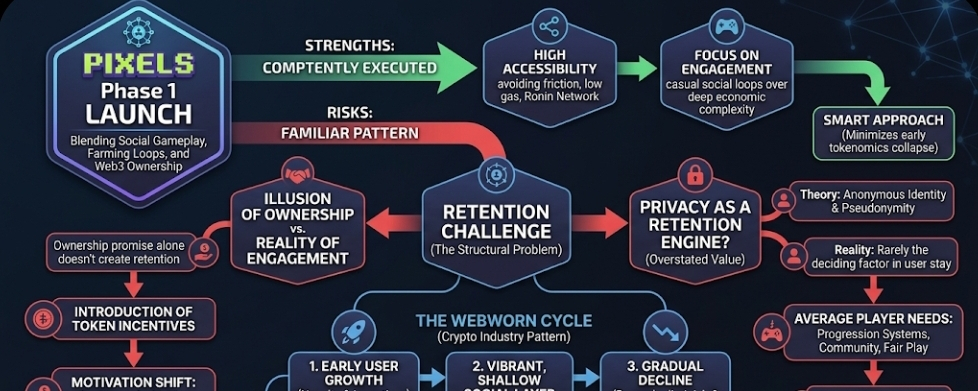
The Phase 1 launch of PIXELS feels familiar in a way that should give both enthusiasts and investors pause. Not because it lacks ambition—on the contrary, its blend of social gameplay, farming loops, and Web3 ownership mechanics is polished enough to attract attention—but because it fits a well-worn pattern in crypto: an engaging early experience wrapped in a tokenized economy that may or may not sustain itself once the novelty fades.
From a distance, PIXELS presents itself as a gentler entry point into blockchain gaming. Built on the Ronin Network, it avoids some of the friction that plagued earlier Web3 titles—high gas fees, clunky onboarding, and intimidating wallet setups. Phase 1, in particular, focuses on accessibility and engagement rather than deep economic complexity. That’s a smart move. Many projects collapse under the weight of over-engineered tokenomics before users even understand why they should care.
Yet even in this early phase, the underlying question remains: what keeps players here after the initial curiosity wears off?
The Illusion of Ownership vs. the Reality of Engagement
PIXELS leans heavily on the promise of digital ownership—land, items, and in-game progress tied to blockchain assets. This idea has been the backbone of Web3 gaming for years, but its track record is mixed at best. Ownership alone does not create retention. If anything, it often creates speculative behavior rather than genuine engagement.
Phase 1 appears to sidestep this somewhat by emphasizing gameplay loops—farming, crafting, social interaction—before aggressively pushing monetization. But history suggests that once token incentives are introduced or scaled, player motivation shifts. Users stop asking “Is this fun?” and start asking “Is this profitable?”
That transition is where many projects begin to unravel.
Privacy Features: Overstated Value Proposition?
A recurring narrative in blockchain projects—including PIXELS—is that enhanced privacy or pseudonymity will drive long-term adoption. In theory, this sounds compelling. Players can interact, trade, and build identities without exposing personal data. In practice, however, privacy has rarely been the deciding factor in whether users stay.
Most players are not leaving traditional games because of privacy concerns. They leave because the gameplay loop becomes stale, the social ecosystem dries up, or better alternatives emerge. Privacy, in this context, is a background feature—not a primary driver.
Even in crypto-native environments, where privacy tools are more visible, they tend to serve niche use cases: high-value traders, security-conscious users, or ideological advocates. The average casual player—the target audience for PIXELS—is far more influenced by progression systems, community activity, and perceived fairness.
If anything, too much emphasis on privacy can introduce friction. Additional layers—wallet management, key security, transaction signing—can quietly erode user experience. Phase 1 of PIXELS does a reasonable job minimizing this, but the tension remains unresolved.
The Retention Problem Crypto Hasn’t Solved
The deeper issue is structural. Crypto projects excel at attracting early attention—airdrops, token incentives, speculative upside—but struggle with retention once those incentives taper off. The audience that arrives for rewards is not necessarily the audience that stays for the product.
PIXELS’ Phase 1 shows awareness of this problem. By focusing on a casual, social experience, it attempts to build intrinsic motivation rather than purely financial engagement. That’s encouraging, but it’s also where skepticism is warranted.
We’ve seen this before:
Early user growth driven by novelty and incentives
A vibrant but shallow social layer
Gradual decline as rewards diminish and content stagnates
The critical test will not be Phase 1 adoption metrics, but Phase 2 and beyond—when the game must stand on its own as entertainment rather than opportunity.
A More Honest Framing of Privacy
If PIXELS wants to leverage privacy meaningfully, it needs to reposition it. Privacy should not be marketed as a retention engine, because it isn’t. Instead, it can serve as a supporting pillar:
Protecting user assets
Enabling secure trading
Allowing flexible identity across ecosystems
These are valuable, but they are not reasons to log in every day.
Daily engagement comes from something far more traditional: compelling gameplay, evolving content, and a sense of belonging within a community.
Final Assessment
Phase 1 of PIXELS is competent—arguably more grounded than many of its predecessors. It prioritizes usability, lowers barriers to entry, and leans into gameplay rather than pure speculation. That alone sets it apart in a crowded field of overpromised and underdelivered projects.
But the skepticism remains justified.
Privacy features, while useful, are unlikely to meaningfully impact long-term retention. The real determinant will be whether PIXELS can transition from a “Web3 experiment” into a genuinely engaging game that people would play even without tokens attached.
Because in the end, the market has already delivered its verdict on crypto gaming:
users will come for the rewards—but they only stay for the experience.