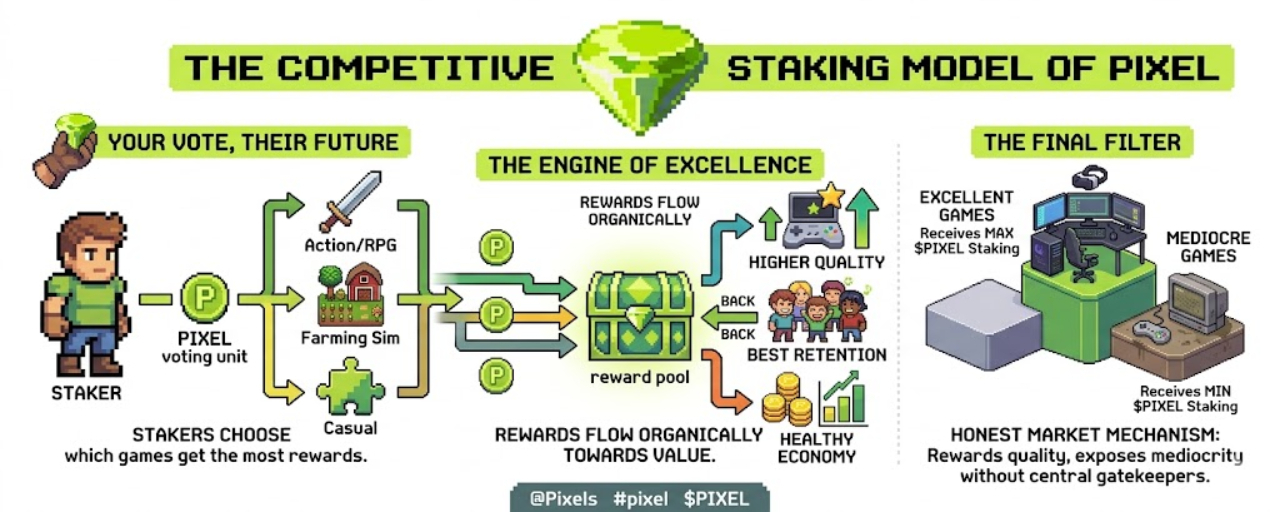
Honestly... the more time I spend studying how staking rewards are distributed across the Pixels platform, the more I respect the deliberate decision they made with their architecture.
They could have gone the easy route like so many others — spreading rewards evenly across all games to keep every partner happy and avoid any conflict. It would have looked nice and collaborative on paper. Instead, they chose the harder, more honest path: letting stakers decide. Your PIXEL allocation directly influences how much reward each game receives every month. That single mechanism changes everything about how the ecosystem evolves.
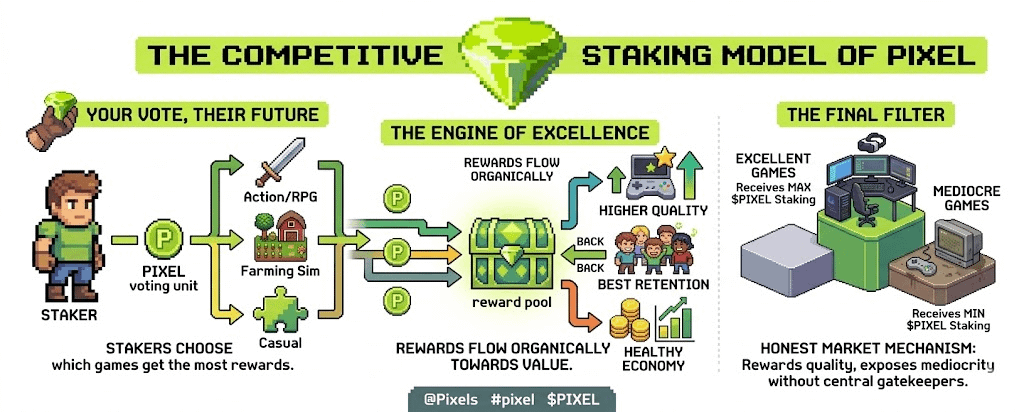
It turns every staker into an active capital allocator. Suddenly, it's not just about believing in Pixels as a whole. It's about evaluating which specific games are delivering the best experience, the strongest retention metrics, and the healthiest internal economy. Games that build something truly engaging will naturally pull more staked PIXEL. Games that fall short will receive less support and have to improve or risk being left behind.
This creates incredibly strong incentives for partner studios. They aren't just building for attention or grants anymore. They're building to compete directly for player capital and long-term engagement. The pressure is real, and it's healthy because it comes from the market itself rather than from any centralized team making decisions in a vacuum.
so yeah... they're letting the market, not a central team, curate which studios get the most resources to grow.
The data already reflects this. With over 100 million PIXEL staked across multiple titles, the distribution isn't random. It's flowing toward the experiences that are actually keeping players coming back and spending inside the games. That kind of organic capital flow is exactly what a healthy publishing platform should look like.
still... I'll say this.
This competitive staking model is one of the most honest quality filters I've seen in Web3 gaming. It rewards excellence and exposes mediocrity without anyone having to play gatekeeper. Over time, this should lead to a noticeably higher average quality of games within the ecosystem compared to platforms that don't have this mechanism. That's powerful, and it's still under-appreciated by most observers.
@Pixels #pixel $PIXEL $TON $CHIP