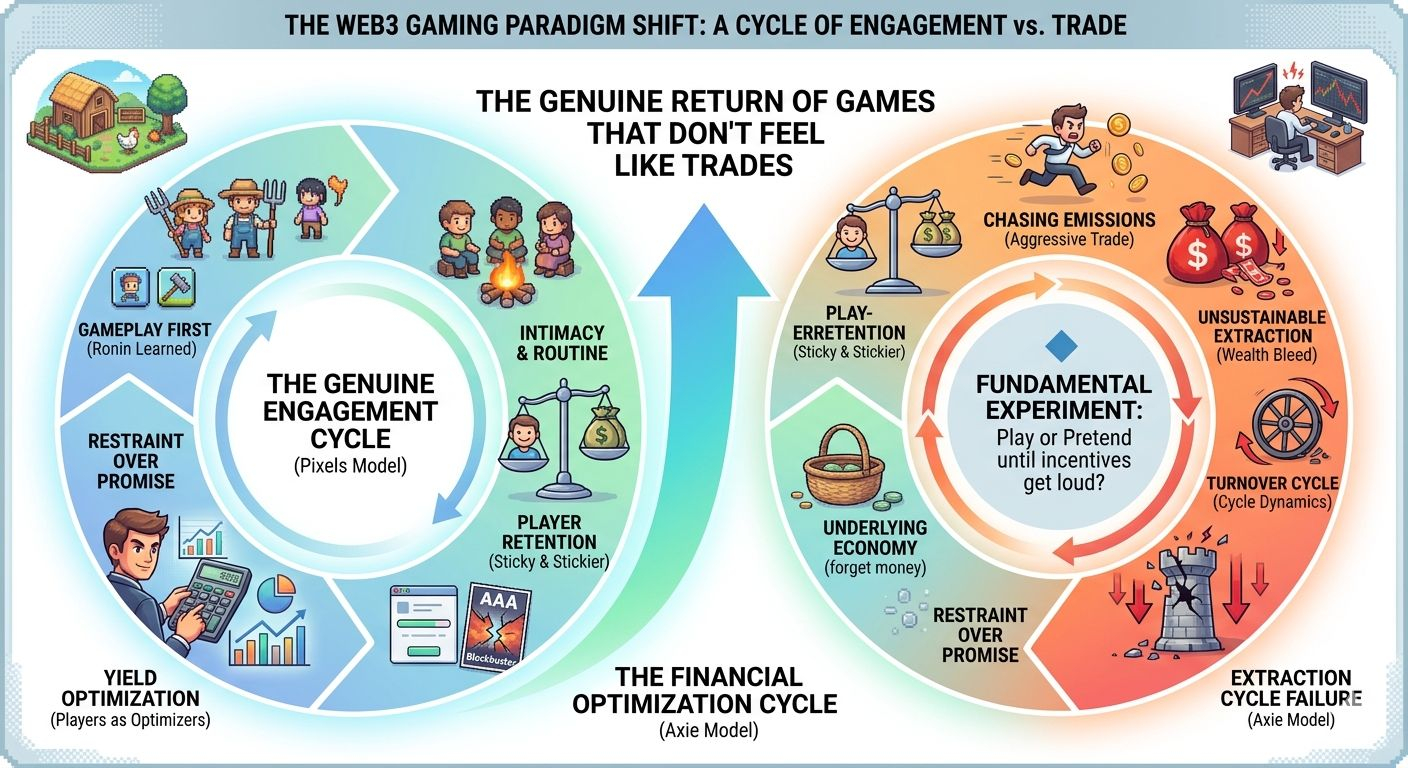

I ran into Pixels at a weird moment in the cycle. You know the kind when liquidity feels like it’s thinning at the edges, AI coins aren’t ripping the way they were a few weeks ago, and people start pretending they always cared about fundamentals again. I was actually looking into restaking flows, trying to understand where the next rotation might land, when I noticed the same thing popping up in my feed over and over: screenshots of pixelated farms, people talking about crops, land, daily routines.
It didn’t feel like a “play-to-earn” wave. It felt quieter than that. Which is exactly why it caught my attention.
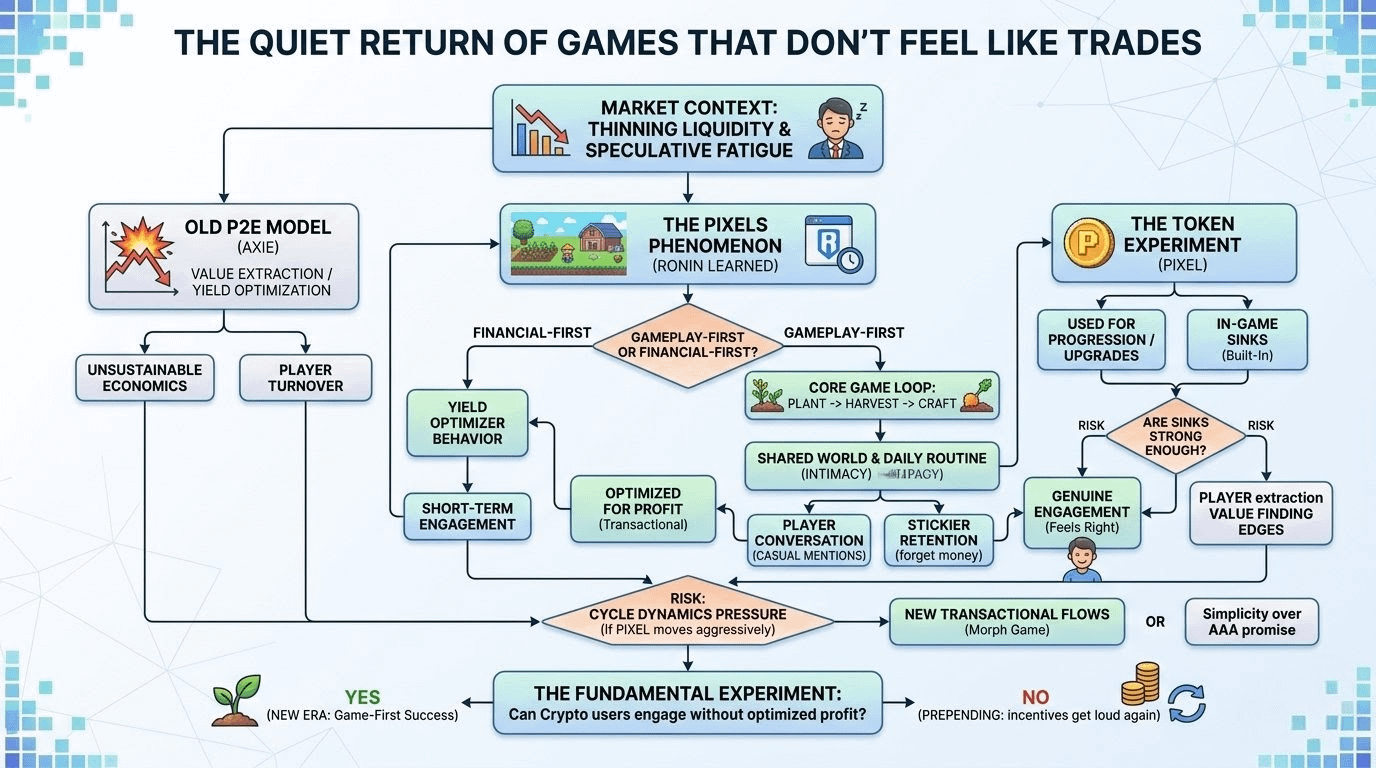
Pixels sits on Ronin, and that alone carries history. Anyone who’s been around remembers what happened with Axie the explosion, the extraction, the slow unwind. So when something starts gaining traction in that ecosystem again, the instinct is to be cautious. But also curious. Because Ronin learned the hard way what doesn’t work.
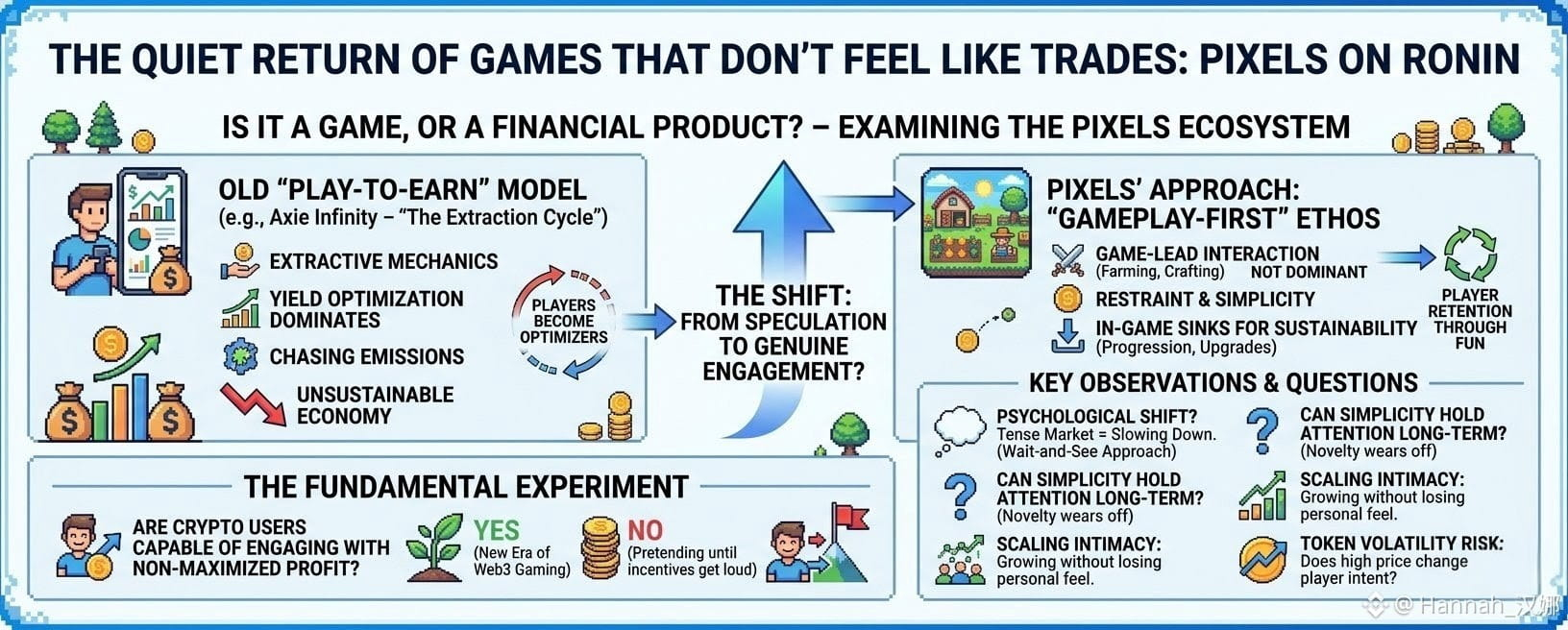
What Pixels is trying to do doesn’t sound revolutionary on paper. It’s a farming game. You plant, you harvest, you craft, you walk around a shared world with other players. But the real problem it’s poking at is deeper than gameplay. It’s trying to answer whether crypto games can exist without turning every player into a yield optimizer.
That matters more now than it did a year ago. Back then, liquidity was loose, and people didn’t mind chasing emissions as long as the chart went up. Now, there’s a bit more hesitation. Capital is still there, but it’s more selective. People have been burned enough times to at least pretend they care about sustainability. So a game that doesn’t scream “earn” from the first interaction feels different.
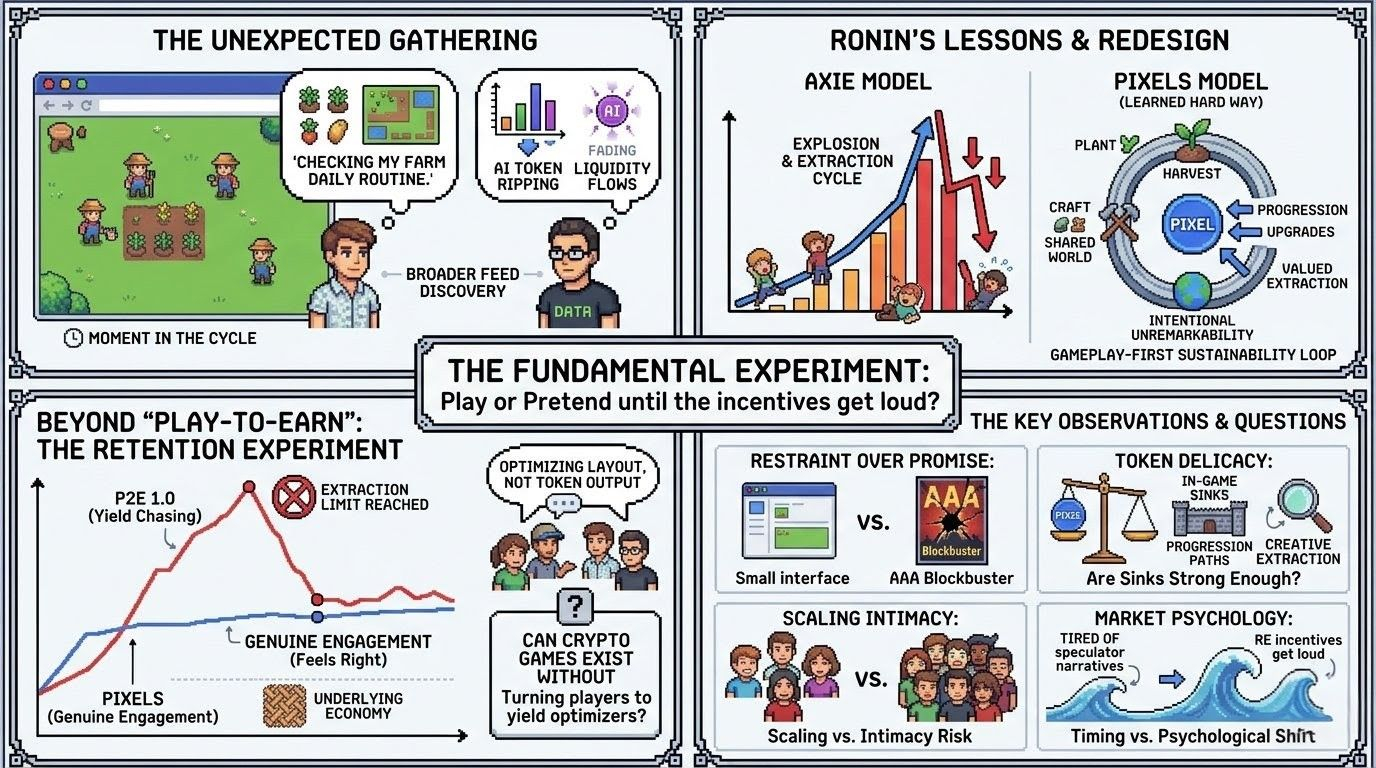
The way Pixels works is almost intentionally unremarkable. It runs in your browser. No heavy setup. You connect, and you’re in. The blockchain part ownership of land, items, the PIXEL token sits underneath the experience instead of dominating it. You’re not constantly being reminded that every action has a financial implication. You just play, and over time you realize there’s an economy woven through it.
That design choice is doing a lot of work. Most Web3 games still feel like financial products wearing a gaming skin. Pixels flips that just enough that you can forget, at least for a while, that there’s money involved. And that changes behavior. People stick around longer when they’re not calculating every move.
The token itself is where things get delicate. PIXEL is used for progression, upgrades, certain in-game actions. There are sinks built in, which is a good sign. The team clearly understands that if tokens only flow outward, the system collapses. But whether those sinks are strong enough is something you can’t really know early on. Players are creative when it comes to extracting value. They’ll find the edges.
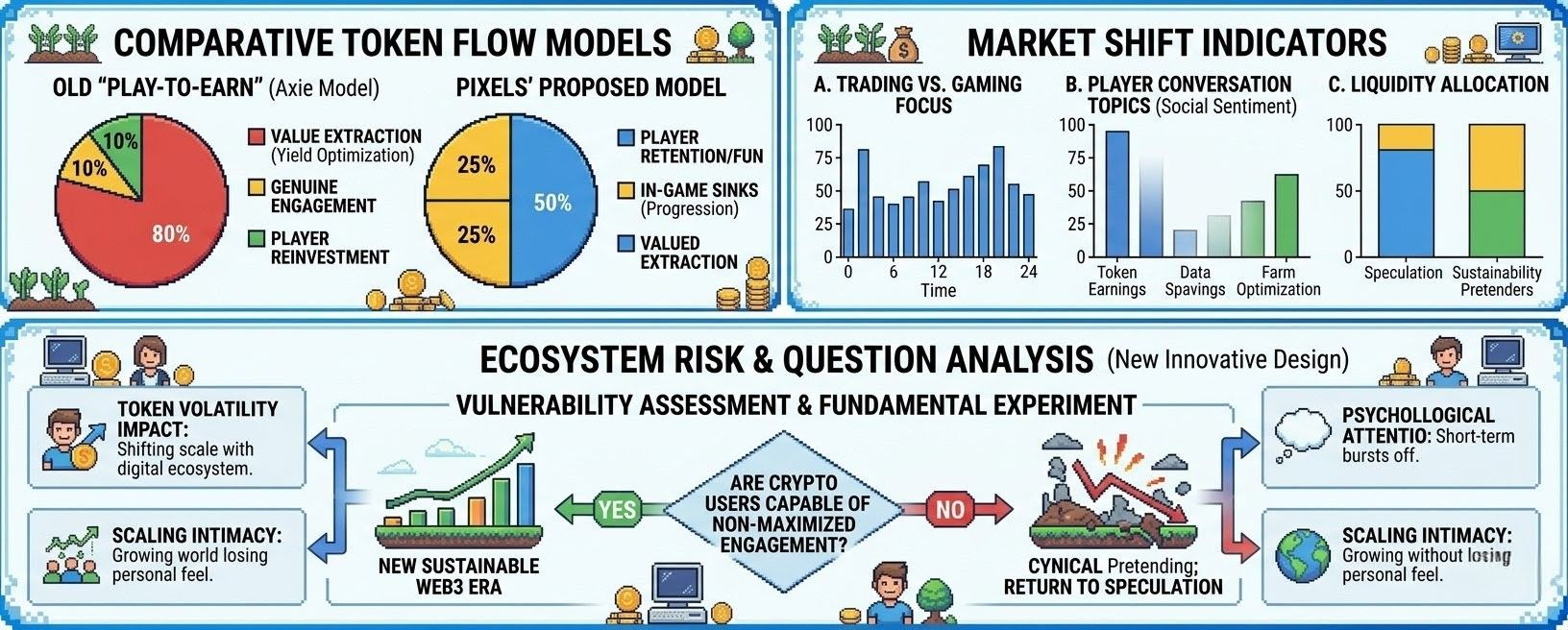
What I’ve been watching more than anything is how people talk about it. Not the official channels, but the casual mentions. Someone saying they logged in just to check their farm. Another person talking about optimizing their land layout, not for maximum token output, but because it “feels right.” That kind of language is rare in crypto. It suggests there’s at least a layer of genuine engagement.
Still, I don’t think it’s immune to the usual cycle dynamics. If PIXEL starts moving aggressively, the tone will shift. New players will arrive with different intentions. The game could slowly morph into something more transactional, even if that wasn’t the original design. We’ve seen that story play out before.
What Pixels does better than most is restraint. It doesn’t try to be everything at once. It’s not chasing the “AAA blockchain game” narrative. It’s not overloading players with systems. It’s small, accessible, and consistent. In a space that tends to overpromise, that simplicity feels almost contrarian.
But there’s a risk in that too. Simplicity can keep people in, but it can also limit how long they stay. Once the novelty wears off, what keeps the loop engaging? If the answer drifts back toward financial incentives, then we’re back where we started.
There’s also the question of whether this kind of game can scale without losing what makes it work. Intimacy is part of the appeal. A shared world that doesn’t feel overcrowded. A routine that feels personal. If it grows too fast, does that break?
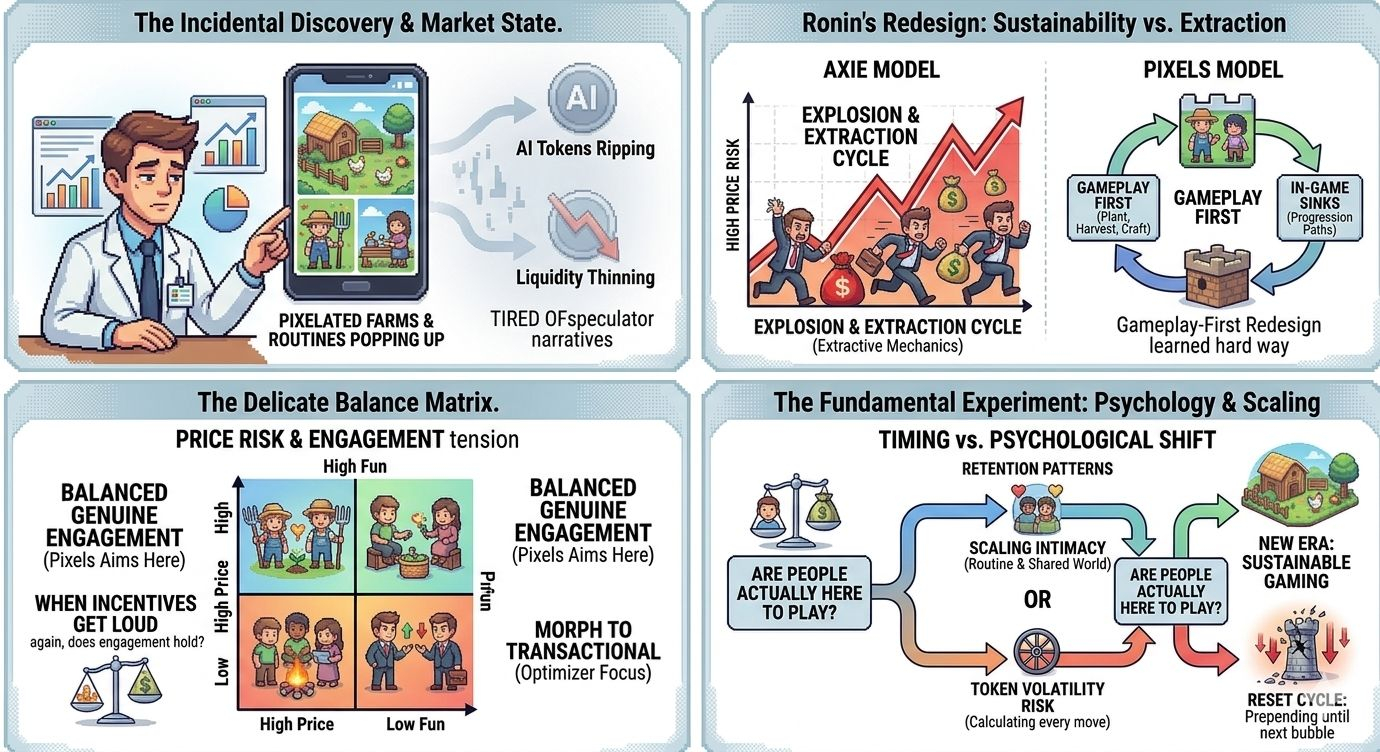
One thing I don’t hear enough people talk about is how Pixels fits into the broader shift away from pure speculation. Not away from it entirely that’s never happening but toward experiences that can hold attention even when the chart isn’t exciting. That might be the real experiment here. Not whether a farming game can succeed, but whether crypto users are capable of engaging with something that doesn’t immediately optimize for profit.
Because if they’re not, then no amount of good design will matter
I keep coming back to a slightly uncomfortable thought. Maybe the success of something like Pixels isn’t just about the game itself. Maybe it’s about timing. A moment in the market where people are tired enough of chasing narratives that they’re willing to slow down, even briefly. If that’s true, then the game is riding a psychological shift as much as a product one.
And psychological shifts are fragile.
So I watch it the same way I watch any emerging narrative. Not with blind optimism, but with curiosity. The retention patterns, the way new players enter, how the economy reacts under pressure. It’s less about whether Pixels becomes dominant, and more about what it reveals.
Because if a simple farming loop can hold attention in a market that usually demands constant stimulation and financial upside, that says something.
But if the moment the token gets interesting is the moment the game starts to change… then maybe we still haven’t solved anything at all.
And that leaves me wondering are people actually here to play this time, or are we just better at pretending until the incentives get loud again?