I’ve been thinking about what it actually means for a system to “learn.”
Not in the abstract sense, but in practice what changes once behavior starts feeding back into the system in a continuous way.
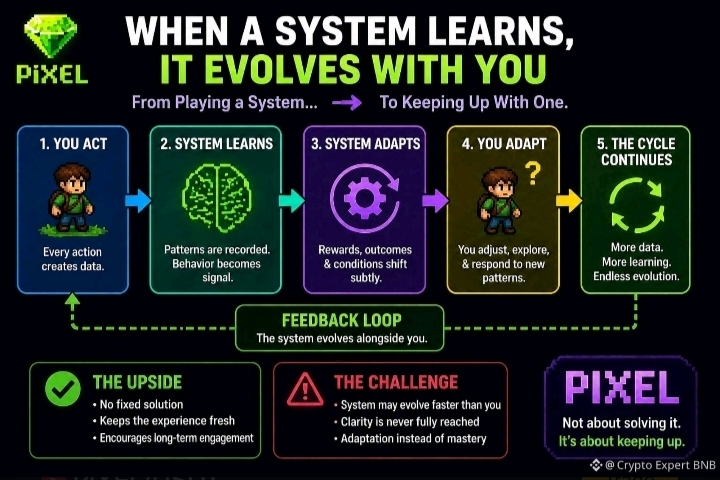
With @Pixels, it doesn’t feel like learning is something that happens occasionally. It feels ongoing. Quiet. Every action, every pattern, every shift in player behavior seems to add a little more signal into something that’s already adjusting itself.
That’s the part I keep coming back to.
Because if the system is constantly learning, then it’s not just evolving over time it’s evolving alongside the players. And that creates a dynamic that’s harder to pin down than a fixed set of rules.
You’re not solving something static.
You’re interacting with something that changes as you do $PIXEL
At first, that might not feel very different. Early on, everything still feels open. You explore, try different paths, get a sense of what works. But as time passes, the system starts reflecting accumulated behavior back into itself.
And that’s where it gets interesting.
Because once enough data builds up, the system doesn’t just respond it starts shaping conditions more deliberately. Not in a visible way, but through how outcomes form, how rewards shift, how certain behaviors seem to align more consistently than others.
And if that learning accelerates, it can start to move faster than individual players.
That’s where the tension comes in.
Because if the system evolves too quickly, players don’t fully catch up. You’re always slightly behind, adjusting to something that’s already moved. Not dramatically, just enough that clarity never fully settles.
You understand parts of it, but never the whole.
I’m not sure if that’s a problem or just a different kind of experience.
And adaptation feels different from control.
Pixels seems to be moving somewhere along that line. Not fully outpacing players yet, but showing signs of a system that’s capable of evolving faster than any single behavior pattern.