
At first, Pixels feels like exactly what it promises. You log in, plant a few crops, wander around, maybe chat, maybe explore. It has that soft, calming rhythm that makes you think you can play it without thinking too much. And for a while, you can.
But then something subtle starts to change.
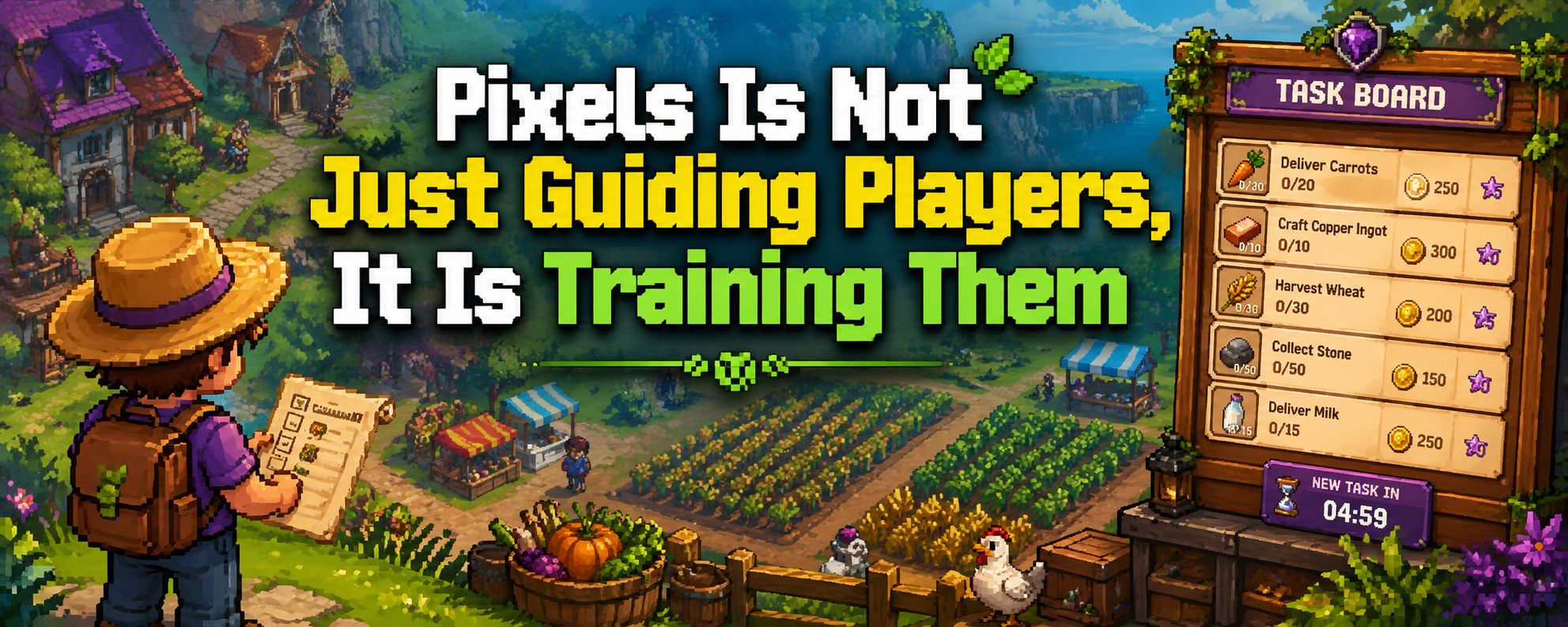
You open the task board, not just to grab a reward, but to check what the game “needs” from you. You look at your inventory differently. You start noticing gaps. You realize you are short on one item, overstocked on another, and suddenly you are not just playing, you are planning. The question shifts from “what should I do?” to “what makes sense to do right now?”
That is the moment Pixels stops being just a farming game.
The task board is the trigger. On the surface, it is simple. Deliver items, get rewards, wait for refresh. But in practice, it feels more like a quiet negotiation between you and the game. It presents demand. You respond with supply. And over time, you start thinking ahead. Should you use what you have now or hold it for a better task later? Should you produce something new or adjust your routine?
It is a small loop, but it slowly rewires how you approach the game.
I have noticed that after a few sessions, players do not just log in to “play.” They log in to check. Check what changed. Check what is worth doing. Check what they can optimize. That behavior is not accidental. It is learned. And Pixels teaches it without ever explaining it.
What makes this interesting is how natural it feels. Nothing about it looks like finance or management. You are still planting, harvesting, crafting. The world is still colorful and relaxed. But underneath, you are making decisions that feel closer to running a tiny operation. Your inventory starts to feel like something you manage, not just something you collect. Your time starts to feel limited in a meaningful way.
Even recent changes in the ecosystem seem to reinforce this. Adjustments to production timing, limits on what land can support, the way VIP adds more tasks instead of just more rewards, all of it quietly pushes players toward thinking in trade-offs. More options do not make the game easier. They make your decisions matter more.
And then there is the social layer. When systems like Bountyfall tie task output into group progress, your routine is no longer just yours. What you produce can contribute to something larger, or compete against it. At that point, you are not just managing your own loop. You are part of a network of other players making similar decisions.
That is where Pixels starts to feel different from most Web3 games.
A lot of games in this space try to make players feel like investors. They highlight tokens, ownership, rewards. Pixels takes a slower route. It lets you feel like an operator first. You learn how to manage your time, your resources, your output. The economic layer comes later, almost as a consequence of behavior you have already developed.
And honestly, that feels more sustainable.
Because people do not come back every day just for rewards. They come back because they feel in control of something, even if it is small. The task board gives that feeling. It turns simple actions into small decisions, and those decisions into a routine that feels personal.
What started as a farming game becomes something closer to a habit. Not an addictive loop in the usual sense, but a structured one. You check in, adjust, execute, and leave. Then you come back and do it slightly better.
That is why I think the task board is more important than it looks. It is not just guiding players. It is shaping how they think. It teaches patience, timing, prioritization, without ever saying those words.
Pixels does not force players to understand its economy. It lets them grow into it.
And somewhere along the way, without really noticing, the player stops being just someone passing through the world. They start feeling responsible for a small part of it.