
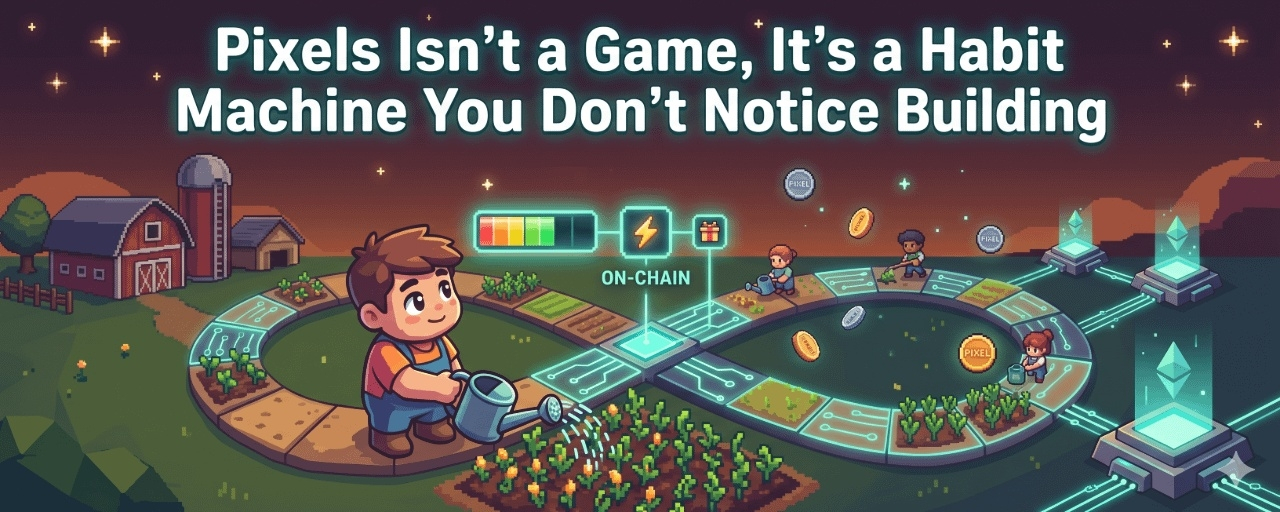
I didn’t start paying attention to Pixels because it was “fun.” That’s the story people like to tell after the fact. What caught my attention was something quieter, almost uncomfortable—the way time seemed to dissolve inside it without resistance.
Not in the dramatic sense where hours disappear and you regret it later. That’s too obvious. What unsettled me was how natural it felt to keep going. Farming a tile, walking a path, collecting a resource—none of it felt urgent, but none of it felt optional either. It was as if the system had found a way to sit just below conscious friction. And that’s where things usually get interesting.
Most people approach Pixels as a game layered with ownership—Web3 elements, token incentives, land, progression. But that framing misses something fundamental. Pixels isn’t just a game with an economy. It’s an attempt to build a behavioral environment where economic logic slowly replaces traditional game design without announcing itself.
That distinction matters more than it sounds.
If you strip Pixels down to its core, what you’re left with isn’t farming or exploration. Those are just interfaces. What’s really being engineered is a loop of predictable engagement under uncertain reward. And that’s not unique to gaming—it’s a pattern that shows up in financial markets, social platforms, even physical economies. The difference is that here, it’s been softened, aestheticized, made approachable.
It’s easy to underestimate that.
I’ve seen this pattern before, just wearing different clothes. Early MMOs, mobile idle games, even certain DeFi protocols—they all flirt with the same idea: can you create a system where users voluntarily align their behavior with the system’s growth without needing constant external pressure?
Pixels feels like a more refined version of that question.
The open world gives the illusion of freedom, but the board—the tasks, the cycles, the rewards—is where the real structure lives. And the longer you stay, the more you realize that your “choices” are often just selections between pre-shaped paths. Not in a restrictive way, but in a guided one. Like walking through a field where the grass has already been pressed down in certain directions.
You can step off the path. But most people won’t.
This is where the conversation usually shifts to tokens, incentives, and sustainability. And yes, those matter. But focusing only on the token misses the deeper layer. Tokens are just the visible tip of a much larger behavioral design.
The real question is: what kind of habits is this system producing?
Because habits outlast incentives.
In the short term, people engage because there’s value—real or perceived. But over time, the reason changes. It becomes routine. Identity. Presence. And once that shift happens, the system no longer needs to “pay” you the same way to keep you there.
That’s where most Web3 games fail, by the way. They front-load incentives without building underlying behavioral anchors. When the rewards thin out, the entire structure collapses because nothing deeper was holding it together.
Pixels, at least from what I’ve observed, seems aware of this. It leans heavily into simplicity, repetition, and low cognitive load. That’s not laziness. That’s intentional. Complexity can attract attention, but simplicity retains it.
Still, there’s a tension here that I don’t think has been resolved.
The more a system leans into economic logic, the more it risks flattening the emotional experience. Games, at their best, create moments—surprise, challenge, narrative. Economies, on the other hand, optimize for efficiency and predictability.
Pixels is walking a thin line between those two worlds.
And I’m not convinced it can fully reconcile them.
There’s a subtle shift that happens when players start thinking in terms of output rather than experience. When a farm is no longer a place you tend, but a unit you optimize. When exploration isn’t curiosity-driven, but reward-driven. It doesn’t happen all at once. It creeps in quietly.
And once it sets in, the world starts to feel different.
Less like a place, more like a system.
This isn’t necessarily a failure. It might actually be the point. But it does change the nature of engagement in a way that most people don’t consciously acknowledge.
Another layer that’s worth paying attention to is how Pixels externalizes value. Traditional games keep value contained—you earn, you spend, but it all stays within the ecosystem. Web3 breaks that boundary. Suddenly, what you do inside the game has potential implications outside of it.
That sounds empowering, and in some ways it is. But it also introduces a different kind of pressure.
When actions have external value, they stop being purely playful. Every decision carries a shadow of optimization. Even if you’re not actively thinking about it, the structure is there, shaping behavior in the background.
This is where illusion and reality start to blur.
The illusion is that you’re playing a game with optional earning.
The reality is that you’re participating in a system where play and production are increasingly intertwined.
And that distinction matters more over time.
Because once systems like this scale, they don’t just influence how people play. They influence how people think about time, effort, and value. They normalize the idea that every action should be legible, trackable, and potentially monetizable.
That’s a much bigger shift than any single game.
It’s tempting to frame Pixels as a step toward the “future of gaming.” I’m more cautious with that kind of language. Not because it’s wrong, but because it’s incomplete.
What I see is less about the future of games and more about the gradual merging of digital environments with economic behavior. Games just happen to be the most socially acceptable entry point for that transition.
Pixels isn’t the final form of anything. It’s an iteration. A probe. A system testing where the edges are—how much structure people will accept, how much freedom they actually use, how incentives reshape engagement over time.
And like most systems in this space, its long-term success won’t depend on how exciting it is at launch. It will depend on whether it can evolve without breaking its own internal logic.
That’s harder than it sounds.
Because once users adapt to a system, changing it becomes risky. You’re not just adjusting mechanics—you’re disrupting habits, expectations, even identities. And in a Web3 context, where users may have financial exposure, that sensitivity is amplified.
So the system has to grow carefully. Almost cautiously.
Too slow, and it stagnates.
Too fast, and it fractures.
That’s the balancing act.
I don’t think Pixels has solved it yet. I’m not sure any project has. But I do think it’s closer to the real problem than most.
Not because it’s bigger or more advanced, but because it feels like it understands something subtle: that the real battle isn’t for attention—it’s for behavior.
And behavior, once shaped, is hard to unshape.
That’s what keeps me watching. Not the token price, not the updates, not the surface-level metrics. But the quieter question underneath it all:
What kind of patterns is this system teaching people to repeat?