
I remember opening my laptop that morning with no intention of looking at gaming again. The market had that slightly drained feeling it gets after a rotation finishes but before the next narrative really shows itself. AI tokens had cooled into something more mechanical, restaking had become background noise unless you were already deep in it, and even the “next infra wave” conversations felt like they were repeating themselves in slightly different words.
Liquidity felt selective. Not gone, just more opinionated. The kind of environment where capital doesn’t flow broadly anymore, it drips into narrow convictions.
That’s usually when I start noticing things I would’ve ignored a few months earlier.
Pixels on Ronin showed up again in that gap.
Not through hype. Not through timelines shouting about it. More like a quiet persistence people still talking about it in passing, still logging in, still building routines inside it while everything around it kept rotating.
At first, I didn’t think much of it. A Web3 farming game still sounds like a category we’ve all mentally archived from previous cycles. We’ve seen too many versions of “play and earn” collapse under the weight of their own incentives. Too many worlds built around extraction disguised as gameplay.
But Pixels doesn’t present itself like it’s trying to reinvent anything. That’s what makes it harder to immediately dismiss.
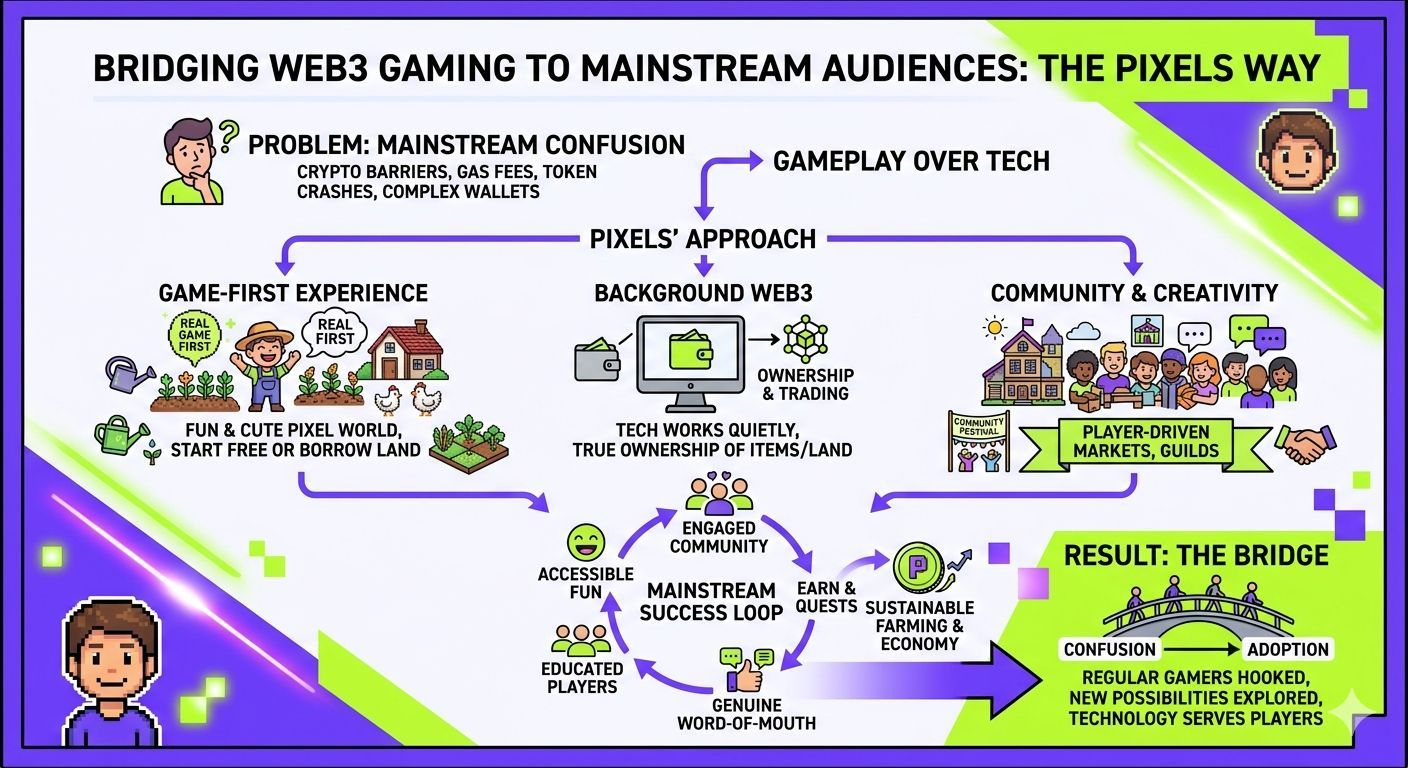
It sits on Ronin, which already signals something important: this is not trying to be a universal chain experiment. Ronin is opinionated. Gaming-first. A place where transaction costs disappear into the background, and the user doesn’t feel like they’re interacting with a financial system every time they click something.
Pixels inherits that design constraint, and it quietly uses it.
The problem it’s trying to solve isn’t the one people usually say out loud. It’s not “onboarding the next billion users” or “bringing gaming on-chain.” Those are just narrative wrappers.
The real problem is much more fragile: can a digital world keep people returning when the financial incentive is no longer the primary reason?
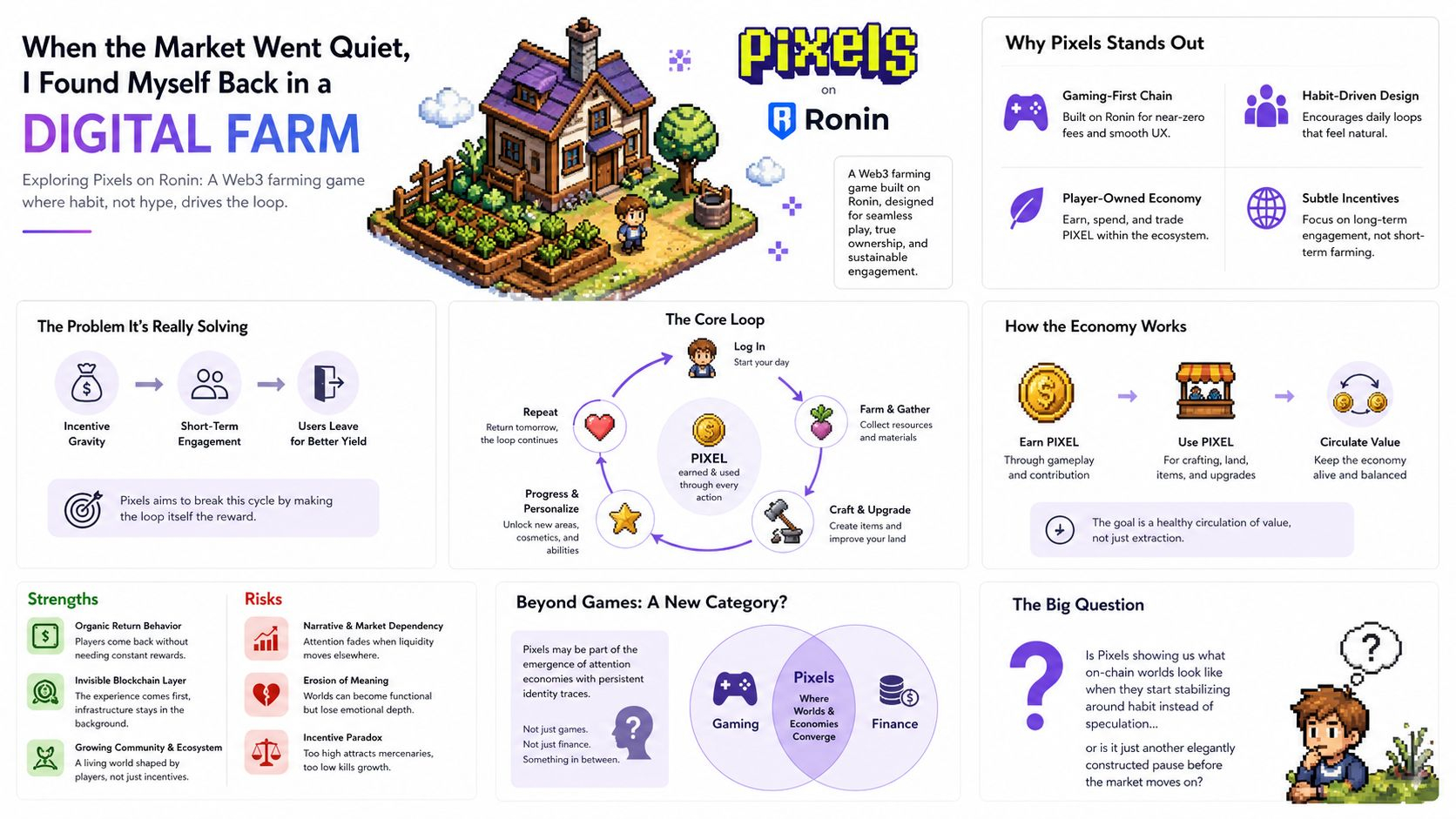
Because in crypto gaming, incentive gravity is usually doing all the heavy lifting. It pulls users in, holds them briefly, then releases them as soon as something else offers better yield or sharper attention.
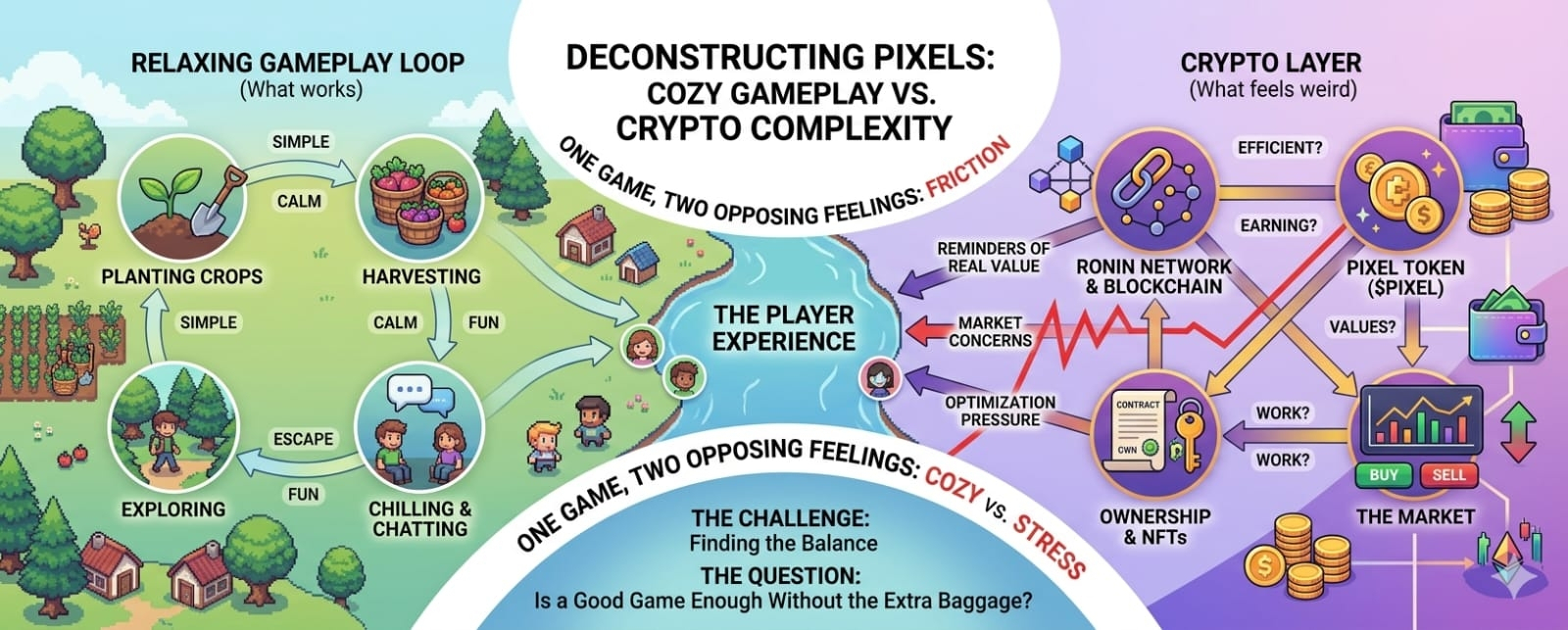
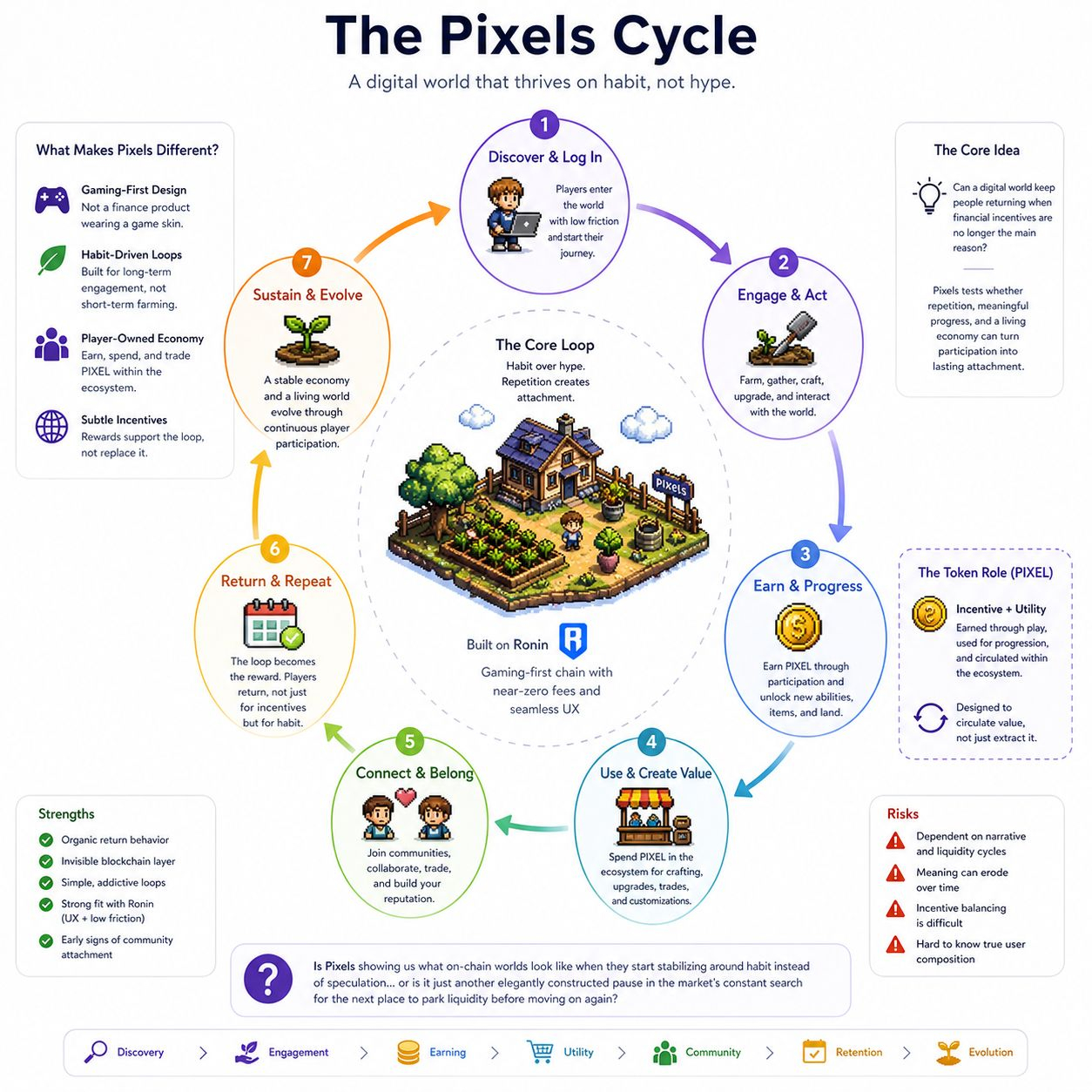
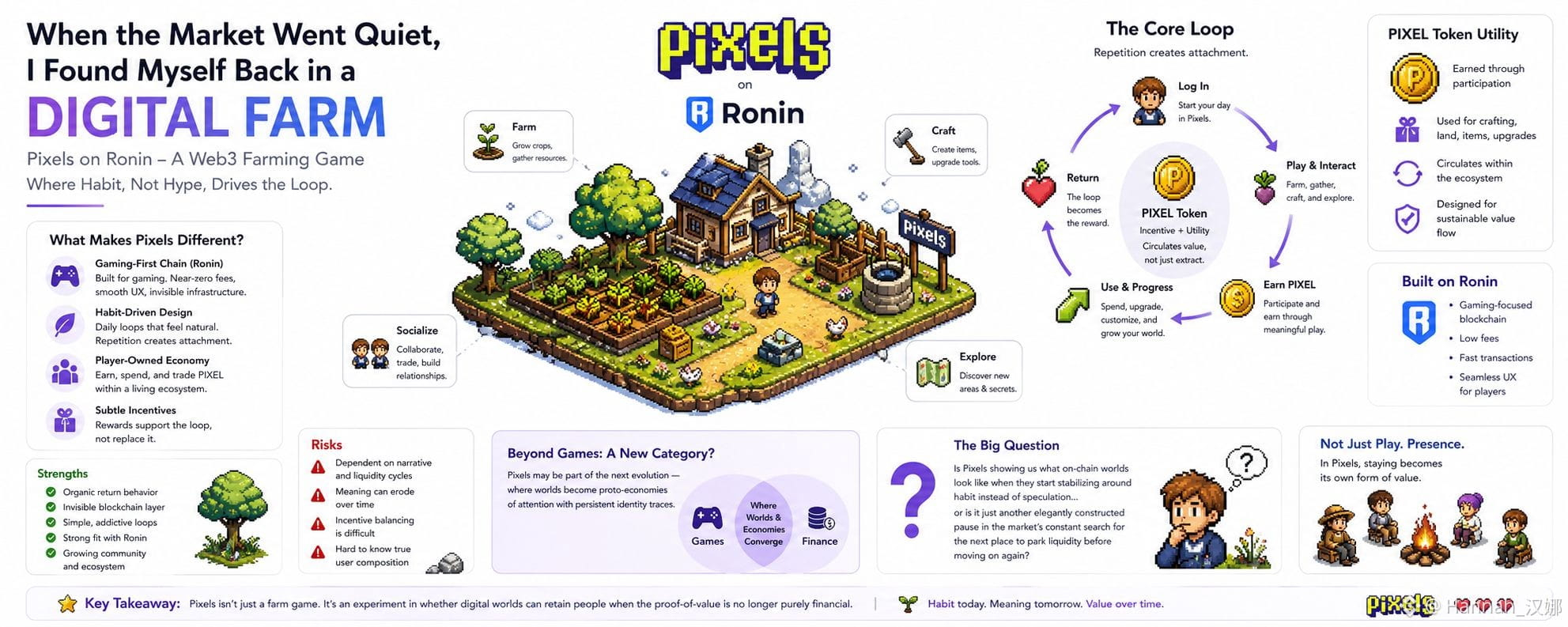
Pixels tries to bend that dynamic by making the loop itself the reward structure. Farming, crafting, upgrading, small social interactions all of it designed to create repetition that doesn’t feel like work or speculation. Just return behavior.
On the surface, it’s simple. You log in, you interact with your land or resources, you progress. The blockchain layer is mostly invisible unless you choose to look at it. That matters more than it sounds like it should. Most Web3 games still make you feel the infrastructure before you feel the experience.
And that’s where Pixels feels slightly different in tone, not necessarily in architecture.
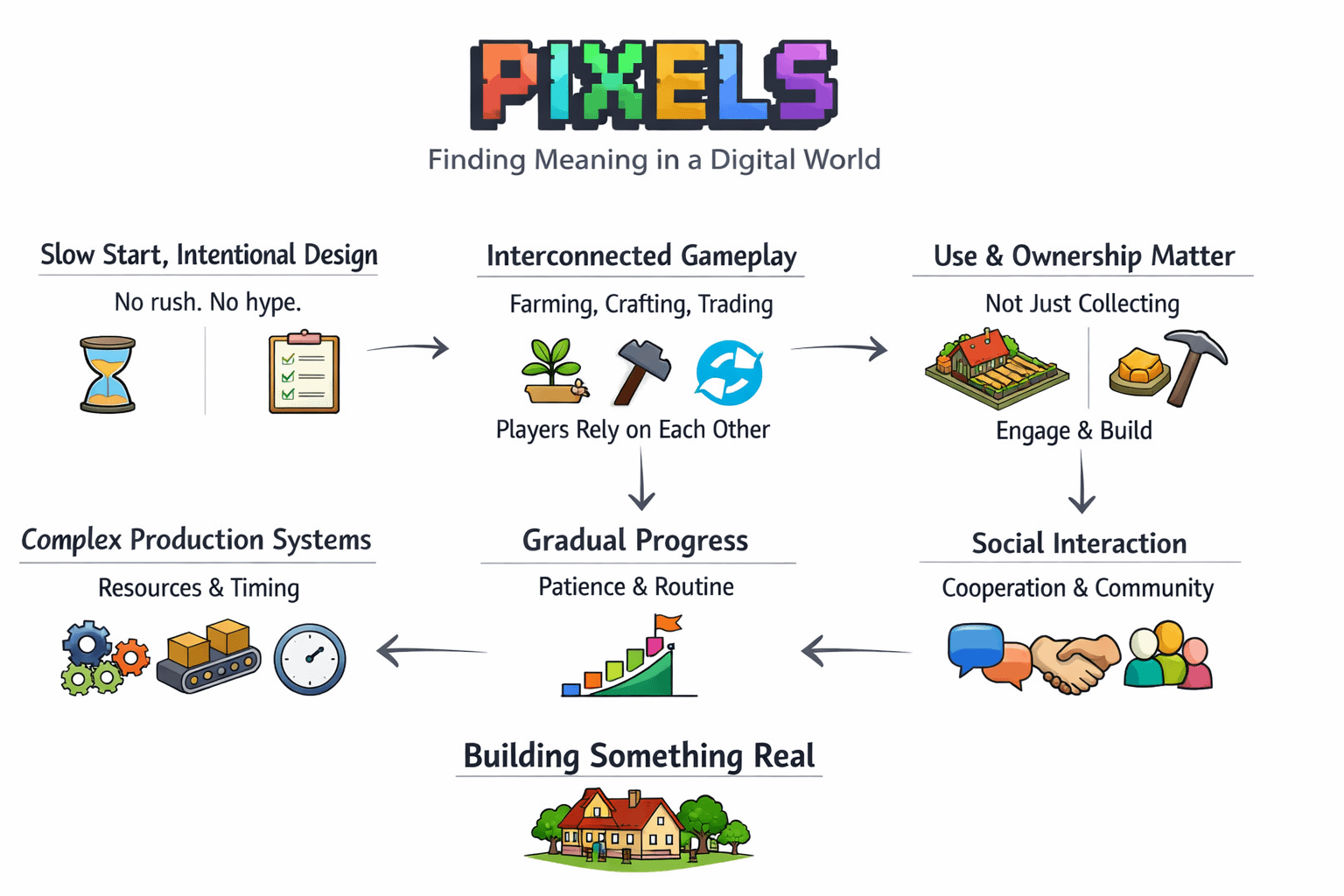
The PIXEL token sits underneath this loop, acting as both incentive and utility. You earn it through participation, spend it inside the ecosystem, and theoretically circulate value rather than extracting it immediately. It’s the same conceptual model many games have tried before, but the difference is in how aggressively it leans on emissions.
It doesn’t feel like it’s screaming for attention through rewards. It feels like it’s trying to normalize usage first.
That said, I’ve been around long enough to know that “feeling organic” in crypto is a dangerous signal to trust too early.
Adoption in these systems often starts with a blended user base. Some are there because they like the game. Some are there because incentives make it rational. Some are just early liquidity scanners disguised as players. You don’t really know the composition until the cycle shifts.
And that shift is the real stress test.
What makes Pixels interesting right now is not that it has solved retention. It hasn’t. No Web3 game has in a durable way yet. It’s that it seems to be testing whether repetition alone, if stable enough, can evolve into attachment without needing constant financial reinforcement.
That’s a harder design problem than most token models ever acknowledge.
The strengths are visible if you spend enough time watching it rather than reading about it. There’s a rhythm to player behavior that doesn’t look purely extractive. People come back without needing immediate reward justification. That alone puts it slightly ahead of many projects that spike harder and decay faster.
But the risks are just as visible if you’ve seen enough cycles.
The first is dependency on narrative rotation. Gaming only gets sustained attention when broader market liquidity is willing to tolerate experimentation. If macro conditions tighten or if attention consolidates elsewhere, even well-designed games get deprioritized quickly.
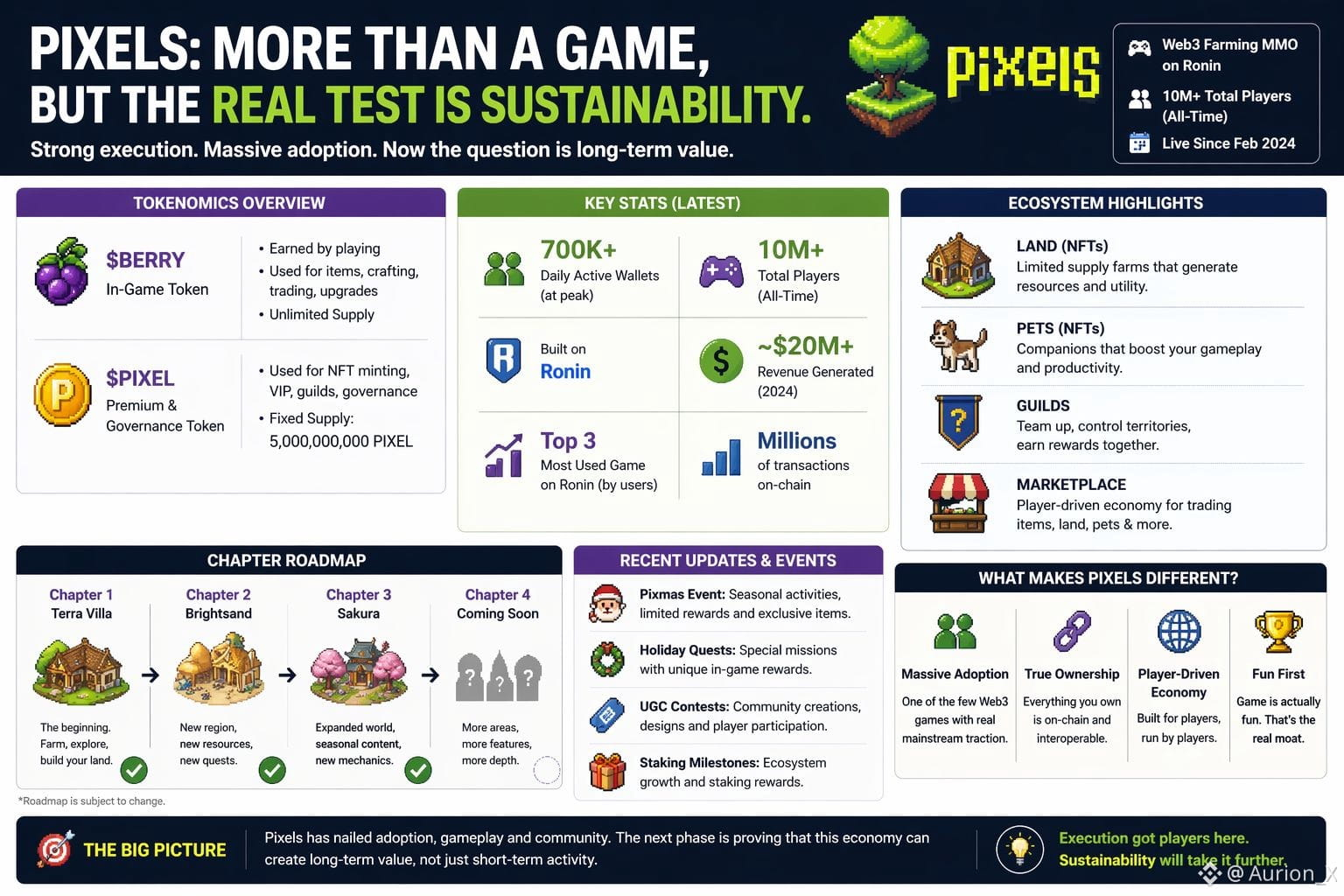
The second is subtle erosion of meaning. Even if the mechanics work, even if players stay active, the emotional layer can still decay slowly. Worlds can become functional without becoming meaningful. That’s usually the stage right before disengagement looks sudden, even though it was building quietly for months
And then there’s the incentive paradox.
If PIXEL rewards are too strong, it attracts the wrong kind of participation mercenary users who optimize behavior and leave. If they’re too weak, engagement stops scaling. Every adjustment is a trade-off between sustainability and growth, and neither side is fully safe.
What I find more interesting though is something slightly less discussed.
Most people still evaluate Web3 games as either “successful games” or “failed tokens.” But that framing misses something subtle happening underneath: these environments are starting to behave less like games and more like proto-economies of attention with persistent identity traces.
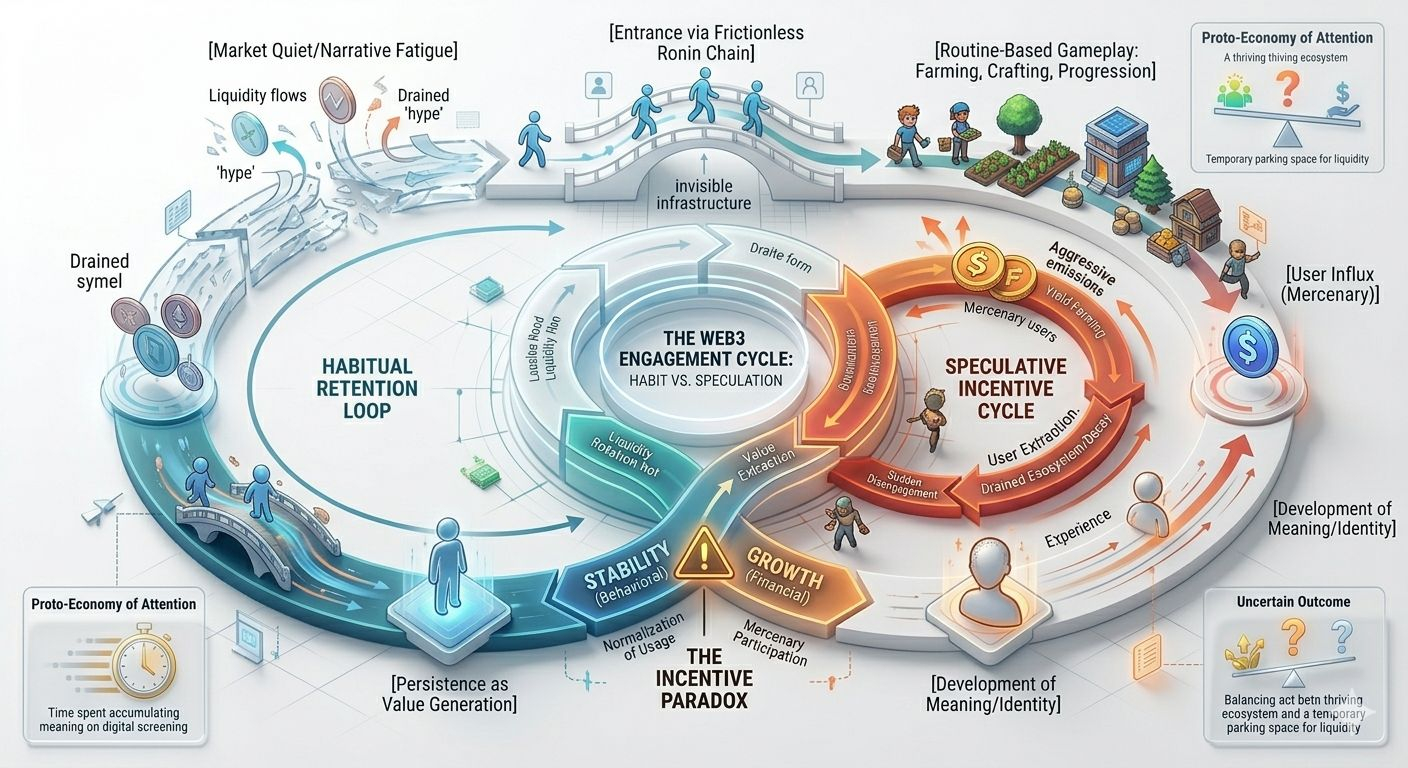
Pixels, intentionally or not, is sitting in that middle space where time spent begins to accumulate meaning even if the system itself is still economically unstable.
That might be the real experiment here. Not whether it becomes a dominant game, but whether repeated digital labor in a semi-financialized environment creates any lasting attachment at all.
And I’m not sure we know the answer yet.
Because every cycle we assume we’re watching adoption, but what we might actually be watching is something closer to behavioral training under fluctuating incentives. A generation learning how to move through systems that reward presence inconsistently.
That thought stays with me more than any roadmap or token model.
Maybe Pixels is just a temporary equilibrium. A well-tuned space that survives as long as attention remains fragmented enough to sustain it. Or maybe it’s an early version of something more persistent not a game, not a financial product, but a hybrid environment where staying becomes its own form of value generation.
Hard to say.
And I keep circling back to one quiet uncertainty I can’t resolve yet.
Is Pixels actually showing us what on-chain worlds look like when they start stabilizing around habit instead of speculation or is it just another elegantly constructed pause in the market’s constant search for the next place to park liquidity before moving on again?