
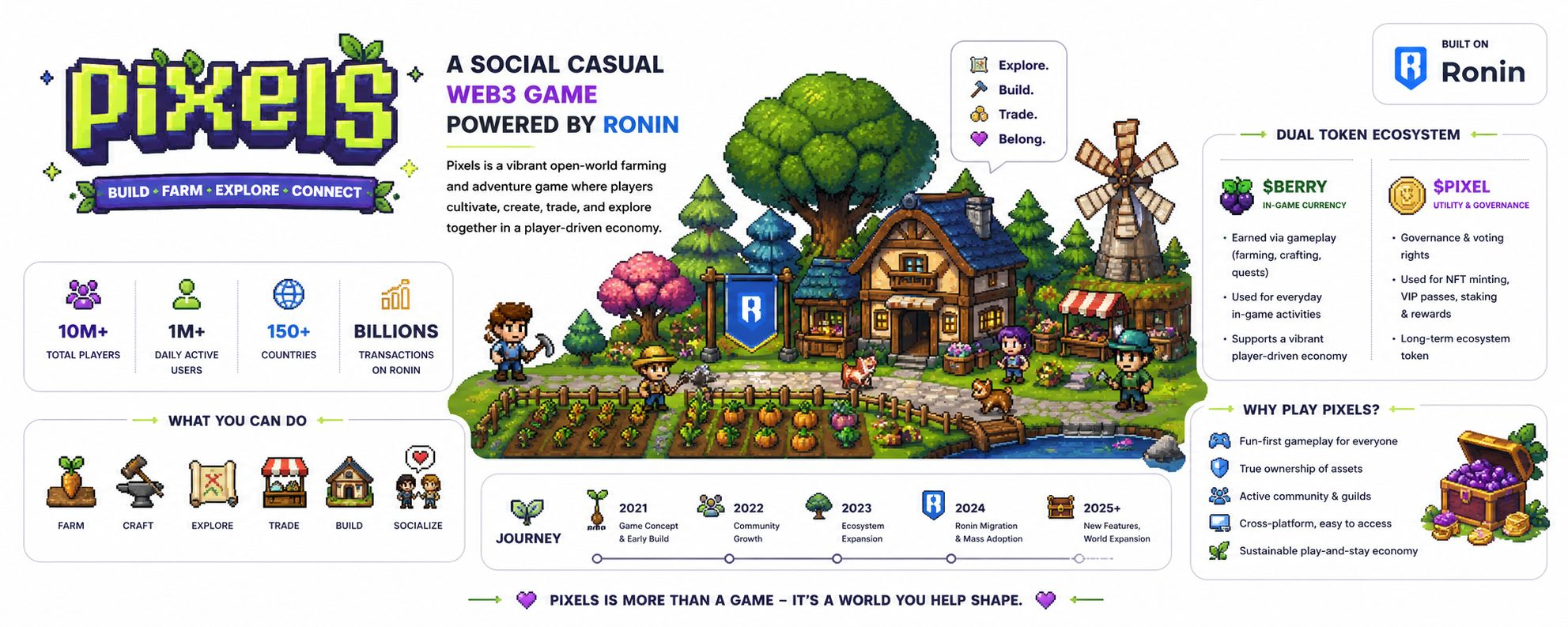
Pixels doesn’t come across like a typical Web3 project trying to grab attention with big promises. It feels quieter, more grounded almost like it accidentally became important. At first glance, it’s just a simple pixel-style farming game where you plant crops, explore, and interact with other players. But the longer you stay, the more you realize there’s something deeper happening beneath that calm surface.
Back when blockchain games were mostly chasing the “play-to-earn” trend, many of them focused too heavily on money and forgot about fun. Players joined for rewards, not for the experience—and when those rewards dropped, so did the player base. Pixels went in a different direction. Instead of asking how much players could earn, it focused on why they would keep coming back. That small shift made a huge difference.
The game was built to be easy to enter. No complicated setup, no heavy downloads—just open it and start playing. That simplicity is intentional. It lowers the barrier for people who are new to Web3, letting them ease into the experience without feeling overwhelmed. You start by farming, collecting resources, and crafting items. It feels familiar, almost comforting, like older games many people grew up with.
But over time, things start to change. You begin trading with other players, improving your land, joining groups, and taking part in a shared world that feels alive. Without realizing it, you move from being just a player to becoming part of a system. There’s a sense that your actions matter, even in small ways.
A major turning point for Pixels came when it moved to the Ronin Network. This shift made the game faster, cheaper to use, and easier to scale. More importantly, it connected Pixels to a larger community already interested in blockchain gaming. After that move, the number of players grew quickly, and the game started gaining real momentum. It wasn’t just surviving anymore—it was expanding.
One of the smarter things Pixels does is how it handles its in-game economy. Instead of relying on a single token for everything, it separates things into two layers. One currency is used for everyday gameplay, while the other is tied to bigger decisions and long-term value. This helps keep the game balanced. Players can enjoy the experience without constantly worrying about market prices, while those who want deeper involvement still have that option.
What really stands out, though, is the social side of Pixels. People don’t just play alone—they interact, trade, form groups, and build connections. Some players focus on farming, others on crafting or trading. Over time, it starts to feel like a small digital community where everyone has a role. It’s not forced or artificial—it grows naturally as people spend time in the game.
There’s also something calming about how Pixels is designed. It doesn’t pressure you to rush or compete constantly. The gameplay has a steady, relaxed rhythm. You log in, do your tasks, maybe talk to other players, and slowly make progress. It’s simple, but that simplicity is what makes it easy to stick with.
Recent updates show that the game is continuing to grow. New systems, deeper gameplay mechanics, and more interaction between players are being added. It’s slowly moving beyond a casual farming game and becoming something bigger, closer to a full online world. At the same time, improvements in the underlying technology mean it can handle more players and more complexity in the future.
Of course, it’s not perfect. The gameplay can feel repetitive at times, and like any Web3 project, it’s still affected by changes in the crypto market. There’s also some reliance on the network it runs on. But even with these challenges, Pixels has managed to stay relevant in a space where many projects disappear quickly.
What makes Pixels interesting isn’t just what it is today, but what it represents. It shows that a blockchain game doesn’t need to rely only on hype or financial rewards to succeed. It can grow by focusing on experience, community, and consistency. It suggests that people might actually stay in a Web3 environment not because they have to, but because they want to.
In the end, Pixels feels less like a trend and more like an ongoing experiment. It’s quietly testing whether games, economies, and communities can blend together in a way that feels natural. And so far, it’s doing a better job of that than most.