
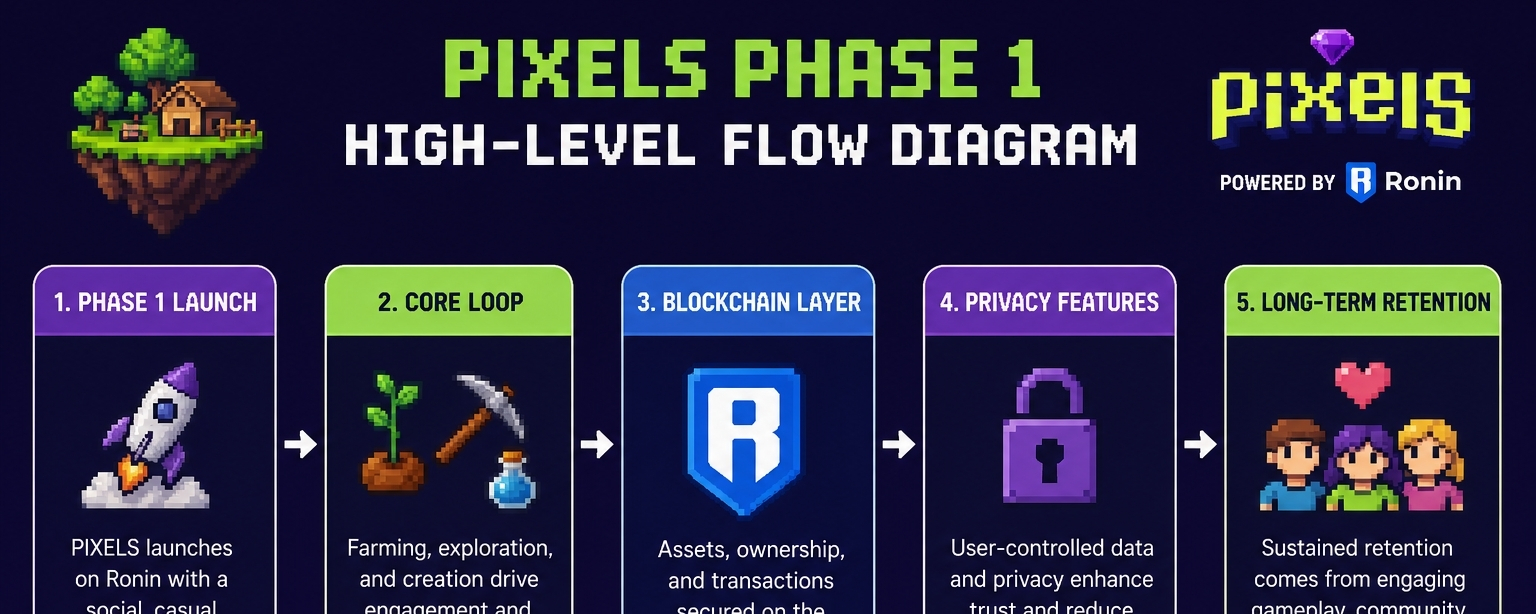
The Phase 1 launch of PIXELS arrives with a familiar blend of charm and ambition—an accessible, social Web3 game layered atop the Ronin Network, promising a relaxed loop of farming, exploration, and creation. On the surface, it feels like a thoughtful attempt to soften the often harsh edges of blockchain gaming. But from the vantage point of someone who has watched countless crypto projects flare up and fade out, the real question isn’t how engaging the first phase is—it’s whether the foundations being laid can sustain attention once the novelty wears off.
Phase 1 in most crypto projects is less about delivering a complete experience and more about crafting a narrative. PIXELS is no exception. The open-world design, low barrier to entry, and emphasis on social interaction are clearly tuned to maximize early adoption. There’s a deliberate effort to make the game feel “alive” before its economy is fully stress-tested. Early users are drawn in not just by gameplay, but by the implicit promise of future value—assets that might appreciate, land that might matter, tokens that might gain utility. It’s a familiar script, and one that has historically relied more on speculation than sustainability.
This is where the discussion around blockchain privacy features becomes relevant. Many newer Web3 ecosystems experiment with enhanced privacy—shielded transactions, pseudonymous interactions, and user-controlled data. In theory, this empowers players, giving them more control over identity and assets. In practice, however, privacy alone has rarely been a driver of long-term retention.
From what I’ve observed, users don’t stay because their transactions are private; they stay because the system they’re participating in continues to feel rewarding, fair, and evolving. Privacy might reduce friction or increase trust at the margins, but it doesn’t solve the core issue: most blockchain games struggle to maintain meaningful gameplay once the financial incentive stabilizes or declines.
In PIXELS’ case, the social and casual framing may actually matter more than any underlying privacy mechanics. If players form communities, build routines, and find intrinsic enjoyment in the game loop, retention can emerge organically. But if engagement is quietly tethered to token performance or asset speculation, no amount of privacy will prevent the eventual drop-off when returns diminish.
There’s also a subtle tension between transparency and privacy in blockchain ecosystems. Transparency builds trust in economies—players can verify scarcity, ownership, and fairness. Too much privacy, on the other hand, can obscure these signals, potentially undermining confidence in systems that rely heavily on perceived integrity. Striking that balance is difficult, and few projects have managed it convincingly.
Ultimately, Phase 1 of PIXELS feels polished enough to attract attention, but not yet differentiated enough to guarantee durability. Privacy features, while conceptually appealing, are unlikely to be the deciding factor in whether users stay. Retention will hinge on something far less technical and far more difficult: whether the game can transition from a speculative playground into a genuinely compelling world.
And if history is any guide, that’s where most projects quietly fall apart.
