
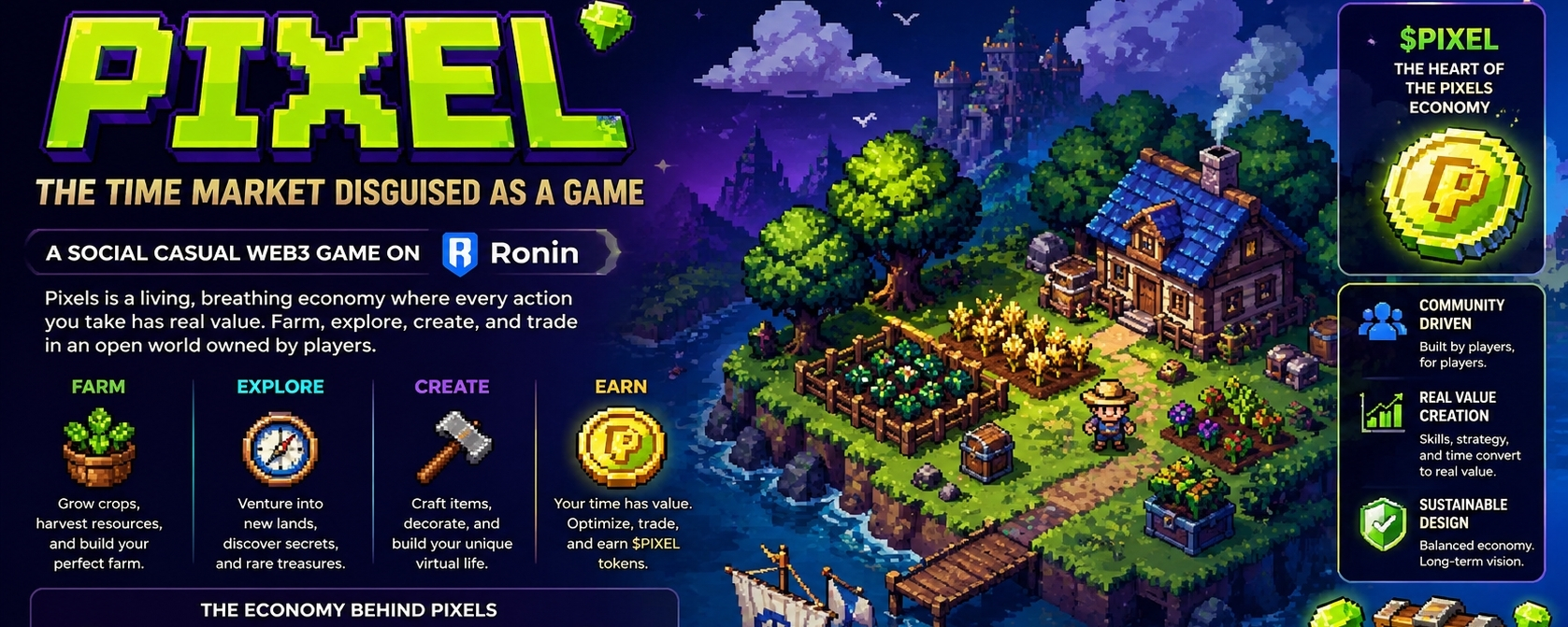
Pixels (PIXEL) didn’t feel like a game to me today. It felt like a system that quietly measures, prices, and rewards human time with more precision than most DeFi protocols ever managed. I logged in expecting a soft loop of farming and exploration, but within minutes my brain shifted into optimization mode. Not because the game forces it explicitly, but because the structure of rewards makes inefficiency feel like a loss. That subtle psychological pivot is where Pixels stops being entertainment and starts behaving like an economy.
What’s actually happening under the surface is not about crops or crafting. It’s about throughput. Every action in Pixels has an implied yield per minute, and once players internalize that, behavior changes fast. You stop asking “what do I want to do?” and start asking “what gives the best return on time?” That’s not game design, that’s labor allocation. The interesting part is that this shift doesn’t require complex DeFi primitives. It emerges from simple loops combined with token incentives, proving that you don’t need financial complexity to create economic behavior—you need consistency and measurable output.
The Ronin infrastructure matters more here than people realize, but not in the usual “fast and cheap” narrative. Low fees don’t just enable transactions; they enable micro-decisions. When every small action can be executed without friction, players start optimizing at a granular level. That creates a behavioral dataset that looks less like gaming activity and more like high-frequency economic participation. If you were to map on-chain activity alongside in-game loops, you’d likely see patterns that resemble liquidity provision behavior in DeFi—constant adjustments, small edges, compounding efficiency.
What most people miss is how Pixels turns soft engagement into hard competition without ever announcing it. There’s no aggressive PvP pressure, but there is implicit competition through resource efficiency. If two players are farming the same assets, the one with tighter loops and better timing extracts more value. That’s functionally identical to yield farming competition, just wrapped in a friendlier interface. The difference is that here, the barrier to entry is psychological rather than technical. You don’t need to understand smart contracts—you just need to notice that your time could be better spent elsewhere in the loop.
The PIXEL token itself behaves less like a reward and more like a compression layer for time value. It aggregates all these micro-optimizations into a tradable output. But this creates a structural tension. If too many players optimize too well, the system risks oversupply of value relative to demand. That’s the same reflexivity problem we’ve seen in past GameFi cycles. The difference is that Pixels doesn’t rely on explosive growth to sustain itself. It relies on steady behavioral engagement. That makes the system more stable in the short term, but potentially more fragile in the long term if token sinks don’t evolve at the same pace as player efficiency.
From an on-chain analytics perspective, the most interesting metric wouldn’t be daily active users. It would be time-to-yield efficiency. How quickly can a new player reach optimal loops compared to early adopters? If that curve compresses over time, it means the system is becoming more competitive and less forgiving. That’s usually where casual users start dropping off, and where economies either mature or collapse. Watching wallet clustering and transaction frequency could reveal when Pixels transitions from a growth phase into a saturation phase.
There’s also an oracle-like dynamic emerging inside the game, even if it’s not formalized. Prices of in-game resources and outputs are indirectly shaped by player behavior, which acts as a decentralized signal system. If a certain activity becomes too crowded, its returns drop. That feedback loop is effectively an internal pricing oracle driven by human action rather than external data feeds. It’s messy, but it’s real, and it aligns closer to free-market dynamics than most token economies that rely on rigid emission schedules.
What makes Pixels structurally different from earlier GameFi attempts is that it doesn’t promise wealth. It quietly invites optimization. That shift removes the hype cycle pressure and replaces it with something more sustainable but less visible: habit formation. Players don’t stay because they expect massive gains. They stay because leaving feels like giving up a refined system they’ve already optimized. That’s a much stronger retention mechanism than speculative upside.
But that strength is also a risk. When a system becomes too optimized, it leaves little room for new value creation. Everything starts to feel solved. At that point, either the developers introduce new layers of complexity, or the economy starts to stagnate. You can already sense early signs of this tension if you look at how players discuss strategies. The conversation is shifting from discovery to refinement. That’s usually the midpoint of a system’s lifecycle, not the beginning.
Zooming out, Pixels is part of a broader shift in crypto where the line between play and work is dissolving again, but in a more subtle form than the last cycle. Instead of explicit “play-to-earn,” we’re seeing “optimize-to-extract.” It’s less noisy, more sustainable, and harder to detect if you’re not paying attention. Capital isn’t flooding in blindly this time. It’s observing, measuring, and waiting for proof that these systems can maintain balance without constant external inflows.
My current read is that Pixels isn’t trying to be the next big GameFi explosion. It’s testing whether a low-friction, behavior-driven economy can quietly sustain itself without breaking. If it succeeds, it won’t look like a breakout—it will look like persistence. And in this market, persistence is more valuable than hype.
What matters now is not how many people are playing, but how they are playing. Because once a game teaches users to think in terms of time efficiency, that mindset doesn’t stay inside the game. It carries over into how they interact with the broader crypto ecosystem. And that’s where Pixels stops being just a product, and starts becoming infrastructure for behavior.
