I’ve been around this market long enough to recognize a pattern: crypto loves speed but real systems move slowly. Every cycle new GameFi projects promise a revolution—play, earn, own—but most fade once incentives weaken. The initial excitement pulls users in yet very few experiences are strong enough to keep them there. Retention not launch hype has always been the real test.
What often gets missed is that games are not just economies they are habits. People don’t stay because of tokens alone; they stay because something about the loop feels worth returning to. This is where many projects miscalculate. They design extraction first and experience second, assuming rewards will substitute for meaning. Over time that imbalance becomes visible and the system starts to empty out.
In that context, Pixels has been interesting to observe. It doesn’t try to look like a breakthrough at first glance. Instead it feels more like a slow experiment in behavior—how players interact how they allocate time and how value forms through participation rather than speculation alone. The presence of $PIXEL in this system matters but not in the usual way. It isn’t just a headline asset; it sits closer to the flow of activity, tied to what players actually do.
The idea of ownership here is also more subtle than many expect. In theory, blockchain gaming has always been about giving players control. In practice that often turns into shallow asset trading with little emotional attachment. But when ownership is connected to time when what you build reflects hours, decisions and small progressions it starts to feel different. The value isn’t only in the asset itself but in the effort behind it.
That’s where player driven economies become more than a narrative. If people care about their space, their output their role in the world then transactions begin to carry context. Markets become extensions of activity rather than isolated systems. It’s a fragile balance though. Too much and the game disappears. Too little and the economy loses meaning.
The “stacked” nature often discussed around Pixels seems to hint at this layering gameplay, economy and social interaction feeding into each other. Not perfectly not completely but enough to suggest a direction. It’s less about maximizing short term returns and more about building loops that don’t immediately break when incentives shift.
Of course skepticism is still necessary. Sustainable on chain ecosystems are harder than they look. Inflation player churn shifting attention all of these pressures remain. No design is immune to them. The question isn’t whether a system can grow quickly but whether it can endure quietly without constant external stimulation.
There’s also a broader question about what players actually want. Ownership sounds powerful but it only matters if it changes behavior. If players don’t feel the difference between renting and owning their digital experience then the underlying technology becomes invisible. Projects like Pixels through $PIXEL seem to be testing whether that difference can be made tangible over time.
Maybe the future of blockchain gaming isn’t explosive or dramatic. Maybe it’s slower more incremental built on small loops of engagement that compound rather than spike. Systems where value is earned through presence not just timing.
And if that’s the case then the real question isn’t whether @Pixels or $PIXEL will lead the market. It’s whether ecosystems like this can quietly prove that player owned economies are more than a concept whether they can reshape how people spend time build identity and participate in digital worlds without needing constant hype to survive.

Articolo
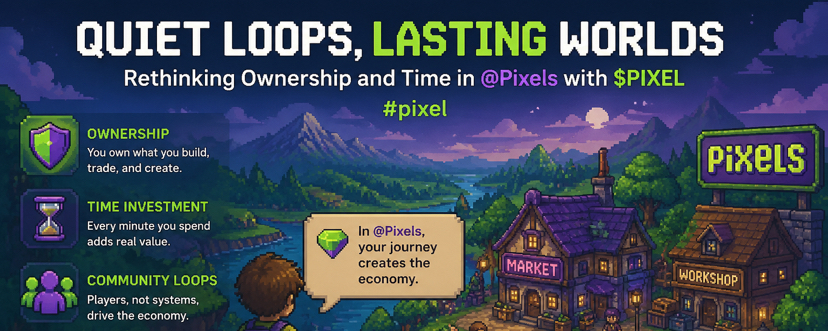
Quiet Loops, Lasting Worlds: Rethinking Ownership and Time in @Pixels with $PIXEL #pixel
Disclaimer: Include opinioni di terze parti. Non è una consulenza finanziaria. Può includere contenuti sponsorizzati. Consulta i T&C.