
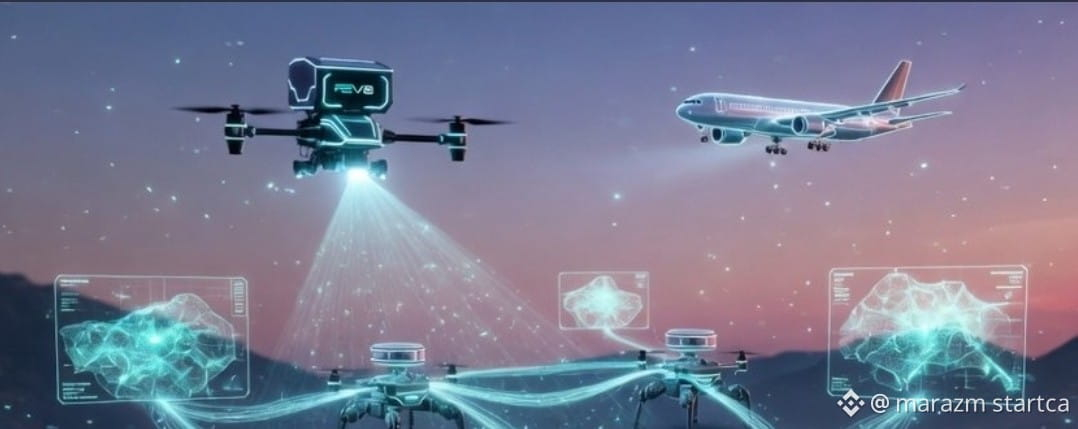
On a viral X post Ouster’s (
@ousterlidar
) REV8 lidar sensor lit up urban streets with vivid, point-by-point RGB color overlaid directly onto high-resolution 3D point clouds. No clunky camera fusion, no alignment headaches — just silicon-native vision that makes machines “see” the world in full human-like detail. It’s a leap forward for Physical AI: robots, drones, and autonomous systems that don’t just navigate, but truly perceive.
Yet perception alone isn’t enough in the real world. As these machines make decisions worth billions in logistics, mining, defense, and smart cities, the missing piece is trust. Who verifies what the sensors saw? How do you prove the data wasn’t tampered with after the fact? Enter Minima (
@Minima_Global
) blockchain-on-chip — a breakthrough that turns edge devices into sovereign blockchain nodes capable of recording immutable, verifiable sensor logs in real time.
While Ouster and Minima have no announced partnership today, their technologies align with uncanny precision. Together, they could create the first truly trustworthy, decentralized Physical AI stack — where high-fidelity lidar perception meets hardware-native blockchain security.
) has spent the past decade perfecting digital lidar. Unlike older spinning-mechanical systems, Ouster’s sensors use a solid-state digital architecture that scales affordably while delivering industry-leading resolution and range.
The headline act right now is the REV8 family, launched in May 2026. It doubles range and resolution over prior models, processes over 10 million points per second, and — crucially — fuses RGB color data at the silicon level using custom L4 Ouster Silicon developed with Fujifilm. Every 3D point comes pre-colored, slashing latency and eliminating the fusion errors that plague traditional lidar + camera setups.
In February 2026, Ouster acquired
@Stereolabs3D
, folding in stereo cameras, AI compute, and advanced perception software. The result: a unified Physical AI platform that combines lidar, vision, sensor fusion, and AI models in one package. Ouster now powers everything from warehouse robots and mining trucks to self-driving shuttles and smart intersections. Revenue hit
$169M
in FY2025 with strong growth, and the company is shipping tens of thousands of sensors annually.
Ouster’s pitch is simple: give machines human-like sight so they can act safely and intelligently in the physical world. But sight without a verifiable record is just data — and in regulated or high-stakes environments, data alone isn’t enough.
Minima: The Trust Layer for Edge Devices
Minima Global is building “the embedded blockchain” — an ultra-lightweight Layer-1 protocol designed from the ground up to run on-chip in resource-constrained devices like phones, IoT sensors, drones, and robots.
The breakthrough came in late 2025: Minima demonstrated a working blockchain-on-chip prototype using Arm-based SoC/FPGA hardware with custom crypto accelerators. A full Minima node now runs directly inside autonomous drone flight controllers. During flight, it receives live sensor and system-state data, hashes it, and records it immutably on-chain — no cloud, no external servers, no single point of failure.
By March 2026, University of Southampton engineers (working with Minima,
@Arm , and @Siemens
Cre8Ventures) had flown the world’s first “blockchain black box” drone. Real-time telemetry, environmental readings, and sensor data were logged directly to the blockchain in a tamper-proof, independently verifiable audit trail. Performance gains were dramatic: up to 500x faster and 10,000% more energy-efficient than software-only approaches.
Minima’s TxPoW (transaction Proof-of-Work) consensus lets every device contribute to network security collaboratively. The result is true edge decentralization: machines that can coordinate peer-to-peer, validate data among themselves, and create permanent, censorship-resistant records — all while sipping power.
Where the Technologies Click: A Natural Synergy
Ouster’s REV8 doesn’t just see in 3D color — it generates dense, semantically rich perception data at high frequency. Pair that with Minima’s on-chip node and you get something revolutionary:
* Tamper-proof perception logs: Every colored point cloud, object classification, and trajectory from an Ouster sensor could be hashed and recorded on-chain in real time by Minima hardware. Regulators, insurers, or fleet operators could independently verify “what the machine saw” without trusting the operator’s cloud.
* Decentralized swarm intelligence: In drone deliveries or robot fleets, Minima nodes could share verified Ouster-derived maps and poses peer-to-peer. No central server means lower latency, greater resilience, and built-in auditability.
* Secure Physical AI at the edge: Ouster’s StereoLabs-enhanced platform already delivers AI perception. Minima adds the cryptographic trust layer — turning perception into provable, shareable truth. Think autonomous mining trucks whose lidar-based obstacle detection is logged immutably for safety audits, or self-driving shuttles whose color-enhanced perception data becomes court-admissible evidence.
Minima has already proven the sensor-logging concept with generic drone data. Ouster’s lidar — especially the new native-color REV8 — is the highest-value sensor payload imaginable for that use case. The hardware profiles match perfectly: both target low-power, rugged, embedded environments in robotics, drones, vehicles, and industrial automation.
Real-World Applications on the Horizon
* Drone logistics and inspection: A delivery drone equipped with REV8 lidar and Minima-on-chip could log every meter of its flight path, obstacle avoidance decisions, and package handling — creating a regulatory-grade black box that regulators love.
* Autonomous fleets: Mining or warehouse robots could form decentralized networks where each machine validates others’ lidar perception data on-chain, reducing collision risks and enabling true swarm coordination.
* Smart infrastructure and AVs: Traffic intersections using Ouster BlueCity could feed color-rich perception into Minima nodes for tamper-proof V2X data sharing.
* Defense and critical infrastructure: In contested or high-security environments, immutable on-device records become a strategic advantage.
Challenges and the Path Forward
Technical integration would require joint engineering — embedding Minima’s protocol into Ouster-compatible compute modules or vice versa — but both companies already work with Arm silicon, making it feasible. Regulatory tailwinds are strong: aviation authorities, automotive safety standards, and data-privacy laws increasingly demand verifiable autonomy.
No partnership exists yet, but the market is moving fast. Ouster is aggressively building its Physical AI platform; Minima is shipping blockchain black boxes into drones. A collaboration — or even an acquisition play — would position both as leaders in the next era of trusted machines.
The REV8 video showed machines seeing the world in color. Minima’s blockchain-on-chip could ensure the world trusts what they see. In the age of Physical AI, perception plus proof isn’t just nice to have — it’s the foundation of scalable, safe, decentralized autonomy.
The hardware is ready. The synergy is obvious. The only question left is: who will build it first?