

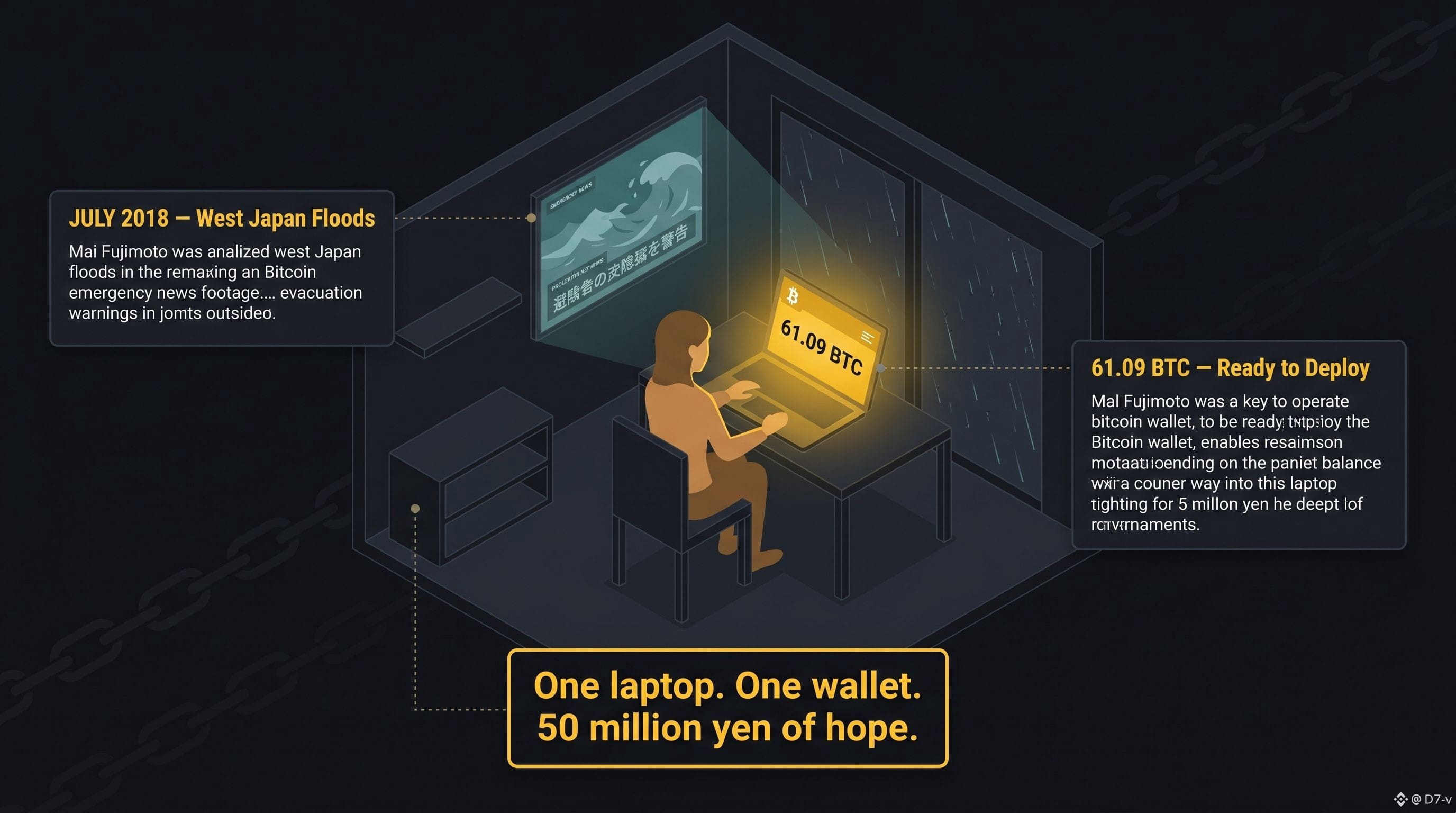
In July 2018, parts of western Japan experienced their worst flooding in decades. Over 200 people lost their lives. More than 17,000 homes were damaged. Eight million people were advised to evacuate. And somewhere in Hiroshima, a woman named Mai opened her laptop and started doing something the world hadn't quite seen before.
Here's the uncomfortable truth about charitable giving: a lot of it gets lost in transit.
Not stolen — lost. Eaten by administrative fees. Held up in international wire transfers. Diluted by layers of overhead between the person who donates and the family who desperately needs help. A 2017 Edelman survey found that less than a quarter of people globally trust non-governmental organizations. The systems we've built to channel human generosity have, somewhere along the way, become leaky pipes.
So when catastrophic floods tore through Hiroshima, Okayama, and Ehime in mid-July 2018 — the deadliest rain disaster Japan had seen in 36 years — a Japanese Bitcoiner named Mai Fujimoto decided to try a different approach entirely.
Meet Mai: Japan's "Miss Bitcoin"
Mai wasn't a disaster relief professional. She was a Bitcoin enthusiast who had built a charity foundation called Kizuma, exploring how crypto could power donations in Japan long before it was fashionable. She understood, better than almost anyone in the country, that cryptocurrency wasn't just a trading asset — it was programmable money with a transparent, immutable trail.
When Binance Charity launched a global appeal for the West Japan Disaster Relief project in the days following the flooding, the response from the global crypto community was staggering. Donations poured in from around the world — BTC, ETH, ERC-20 tokens — pooling rapidly on Binance's platform. By October 2018, the campaign had raised 63.03 BTC and 169.85 ETH, combined worth approximately $1.41 million at the time.
But there was a problem. Most of the Japanese NPOs on the ground — the organizations who knew where the shelters were, which families needed help, and which suppliers could deliver emergency goods — had never touched a crypto wallet in their lives. All those donated Bitcoin were sitting on-chain, representing genuine human generosity, and couldn't reach the people who needed it most.
Binance reached out to Mai.
The Last-Mile Problem That Crypto Solved
The "last-mile problem" in humanitarian aid refers to the gap between funds being raised and funds actually reaching beneficiaries. It's where aid most often fails — not through bad intentions, but through logistical friction: currency conversion delays, banking intermediaries, identity verification requirements, and institutional red tape that can hold up life-changing funds for weeks or months.
Binance transferred 61.09 BTC directly to Mai. Not to a bank. Not through a wire transfer that would take days and eat into the principal. Directly, on-chain, in minutes.
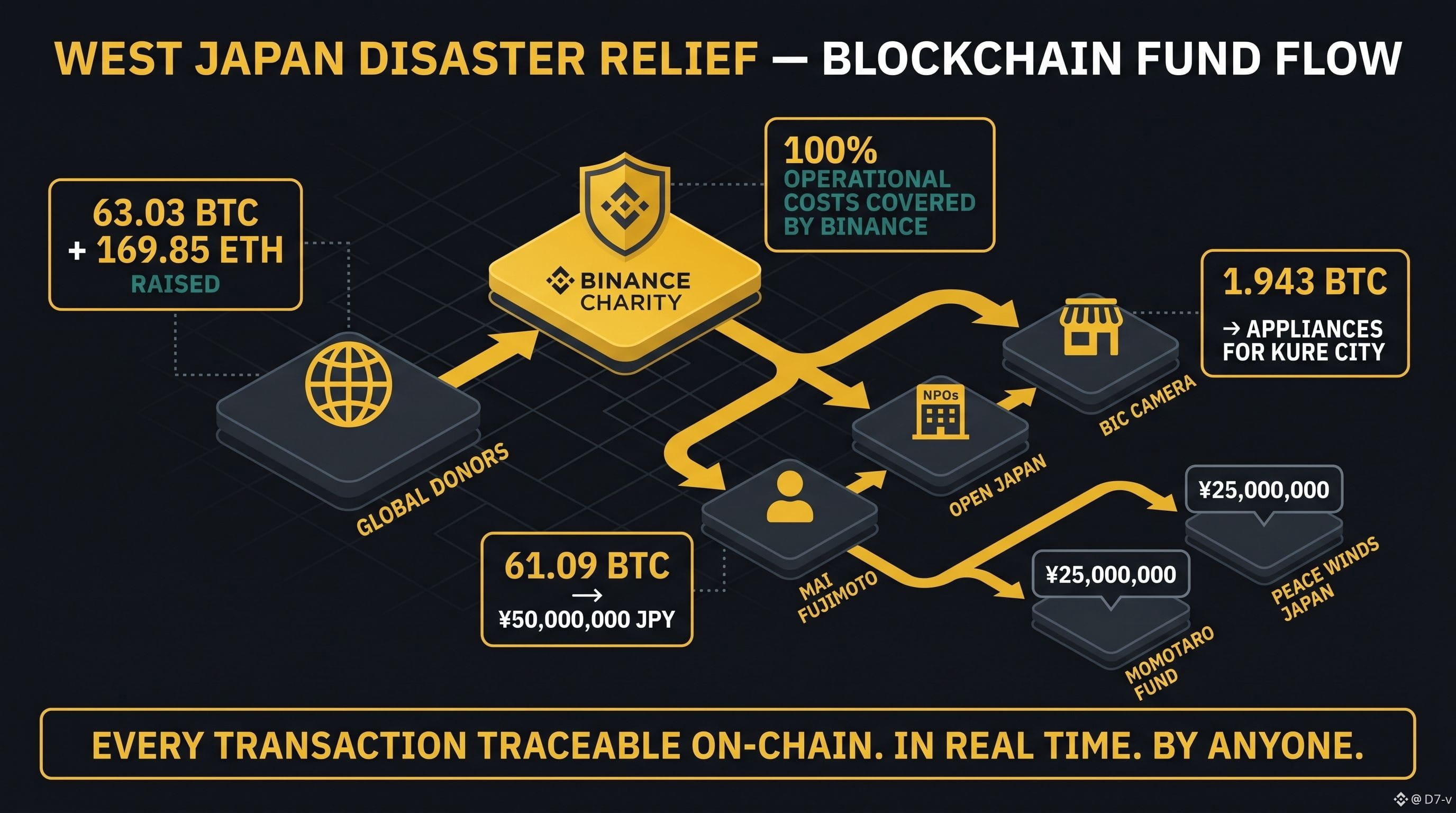
Mai then converted those Bitcoin into approximately 50 million yen and allocated funds to verified local organizations. Twenty-five million yen went to the Momotaro Fund and Peace Winds Japan — two credible local operators she knew and trusted. A further 1.943 BTC was donated to Bic Camera specifically to purchase appliances for temporary shelters in Kure City. Another 169.85 ETH went to Open Japan, which converted it to yen and distributed relief funds to victims directly.
Every single one of those transactions is traceable on the blockchain — not "audited and reported later," but traceable in real time, by anyone, anywhere in the world.
Why Binance Charity Is Different From a GoFundMe
This is the part where crypto philanthropy stops sounding idealistic and starts sounding genuinely revolutionary — but only if you understand what's actually happening under the hood.
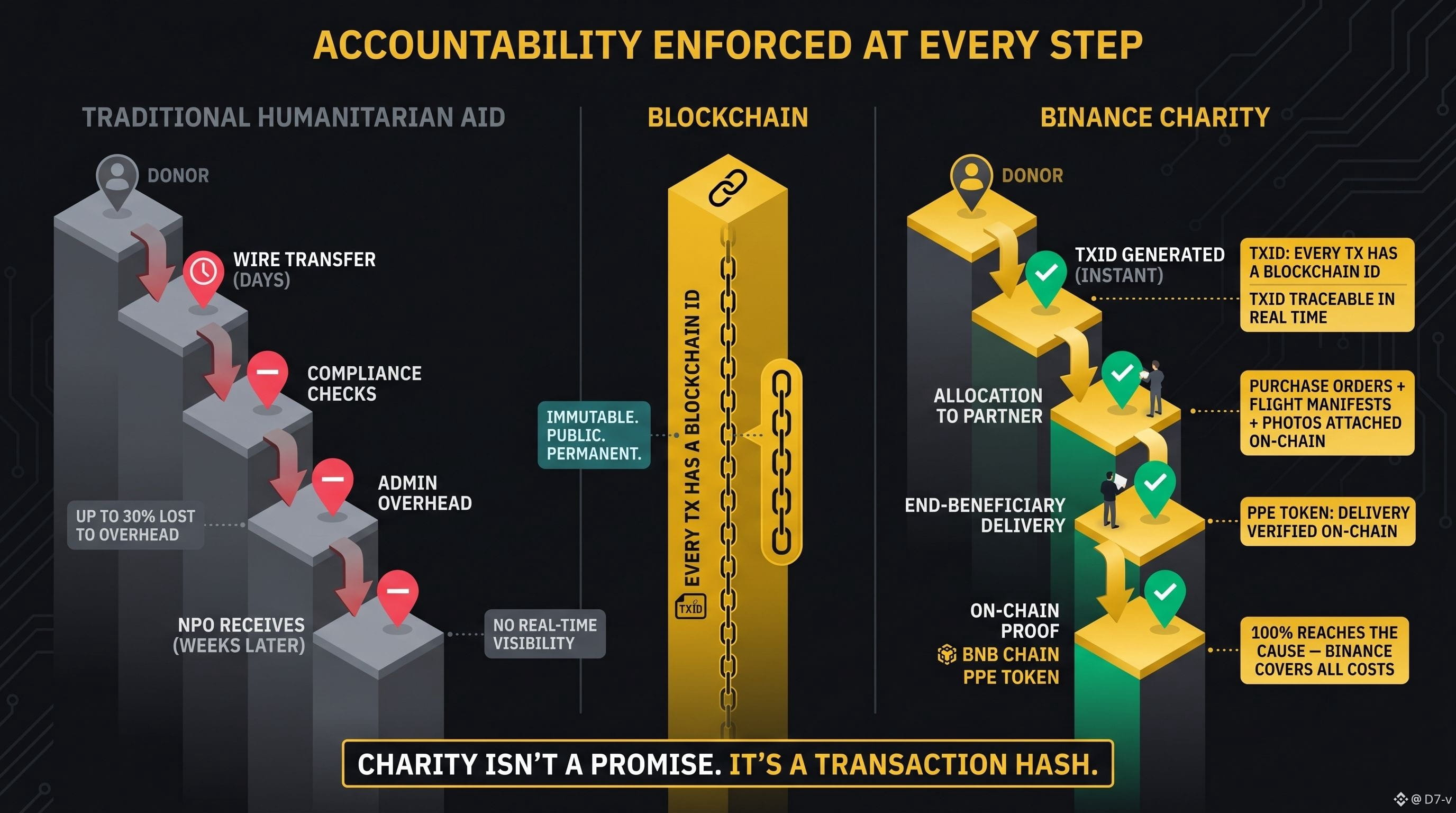
When Binance Charity receives a donation, every transaction is logged with a blockchain transaction ID (TXID). Donors can look up their specific TXID and follow their contribution through multiple layers: from initial receipt, through allocation to a charity partner, to end-beneficiary distribution. Binance covers 100% of operational expenses, meaning every donated satoshi goes to the cause — not to keeping the lights on at headquarters.
For the COVID-19 relief campaign, Binance Charity went further, creating a purpose-built PPE Token on BNB Chain. Hospitals received tokens representing a specific quantity of masks. When masks were delivered, the tokens transferred automatically from hospital wallets to supplier wallets — proving last-mile delivery on-chain. Purchase orders, flight manifests, and photographic proof of healthcare workers receiving equipment were all attached to on-chain records.
That's not a charity donation. That's accountability enforced at every step.
The Numbers Behind the Story
To appreciate the scale of what happened, it helps to look at the fund flows plainly:
61.09 BTC (~¥50,000,000) → Mai Fujimoto → Momotaro Fund, Peace Winds Japan, and local NPOs
169.85 ETH (~¥5,300,000) → Open Japan → Direct relief to flood victims
1.943 BTC → Bic Camera → Emergency appliances for Kure City temporary shelters
Total raised: 63.03 BTC + 169.85 ETH (~¥56,700,000 / ~$505,000)
Every row in that table has an on-chain equivalent — a transaction hash, a wallet address, a timestamped record. This is what "transparent philanthropy" actually means, not just a promise in a press release.
What Traditional Aid Couldn't Have Done Here
Picture the alternative. A traditional humanitarian fund receives wire transfers from donors across Japan, Singapore, the United States, and Europe. Each wire incurs fees. Some transactions are held up by compliance checks. A significant chunk goes to operational overhead. The NPOs on the ground submit receipts, wait for reimbursements, and work months later when the acute crisis has already passed.
With Binance and Mai as the infrastructure layer, donations crossed borders in minutes, not days. Conversion happened at market rates without correspondent bank markups. Allocation happened in days, not months. And verification didn't require a third-party audit — it was baked into the protocol.
This is the use case that crypto advocates have been pointing to for years, often in the abstract. The Japan flood campaign made it concrete: 50 million yen, moved faster and more transparently than any bank wire could have managed, to communities that needed it immediately.
From One Story to a Global Movement
Mai's story doesn't end with the floods. After seeing what was possible, she continued helping Japanese non-profits navigate the world of crypto donations, turning a one-off crisis response into a repeatable playbook for digital-age philanthropy in Japan.
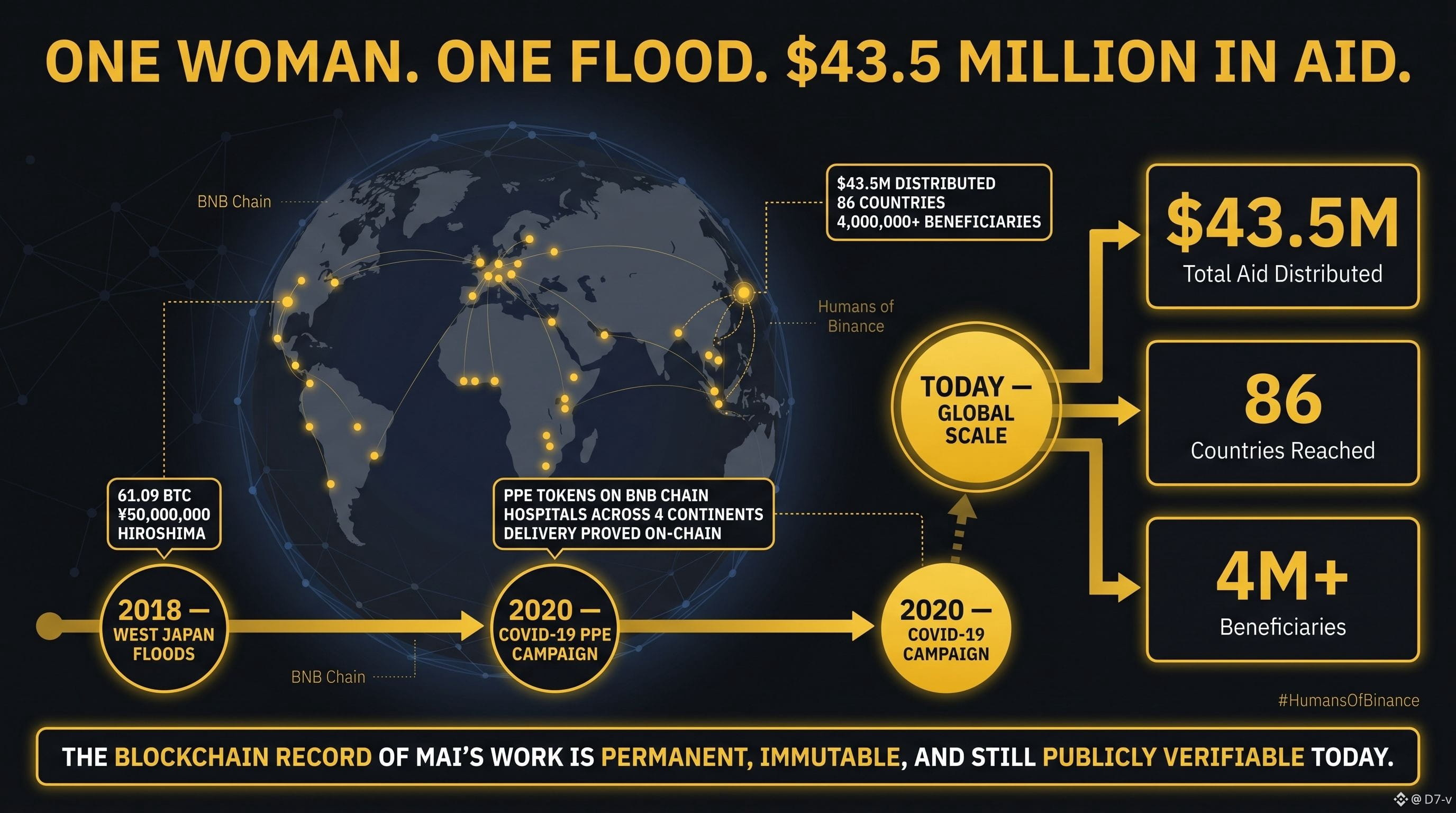
And Binance didn't stop there either. Since the Japan campaign, Binance Charity has distributed more than $43.5 million in aid across 86 countries, reaching over 4 million beneficiaries through disaster relief, education, and humanitarian support campaigns. Emergency flood relief in Vietnam. Landslide response in Sumatra. The COVID-19 PPE campaign that delivered to hospitals across four continents. Each campaign built on the same core principle: blockchain as the accountability layer, trusted local partners as the human layer.
Humans of Binance: Your Story Might Be Next
Mai's journey is now part of the Humans of Binance series — a global storytelling campaign Binance launched in September 2025 to spotlight the real people behind the wallets. Not traders chasing returns, not protocol engineers writing Solidity code — ordinary people who used crypto to change something in their lives or their communities.
New stories drop weekly across Binance's channels, and there are currently over 2,600 user stories from more than 100 countries. There are entrepreneurs who built businesses using Binance Pay, families who bypassed broken banking systems using stablecoins, and now, relief workers like Mai who turned a natural disaster into a demonstration of what this technology can actually do. youtube
If you've used Binance — or crypto more broadly — to do something meaningful, the campaign wants to hear from you. Share your story under #HumansOfBinance, and the most compelling submissions get turned into short animated features, with featured storytellers eligible for a share of a 3,000 USDC reward pool.
The Takeaway
There's a version of the crypto story that's all charts and price predictions and Twitter arguments about which L2 is going to win. And then there's this version: a woman in Hiroshima converting Bitcoin into emergency yen within days of a catastrophe, channeling 50 million yen to families who had lost everything, with every transaction documented on a public ledger that anyone in the world can audit.
Both versions are true. But only one of them is a reason to care.
The flood waters recede. The headlines move on. But the blockchain record of Mai's work in July 2018 is permanent, immutable, and still publicly verifiable today — proof that when the right infrastructure meets the right person, crypto can be genuinely, measurably good.
That's the story worth telling.
Want to read more real stories of crypto changing lives? Follow #HumansOfBinance across Binance's social channels, or share your own story and become part of the movement.