
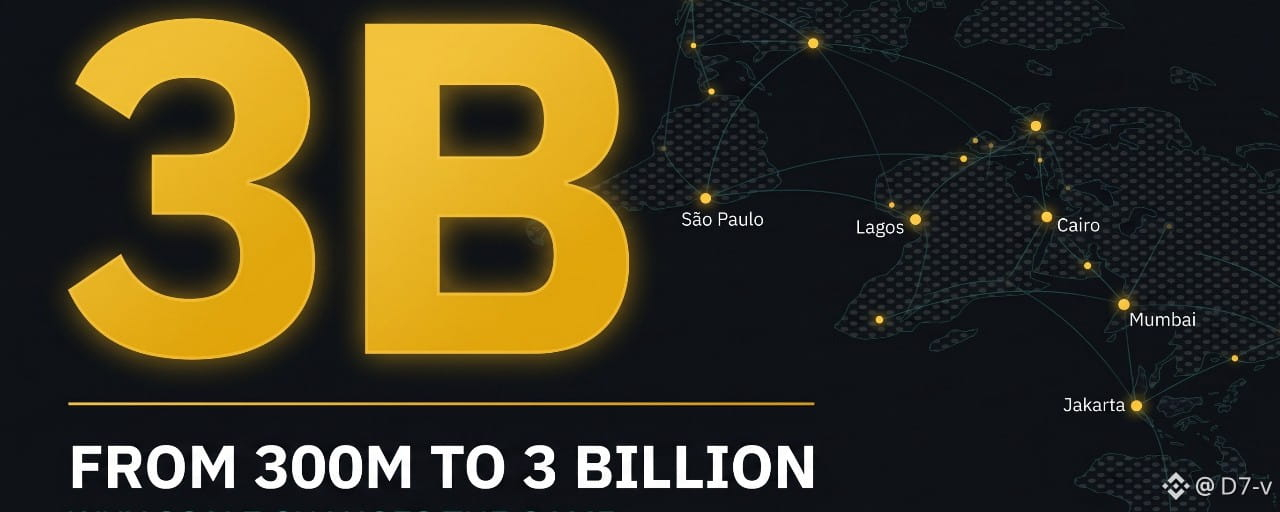
From 300M to 3 Billion: Why Scale Changes the GameBinance Co‑CEOs Yi He and Richard Teng opened the event with a simple but aggressive question: how do you take crypto from roughly 300 million users to 3 billion?Their answer wasn’t “number go up.” It was infrastructure, emerging markets, and relentlessly lowering the “activation energy” for the next billion users.Teng emphasized something that often gets lost in Western discourse: for a huge part of the world, crypto isn’t a speculative asset class—it is the most practical way to access dollars, payments, and basic financial services that local banks fail to provide.
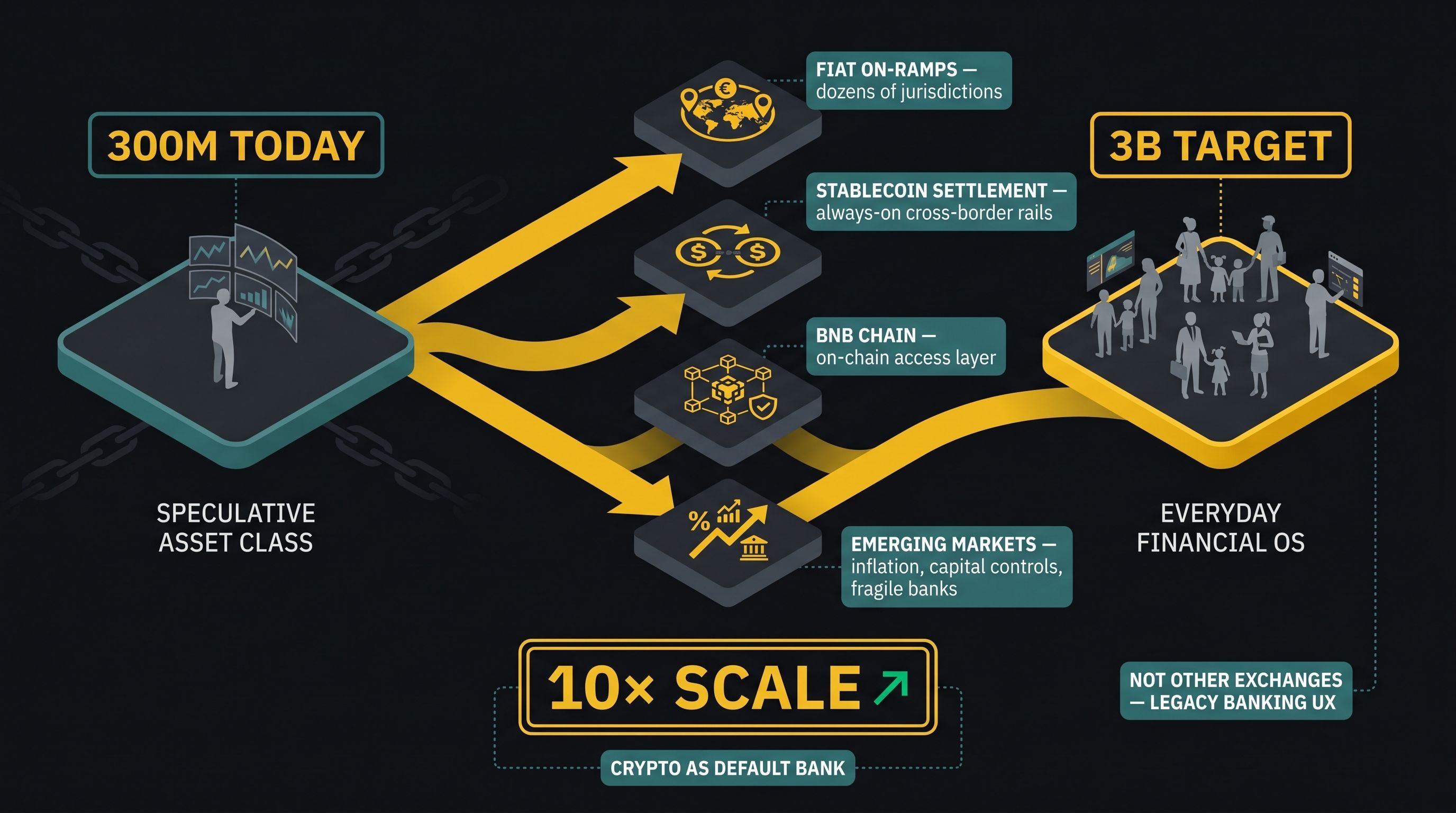
Stablecoins moving across Binance’s ecosystem already behave like an always‑on, cross‑border settlement layer, especially in regions with inflation, capital controls, or fragile banking rails.What makes Binance interesting here is not just its spot or futures volumes, but its evolution into an all‑in‑one financial operating system: fiat on‑ramps in dozens of jurisdictions, stablecoin pairs across major assets, on‑chain access through BNB Chain, and institutional‑grade products layered on top.If the goal is 3 billion users, the real competition isn’t other exchanges—it’s legacy banking UX, settlement times, and the friction of opening an account in the traditional system. Tokenizing the Capital Markets: From Pitch Deck to PlumbingThe most structurally important conversation came at the end: Rob Goldstein (COO of BlackRock) and Kaiser Ng (SVP of Finance at Binance) on tokenizing capital markets.Goldstein’s message was blunt: more and more wealth is ending up in digital wallets, and the capital markets world has to follow those users into tokenized formats, not force them back into legacy channels.This isn’t just a vibes‑based narrative. Multiple independent analyses now forecast tokenized real‑world assets—bonds, funds, credit, real estate—to reach around 9–16 trillion dollars by 2030, with some estimates extending to nearly 19 trillion by 2033.In other words, we’re moving from “wouldn’t it be cool to tokenize X” to “this is where a non‑trivial slice of global assets will live.”Crucially, Binance isn’t just talking about tokenization—it is already wiring it into live institutional workflows.One flagship example: the Franklin Templeton × Binance Institutional Off‑Exchange Collateral Program, where institutions can use tokenized shares of regulated money‑market funds as collateral for trading on Binance, while the assets stay in third‑party, regulated custody.This structure lets funds keep their capital in a compliant, yield‑bearing vehicle, have it mirrored as collateral on Binance, and still access 24/7 liquidity—without dumping everything into an exchange hot wallet.Zoom out and you can see the architecture forming: Tokenized money‑market fund shares and other RWAs live in regulated custody and on chains like BNB Smart Chain. Institutional‑grade trading and derivatives live on Binance, with mirrored collateral and risk controls. On‑chain ecosystems and institutional DeFi platforms (for example, projects like Allo that focus on RWA perps and tokenized commodities) provide additional liquidity and programmable use cases.
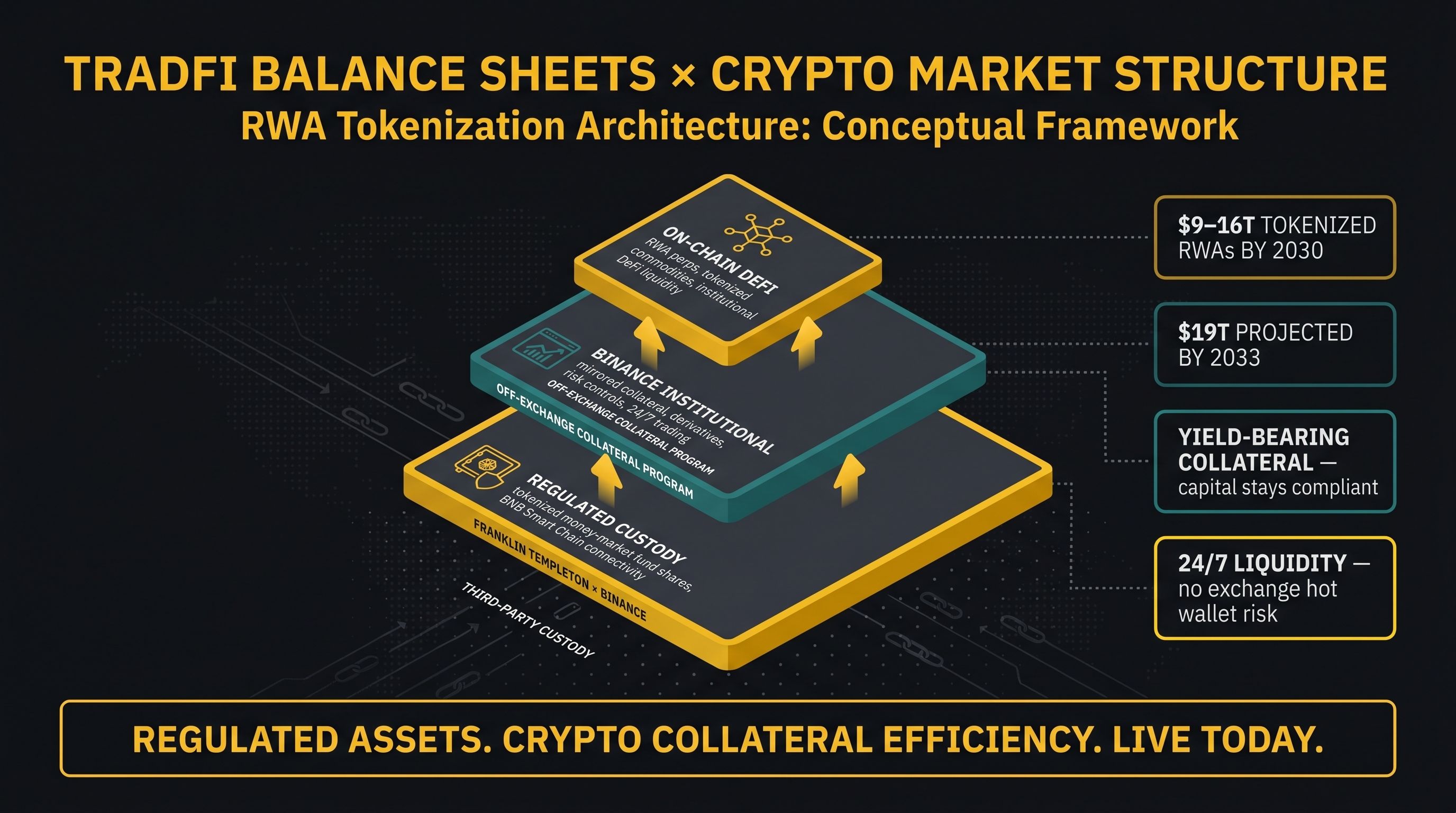
What Goldstein and Ng were really describing was “TradFi balance sheets, crypto market structure”—the marriage of traditional asset quality with crypto‑native collateral efficiency. Smart Money, AI, and the New Capital StackThe “Where Smart Money Is Moving Now” session with CZ, Chamath Palihapitiya, and Anthony Pompliano zoomed out from specific tokens to portfolio construction in a world where AI, energy, and crypto are becoming tightly coupled.The conversation focused on multi‑cycle themes: AI compute infrastructure, tokenized assets, Bitcoin and stablecoins as macro hedges, and how capital is rotating between these layers.A recurring motif was the rise of “picks and shovels” investing—data centers, chips, energy, and base infrastructure for AI—paired with programmable money rails where assets, collateral, and payments can move at internet speed.Here, Binance’s role is less about specific coins and more about being the liquidity and derivatives backbone that lets funds express views across BTC, ETH, AI tokens, RWAs, and macro hedges in a single venue.
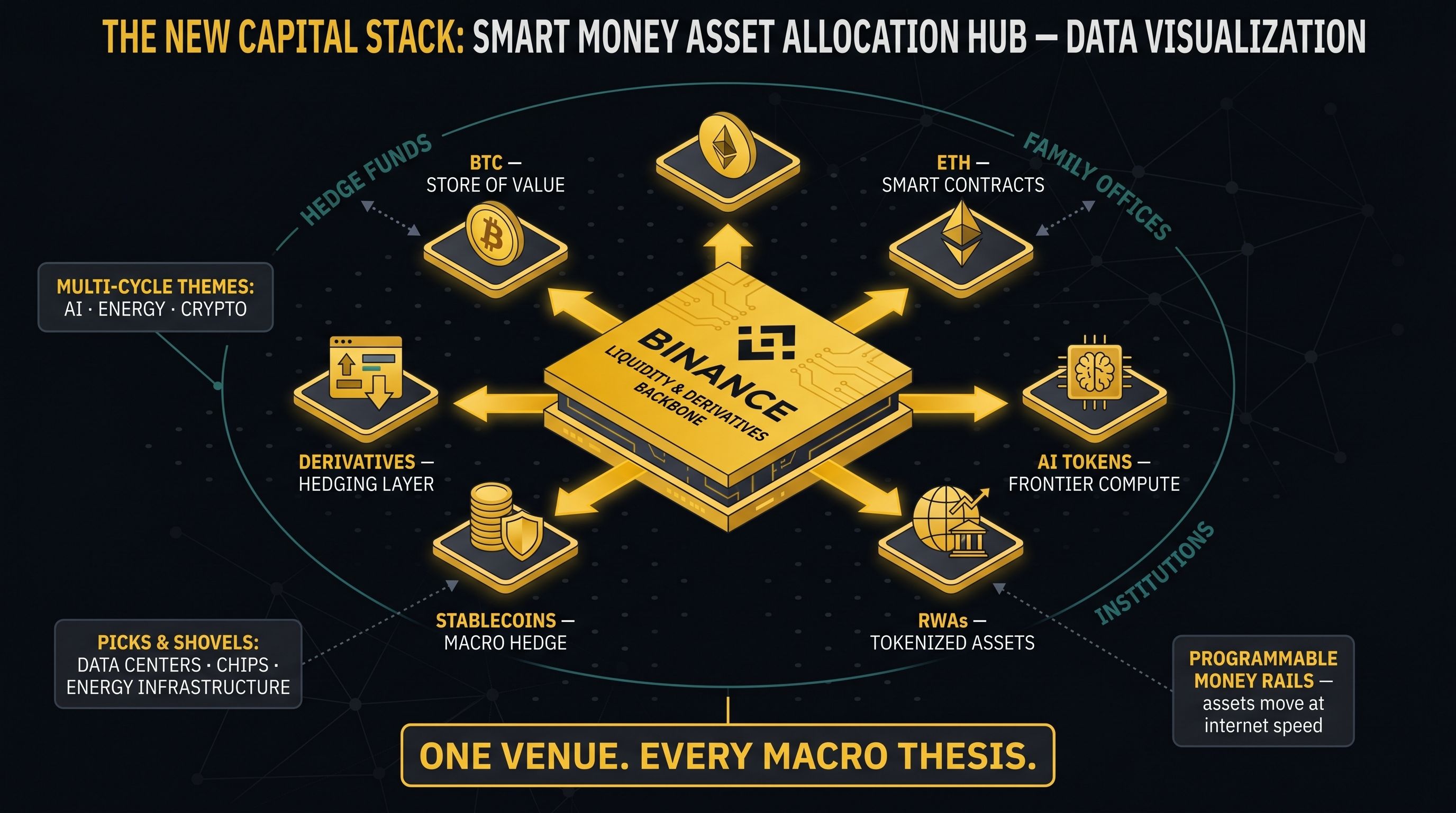
If you’re a fund manager, the idea of having tokenized money‑market exposure in regulated custody, Bitcoin and stablecoins as macro plays, and a deep derivatives market on Binance to hedge and express views is incredibly powerful.Binance essentially sits at the point where “smart money” can translate big macro theses—AI boom, rate cycles, de‑dollarization fears—into actual positions and hedges. AI + Crypto: From Hype to Actual WorkflowsOne of the most forward‑looking threads across the event was the intersection of blockchain, AI, and frontier tech, highlighted in Ella Zhang’s segment and echoed throughout the agenda.The thesis is simple: if AI agents are going to act on our behalf, they’ll need a neutral, programmable finance layer to hold assets, pay for compute, and settle with other agents—and blockchains are the natural substrate.Binance is already poking at this future with Binance AI Pro, an AI assistant embedded directly into the trading experience.Early user reports show it’s particularly strong at synthesizing information—volume, sentiment, technical structure—into a coherent case for or against a trade, rather than just barking out isolated signals.
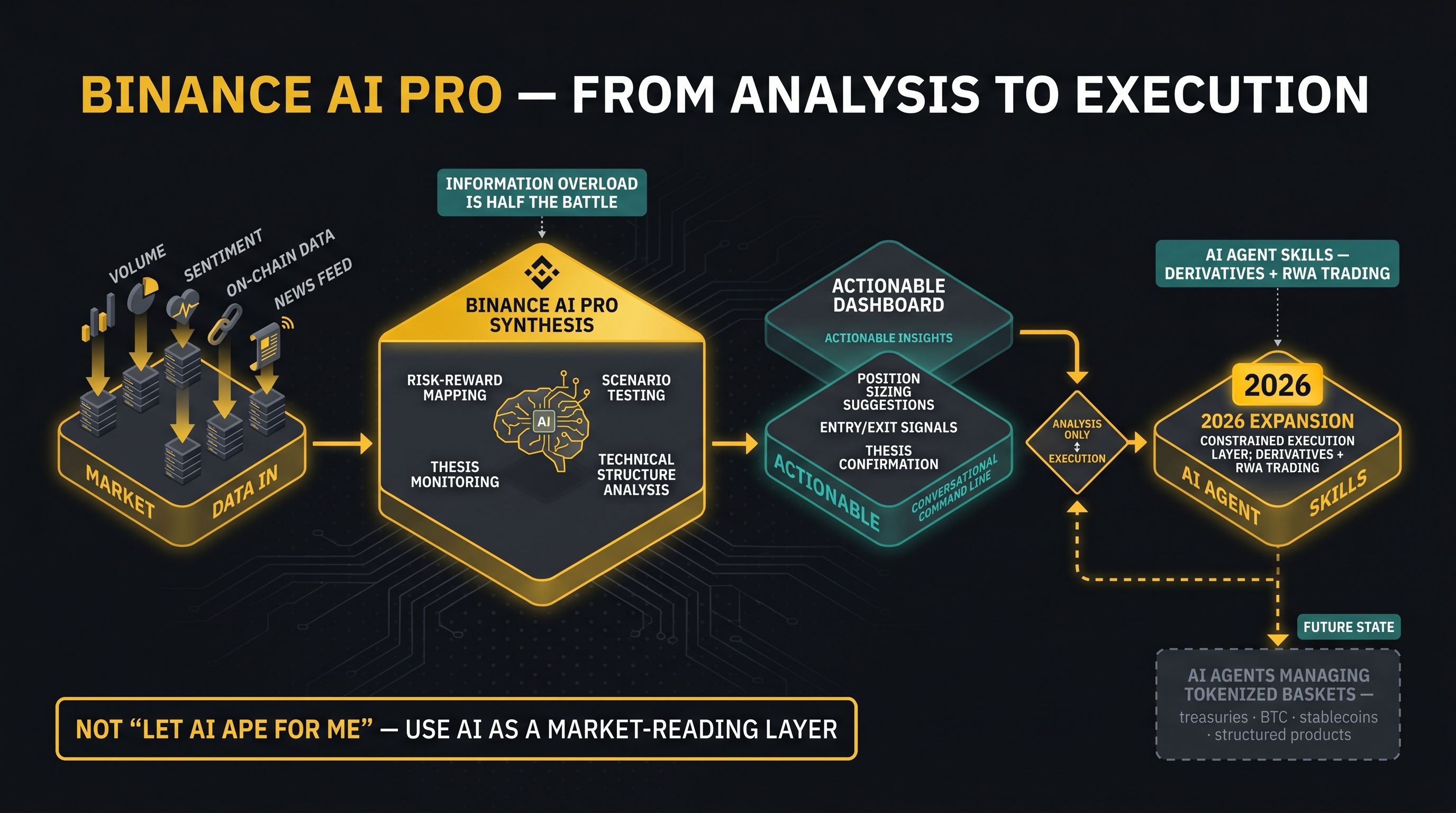
More importantly, in 2026 Binance has begun expanding “AI Agent Skills” across derivatives and RWA trading, so these AI workflows can eventually move from analysis to constrained execution in a controlled environment.If you’re a serious trader, the most underrated use case isn’t “let the AI ape for me,” but using AI Pro as a market‑reading and scenario‑testing layer:you can ask it to map out risk‑reward across several assets, monitor conditions against your thesis, or translate dense on‑chain and news data into an actionable dashboard—all without leaving Binance.In a world where information overload is half the battle, turning Binance into a conversational command line for markets is a subtle but huge upgrade.Combine that with tokenization and you start to glimpse the endgame: AI agents managing baskets of tokenized treasuries, BTC, stablecoins, and structured products, rebalancing and hedging through Binance’s derivatives and on‑chain rails. Bitcoin, Layers, and the Long GameNo serious “future of crypto” event would be complete without talking about Bitcoin’s role in all this—and Adam Back delivered that perspective in the “Why We’re All Satoshi” slot.Back has long argued that Bitcoin is evolving into a kind of monetary base layer: slow, conservative, and maximally robust, with innovation pushed to higher layers like sidechains and Layer‑2 networks.
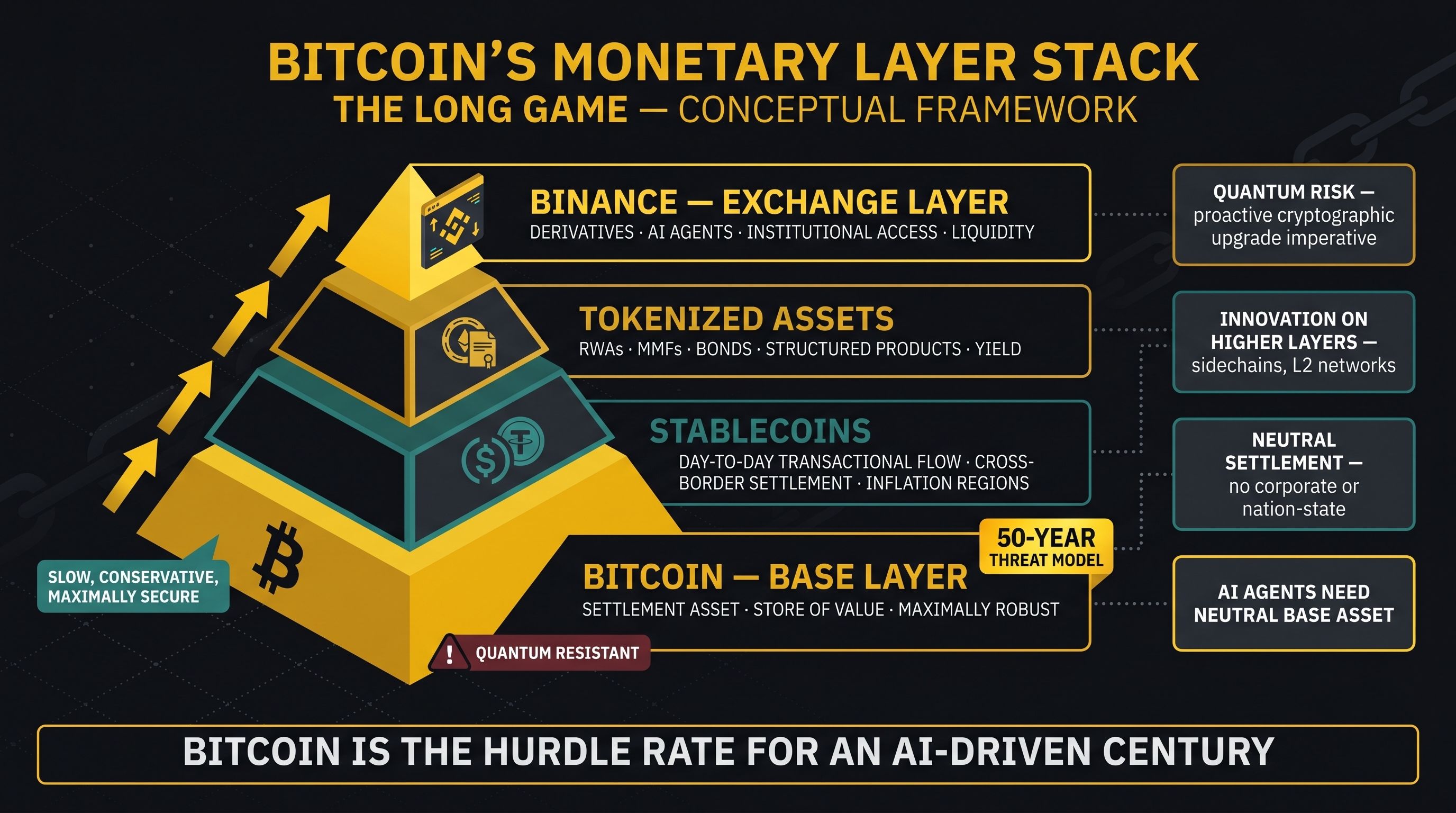
That view fits neatly with everything else discussed at Binance Online.If tokenized treasuries, MMFs, and RWAs are going to be traded 24/7, and if AI agents are going to need a neutral settlement asset with no corporate or nation‑state behind it, Bitcoin remains the obvious candidate—even as stablecoins dominate day‑to‑day transactional flow.Back also repeatedly flags quantum risk and the importance of proactive cryptographic upgrades—a reminder that if Bitcoin is going to be the “hurdle rate” for an AI‑driven century, it has to be engineered with a 50‑year threat model in mind, not just the next cycle.For Binance, this long‑game framing is already reflected in its product mix: BTC at the core of spot and derivatives, layers of stablecoins for liquidity, and emerging support for tokenized products and institutional collateral on top.It’s essentially a stack: Bitcoin as store‑of‑value base, stablecoins as money, tokenized assets as yield, and Binance as the exchange and infrastructure layer tying it together. Why This Summit Actually MattersCrypto conferences and online events can often feel like a blur of slogans and ticker talk. Binance Online 2026 was different because it stitched together the pieces into a coherent roadmap:
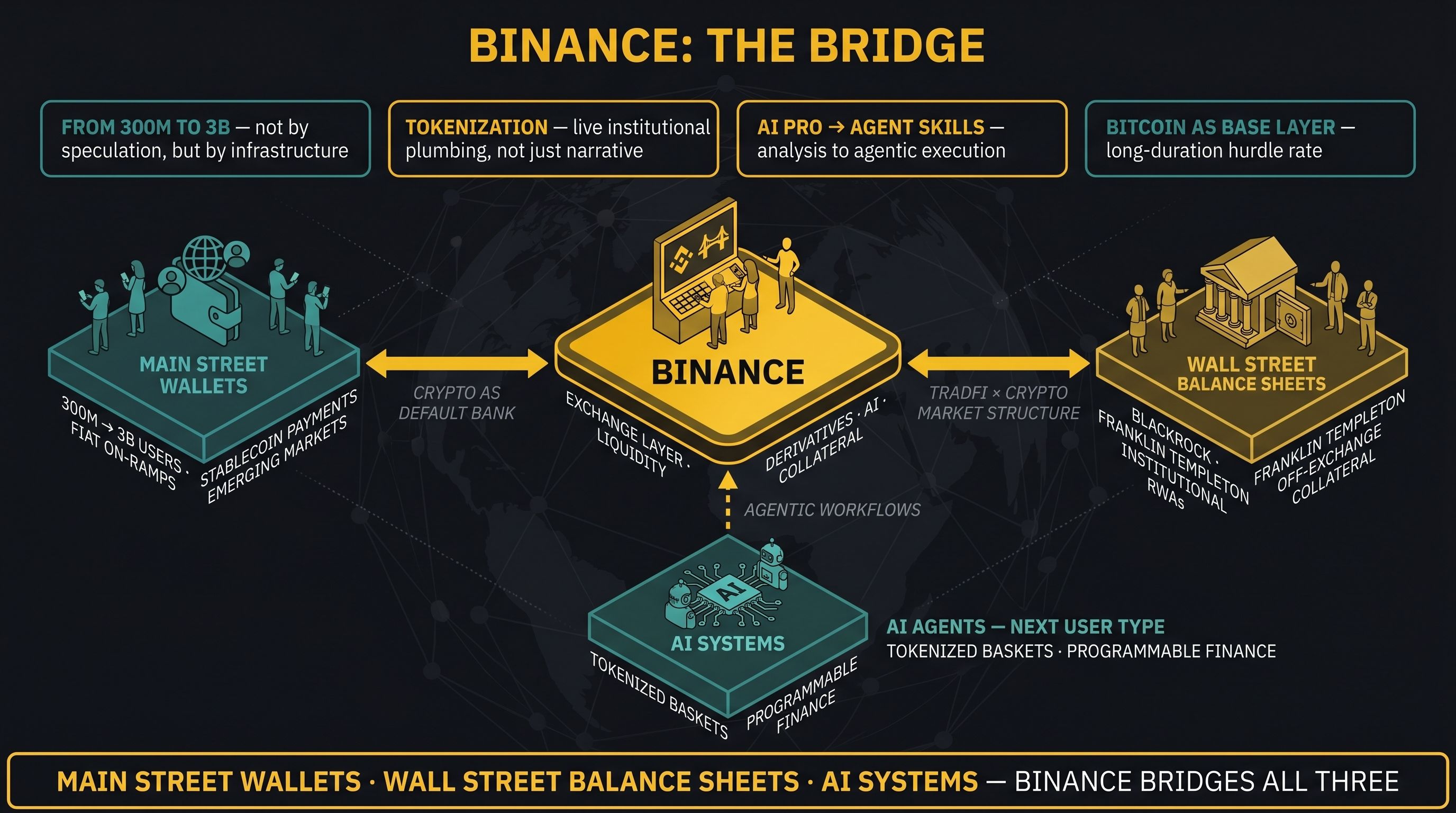
From 300M to 3B users: not by chasing speculative mania, but by making crypto a better default than local banks for billions of people. From “tokenization story” to live institutional plumbing: regulated MMFs as off‑exchange collateral, RWAs on BNB Chain, and institutional‑grade access to on‑chain markets. From AI hype to agentic workflows: Binance AI Pro as a real tool for traders today, and AI Agent Skills as the bridge to fully agent‑aware market infrastructure tomorrow. From Bitcoin as trade to Bitcoin as base layer: a long‑duration asset underpinning everything from tokenized funds to AI‑native treasuries.
If you’re a builder, there’s a clear message: design for a world where wallets are default, tokenized assets are normal, and your users might be AI agents as often as humans.If you’re a trader or investor, the takeaway is just as clear: the edge is shifting from picking the next meme to understanding how these layers—Bitcoin, stablecoins, RWAs, AI, and exchanges like Binance—interlock into a new financial stack.And if you’re simply crypto‑curious, Binance Online 2026 showed that this isn’t just an industry trying to survive the next cycle.It’s an industry quietly wiring itself into the core of global markets—with Binance positioning itself as the bridge between Main Street wallets, Wall Street balance sheets, and the AI systems that will increasingly sit between them.