
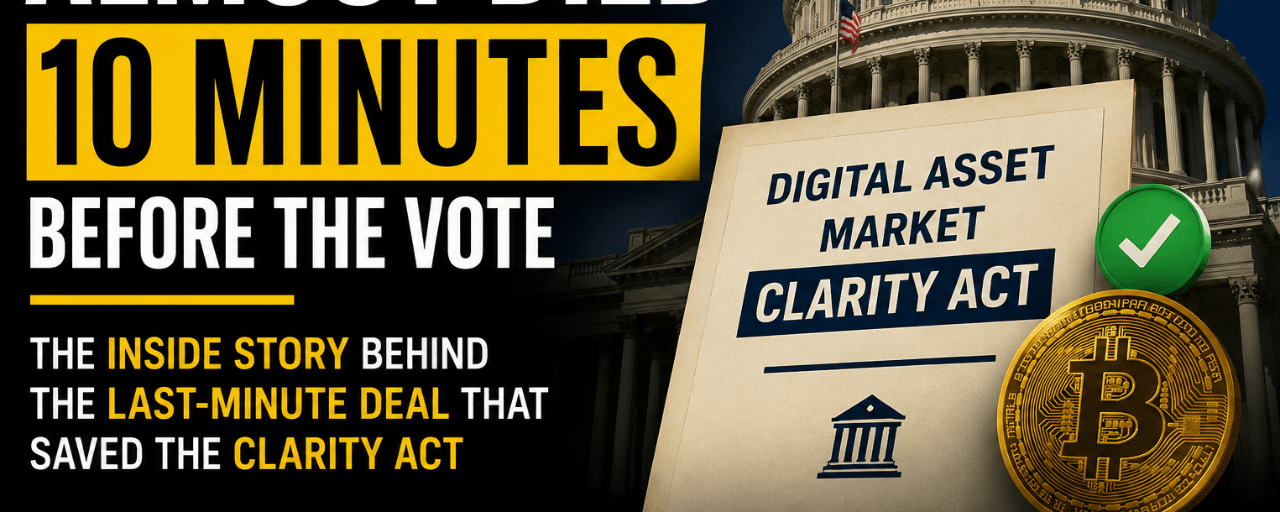
For years, one of the biggest problems facing the global crypto industry has not been technology.
It has been regulation.
More specifically, the lack of clarity around a simple question:
When is a crypto token a security, and when is it just a digital commodity?
In the United States, that question has triggered lawsuits, exchange delistings, enforcement actions, banking restrictions, and billions of dollars in uncertainty across the digital asset industry.
Now, the U.S. Senate is attempting to change that.
A newly proposed legislative framework known as the Digital Asset Market Clarity Act seeks to establish one of the most comprehensive crypto regulatory structures ever proposed in the United States.
And if enacted, it could fundamentally reshape how crypto businesses, token issuers, exchanges, DeFi protocols, stablecoin issuers, and software developers operate in the U.S.
But what exactly is this bill about?
And why is the global crypto industry paying close attention to it?
The Real Problem the Bill Is Trying to Solve
For over a decade, the U.S. crypto market has operated in a regulatory grey zone.
The SEC has repeatedly argued that many crypto tokens are securities under the traditional Howey Test, while the crypto industry has pushed back, arguing that many blockchain tokens function more like commodities, network utilities, or decentralized assets.
The result?
A fragmented environment where:
Exchanges do not know which tokens can legally be listed.
Token issuers struggle to determine whether they are issuing securities.
Developers fear liability for publishing code.
DeFi projects face uncertainty regarding AML obligations.
Banks remain cautious about crypto exposure.
Investors lack clarity regarding customer protections and insolvency rights.
The Digital Asset Market Clarity Act is essentially an attempt to create a formal statutory framework that separates:
Securities
Digital commodities
Network tokens
Investment contracts involving tokens
Instead of relying solely on decades-old securities law principles.
A Shift Away From “Regulation by Enforcement”
One of the most important aspects of this bill is philosophical.
The bill appears to acknowledge that applying traditional securities law to all digital assets may not always work effectively.
Instead of relying primarily on lawsuits and enforcement actions, the legislation attempts to create:
Defined categories of digital assets.
Clear regulatory jurisdiction.
Disclosure obligations tailored to crypto projects.
Rules for secondary market trading.
Standards for decentralization.
Coordinated oversight between the SEC and CFTC.
In other words, the bill is trying to build a modern market structure law specifically for digital assets.
The SEC vs. CFTC Debate — Finally Addressed?
One of the largest regulatory battles in the U.S. crypto sector has been determining which regulator should oversee crypto spot markets.
The proposed framework attempts to split responsibilities mainly between:
The Securities and Exchange Commission (SEC); and
The Commodity Futures Trading Commission (CFTC).
The SEC’s Role
The SEC would continue regulating certain token offerings, especially where token value depends on the entrepreneurial or managerial efforts of founders or centralized teams.
The bill introduces the concept of an “ancillary asset”, which refers to a network token whose value depends on the efforts of an originator or related persons.
This is important because the bill effectively recognizes that:
A token sale may involve an investment contract even if the token itself may later function as a non-security.
That distinction is one of the most significant policy shifts in the entire proposal.
The CFTC’s Role
The CFTC would gain stronger authority over digital commodity spot markets and intermediaries dealing in digital commodities.
This would likely include:
Crypto exchanges
Brokers
Dealers
Trading venues
Certain custodians
The bill repeatedly emphasizes SEC–CFTC coordination, joint rulemaking, and inter-agency cooperation.
The Most Important Concept: “Network Tokens”
Perhaps the most groundbreaking part of the bill is the introduction of the term “network token.”
Under the proposal, a network token is essentially a digital commodity intrinsically linked to a blockchain network and expected to derive value from the use of that distributed ledger system.
However, the bill also clearly states what a network token cannot be.
A token would not qualify if it effectively represents:
Equity interests
Debt rights
Dividend rights
Profit-sharing arrangements
Liquidation rights
Interests in investment companies or pooled asset structures
This is extremely important because it creates a potential legal separation between:
Token Type
Likely Treatment
Utility/network token
Potential non-security
Tokenized equity
Security
Profit-sharing token
Security
Debt-based token
Security
Decentralized governance token
Potentially commodity-like
For crypto founders, this could become one of the most significant legal distinctions in the U.S. market.
Secondary Market Trading Could Finally Become Clearer
Another major issue the bill attempts to address is secondary market trading.
Currently, many exchanges fear that listing certain tokens could expose them to allegations of facilitating securities trading.
The proposed legislation states that, under certain conditions, secondary market sales of qualifying network tokens would not be treated as securities transactions.
That could have enormous implications for:
Centralized exchanges
Broker-dealers
Market makers
Custodians
Liquidity providers
Institutional trading platforms
If implemented properly, this may significantly reduce uncertainty around token listings in the United States.
Crypto Projects Would Face Extensive Disclosure Obligations
While the bill provides pathways for network tokens to avoid full securities treatment, it does not eliminate regulatory obligations.
Instead, it introduces extensive disclosure requirements for token originators.
The required disclosures may include:
Corporate information
Financial statements
Management details
Token supply mechanics
Governance structures
Risk factors
Token distribution history
Market support activities
Token ownership concentrations
Code audits
Custody information
Technical infrastructure details
Development timelines
Decentralization roadmaps
In many ways, the proposal attempts to create a crypto-specific disclosure framework that sits somewhere between:
Traditional securities disclosure; and
Pure commodity regulation.
This could become particularly relevant for token issuers seeking U.S. market access.
The Bill Also Targets DeFi
The DeFi sections are especially interesting.
Contrary to what some may expect, the bill does not simply exempt DeFi from regulation.
Instead, it attempts to distinguish between:
Truly decentralized systems; and
Non-decentralized protocols operating like intermediaries.
The legislation calls for rulemaking regarding how existing securities intermediary obligations and Bank Secrecy Act requirements should apply to certain DeFi trading protocols.
The bill also includes provisions relating to:
Digital asset mixers
Cybersecurity programs
Offshore stablecoins
Messaging systems
Foreign intermediary risks
Financial stability studies
AML/CFT controls
This suggests that U.S. lawmakers are increasingly focused on DeFi infrastructure rather than only centralized exchanges.
Stablecoin Yield Products May Face Restrictions
The bill also addresses stablecoins.
One particularly notable provision seeks to prohibit interest or yield payments on payment stablecoins in certain circumstances.
This appears designed to prevent stablecoin products from functioning like unregulated bank deposits or yield-bearing savings accounts.
The bill also targets misleading stablecoin marketing claims, especially representations suggesting that stablecoins are:
Government-guaranteed
FDIC-insured
Risk-free
Equivalent to bank deposits
This reflects broader U.S. concerns around shadow banking and financial stability.
Software Developers Receive Important Attention
One of the most controversial issues in crypto regulation globally is whether software developers can be held liable merely for publishing or maintaining code.
The bill contains an entire title dedicated to:
Protecting software developers
Blockchain regulatory certainty
Self-custody rights
NFT safe harbor provisions
This is particularly significant because many developers fear that writing code could expose them to money transmission or securities-related liability.
The proposal appears to acknowledge that publishing software is fundamentally different from operating a regulated financial intermediary.
Customer Asset Protection and Bankruptcy
Following several high-profile crypto collapses, including exchange insolvencies, customer asset protection has become a major policy issue globally.
The bill addresses:
Customer property protections
Insolvency treatment
Bankruptcy safe harbors
Asset segregation frameworks
This could become critically important for exchanges, custodians, lenders, and institutional investors operating in the U.S. market.
Why This Matters Globally — Not Just in America
Even though this is a U.S. legislative proposal, its implications are global.
The United States remains one of the world’s most influential financial markets.
If the bill progresses, it could influence how other jurisdictions structure:
Token classification frameworks
Exchange regulation
Stablecoin oversight
DeFi supervision
Developer protections
Custody standards
AML/CFT expectations
In many ways, this proposal reflects a growing international trend:
Regulators are slowly moving away from asking whether crypto should exist, and are instead focusing on how it should be regulated.
Final Thoughts
The Digital Asset Market Clarity Act is not a simple crypto licensing bill.
It is an attempt to redesign how digital assets are legally categorized, supervised, traded, disclosed, and protected in the United States.
Whether the bill eventually passes in its current form remains uncertain.
But one thing is already clear:
The global conversation around crypto regulation is evolving rapidly.
And increasingly, lawmakers are recognizing that digital assets may require dedicated legal frameworks rather than forcing every blockchain innovation into regulatory models created decades before crypto even existed.
For crypto businesses, exchanges, token issuers, DeFi protocols, and investors, understanding these developments is no longer optional.
It is becoming a strategic necessity.
This article is provided for informational and educational purposes only and does not constitute legal advice. Regulatory treatment of digital assets varies across jurisdictions and remains subject to legislative and regulatory developments.