


The charts were bleeding a deep, aggressive red. It was late March, right around the time the market had to absorb a staggering $14 billion Bitcoin options expiry.
My inbox was overflowing with panic. Mentions on the feed were screaming about "the end of the bull run." Retail traders were frantically cutting losses at the exact bottom, driven by pure, unadulterated emotion.
I sat back, sipped my coffee, and smiled.
To the untrained eye, it looked like chaos. But to anyone who understands the deep structural architecture of blockchain markets, it wasn't a crash. It was a beautiful, calculated liquidity reset.
If you are tired of being the liquidity for institutional players, it is time to change how you look at the game. Let’s dismantle the noise and look at the exact frameworks required to build consistent, sustainable trading profits.
Market Structure Over Market Hype
Most retail traders treat the crypto market like a casino, chasing whatever microcap token is trending on social media. They buy the top of the hype cycle and act as exit liquidity for the builders and early allocators.
Smart money doesn't care about hype. Smart money tracks capital rotation and network infrastructure.
The market moves in structural waves. When liquidity flushes out the over-leveraged long positions, it leaves behind a clean slate. The traders who win consistently are the ones who stop looking at the 5-minute candle charts and start looking at where the actual foundation is being built.
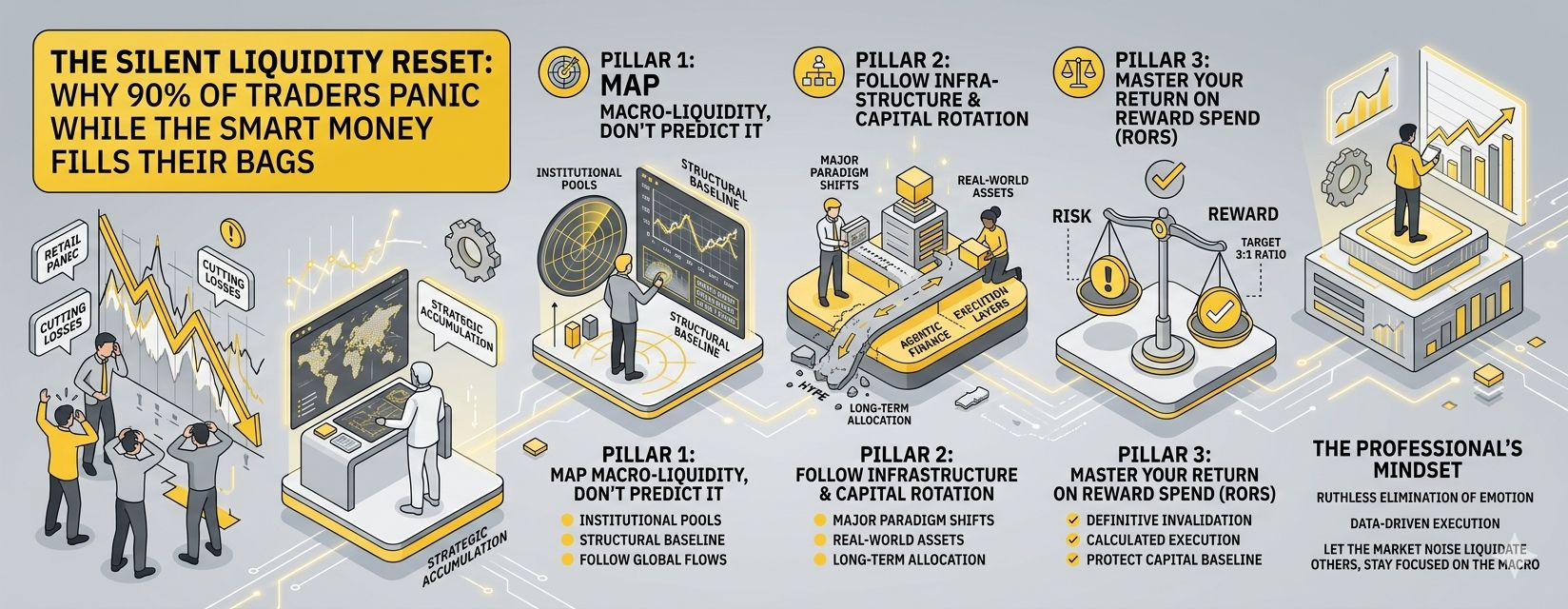
The 3 Pillars of a Profitable Trading Framework
To survive and dominate a full market cycle, your strategy must transition from speculative gambling to systematic execution. Here are the three pillars that separate the professionals from the tourists.
1. Map Macro-Liquidity, Don't Predict It
Stop trying to guess the exact bottom. Instead, map out the major institutional liquidity pools and support floors.
Look for areas where massive options expiries or ETF inflows have established a structural baseline.
When the market experiences a sharp correction, look for asset classes showing relative strength—those are the sectors big capital will pump first when the bounce occurs.
2. Follow Infrastructure and Capital Rotation
Chasing fleeting trends will eventually drain your portfolio. True wealth in this space is generated by identifying major paradigm shifts early.
The Trend Shift: We are moving rapidly toward institutional real-world asset (RWA) tokenization and agentic finance.
The Strategy: Position yourself in protocols that provide the foundational architecture—the execution layers, verification networks, and privacy infrastructure that institutions actually require to deploy capital.
3. Master Your Return on Reward Spend (RORS)
Every trade is an allocation of capital and risk. If you risk $1 to make $1, you are playing a losing game over the long run.
Never enter a trade without a definitive invalidation point (your stop loss).
Target setups that offer at least a 3:1 Reward-to-Risk ratio. This means even if you are wrong 60% of the time, your winning trades will keep you deeply profitable.
The Professional's Mindset: A market correction is not an emotional crisis; it is a mechanical transfer of wealth from the impatient to the patient.
The Hard Truth of Long-Term Success
The secret to highly profitable trading isn’t a secret indicator or a magical trading bot. It is the ruthless elimination of emotional bias.
When the market washes out, the crowd looks at their losses. The professional looks at the data, identifies the structural shifts, and calmly executes their plan. Treat trading like a business, protect your capital baseline at all costs, and let the market noise liquidate everyone else while you stay focused on the macro structure.
What is your strategy during a major liquidity reset? Are you buying the structural support or waiting for a macro confirmation? Let's talk in the comments below 👇
#CryptoAnalysis #TradingStrategies #Write2Earn #MacroLiquidity