


For years, the United States treated crypto regulation like a problem it could postpone.
Regulators sued exchanges. Lawmakers held hearings. Agencies argued over jurisdiction. Courts tried to interpret laws written decades before blockchains existed. Meanwhile, the industry kept growing anyway — messy, speculative, global, impossible to fully contain.
Now Congress is trying something different.
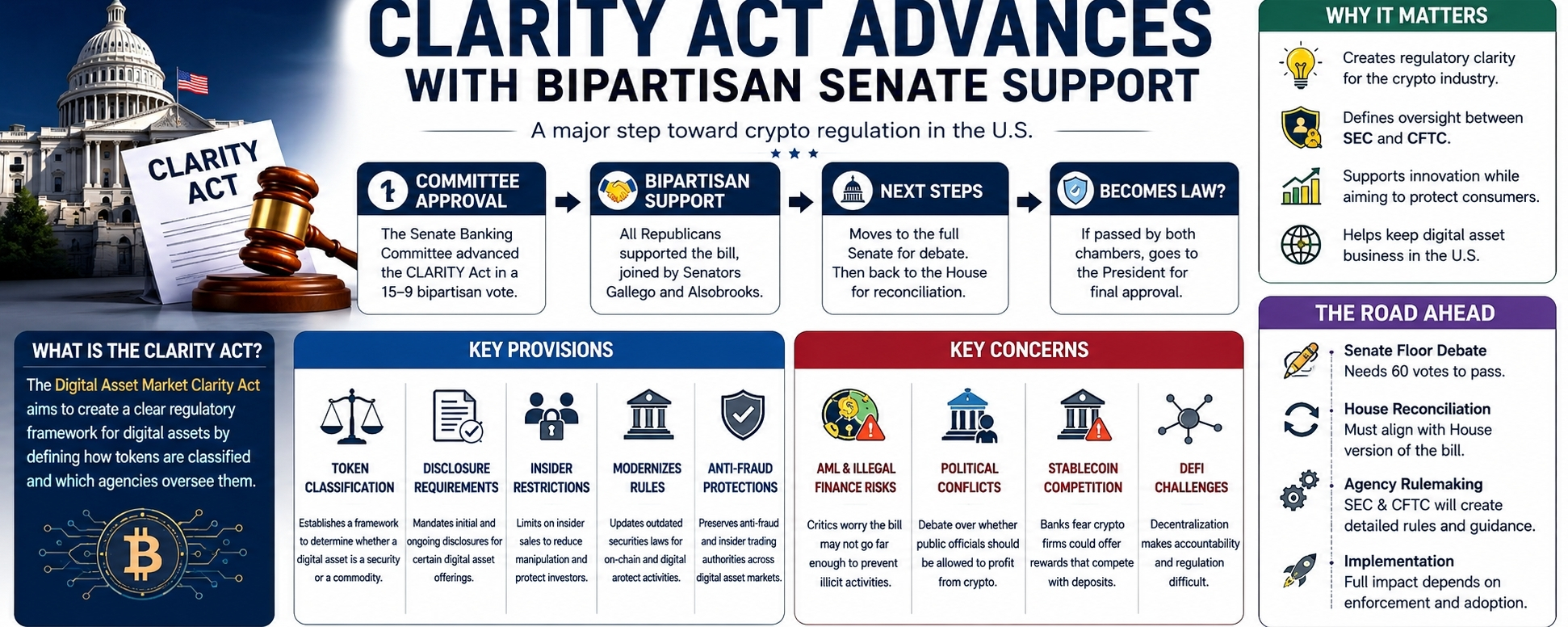
The CLARITY Act, one of the most important crypto market structure bills introduced in the United States, has advanced through the Senate Banking Committee with bipartisan backing. That alone is significant. Not because the bill is guaranteed to become law, but because Washington is finally moving from reactive enforcement to actual framework-building.
And that changes the conversation.
The debate is no longer whether crypto should exist. The debate is about who controls its rules, who benefits from them, and whether the U.S. financial system can absorb digital assets without importing all of crypto’s chaos alongside them.
That is the real story behind the CLARITY Act.
Crypto’s Biggest Problem Was Never Technology
It Was Uncertainty.
For years, crypto companies in the United States operated inside a strange legal gray zone.
A token could be considered a commodity one day and an unregistered security the next. An exchange could spend years trying to comply with regulations without ever receiving a clear answer on what compliance actually looked like. Startups were expected to follow rules designed for traditional financial products that did not map cleanly onto decentralized networks.
The result was predictable.
Projects moved offshore. Investors operated in confusion. Regulators relied heavily on enforcement actions because formal legislation never arrived. Instead of clear rules, the industry got lawsuits, settlements, and contradictory interpretations.
And eventually, even policymakers who disliked crypto had to acknowledge the obvious: ambiguity was not producing stability.
It was producing fragmentation.
The CLARITY Act is Congress attempting to fix that fragmentation by building an actual legal structure around digital assets.
Not a perfect structure.
Not a universally accepted structure.
But a structure nonetheless.
What the CLARITY Act Actually Tries To Do
At its core, the bill tries to answer one deceptively simple question:
What exactly is a crypto asset under U.S. law?
That question sounds technical until billions of dollars depend on the answer.
If a token is classified as a security, it falls under the SEC’s authority. That means stricter disclosure requirements, registration obligations, and securities law oversight.
If it is treated more like a commodity, the CFTC becomes more relevant, and the regulatory environment changes dramatically.
This distinction has shaped nearly every major crypto battle in America over the last several years.
The CLARITY Act attempts to draw cleaner lines between these categories while creating disclosure standards specifically designed for digital assets. The idea is to stop forcing blockchain-based systems into legal frameworks originally designed for stocks and traditional investment contracts.
Supporters argue this gives companies a path to compliance.
Critics argue it creates loopholes.
Both sides have a point.
Why Bipartisan Support Matters More Than People Think
Crypto regulation has become politically awkward in Washington.
Some Republicans frame digital assets as innovation being suffocated by overregulation. Some Democrats view parts of the industry as speculative systems built around weak consumer protections and aggressive lobbying power.
That divide made bipartisan movement difficult.
Which is why the Senate Banking Committee vote matters.
A bipartisan committee advance signals something important: enough lawmakers from both parties now believe crypto markets require formal rules rather than indefinite legal improvisation.
That does not mean there is broad agreement on what those rules should look like.
Far from it.
Even some Democrats who supported advancing the bill made it clear they still have serious concerns around anti-money-laundering controls, political conflicts of interest, and investor protection.
In other words, the coalition supporting the bill is conditional.
The support exists because many lawmakers now agree the current system is unsustainable — not because they suddenly trust the crypto industry.
That distinction matters.
The Industry Wants “Clarity” For An Obvious Reason
Large-scale capital hates uncertainty.
Banks hate uncertainty.
Public companies hate uncertainty.
Institutional investors especially hate uncertainty.
No major financial institution wants to build long-term infrastructure around assets that might later be reclassified under a completely different regulatory regime. Legal unpredictability slows adoption more effectively than almost any market downturn.
The crypto industry understands this.
That is why market structure legislation became one of its biggest lobbying priorities.
Without legal clarity, crypto remains speculative infrastructure. With legal clarity, it becomes easier to integrate into traditional finance, payment systems, custody platforms, and institutional portfolios.
That is the real prize.
Not just survival.
Normalization.
And normalization is incredibly valuable.
But There’s A Problem Nobody Wants To Fully Admit
Crypto’s history makes trust difficult.
This industry has produced innovation, yes.
But it has also produced exchange collapses, insider token allocations, misleading decentralization claims, governance manipulation, rug pulls, leverage blowups, and retail investors discovering too late that “community-owned” systems were often controlled by small insider groups.
That history changes how every crypto bill gets evaluated.
Critics worry the CLARITY Act could accidentally legitimize weak structures by giving them regulatory recognition before the underlying market behavior improves.
And honestly, that concern is reasonable.
Because one of crypto’s oldest patterns is transforming unresolved risk into sophisticated legal language.
A project calls itself decentralized while governance remains concentrated.
A token claims utility while functioning mainly as speculation.
An exchange claims transparency until liquidity disappears.
The industry has often moved faster than accountability.
That is exactly why lawmakers remain divided.
The Most Important Fight Isn’t About Bitcoin
It’s About Financial Power.
Buried underneath the legal language is a much larger struggle over who controls the next generation of financial infrastructure.
Banks see stablecoins as potential competitors to deposits.
Payment companies see blockchain networks as settlement infrastructure.
Crypto firms want direct access to markets traditionally controlled by financial intermediaries.
Meanwhile regulators worry about systemic risk, illicit finance, and what happens when highly interconnected digital markets fail at scale.
The CLARITY Act sits directly in the middle of that conflict.
This is no longer a niche internet policy debate.
It is a battle over financial architecture.
And everyone involved knows it.
DeFi Is Still The Hardest Problem
Traditional regulation depends on identifiable intermediaries.
Banks have operators.
Brokerages have executives.
Stock exchanges have legal entities.
DeFi complicates all of that.
A decentralized protocol might be governed by token holders spread across multiple countries. Control may exist socially rather than legally. Responsibility may become intentionally diffuse.
That creates a serious regulatory dilemma.
Who becomes accountable when something breaks?
The developers?
The validators?
The governance token holders?
The interface operators?
Nobody has fully solved this problem yet — including the CLARITY Act.
And that is important because decentralized systems are where many of crypto’s biggest unresolved legal questions still exist.
Not at the edges.
At the core.
The Real Test Comes After The Headlines
Even if the bill ultimately becomes law, the difficult part begins afterward.
Because legislation creates frameworks.
Regulators create operational reality.
The SEC and CFTC would still need to define rules, timelines, registration processes, disclosures, exemptions, and enforcement priorities. Lobbying would continue. Industry pressure would continue. Court challenges would continue.
That means “clarity” will not arrive overnight.
The market may celebrate legislative progress immediately, but actual regulatory implementation could take years.
And during that period, every definition will matter.
Especially the small ones.
Because financial systems are often shaped less by headlines than by technical wording buried inside rulebooks.
What This Moment Really Means
The CLARITY Act represents something larger than a crypto bill.
It represents Washington accepting that digital assets are no longer temporary.
The government is moving from asking whether crypto belongs inside the financial system to deciding how deeply integrated it should become.
That shift is historic.
But it is also dangerous if handled poorly.
A weak framework could legitimize instability.
An overly aggressive framework could push innovation offshore again.
Finding the balance is extraordinarily difficult.
And honestly, nobody should pretend otherwise.
The crypto industry wants freedom.
Regulators want control.
Investors want growth.
Consumers want protection.
Those goals do not naturally align.
The CLARITY Act is an attempt to force them into the same legal structure anyway.
Whether that structure ultimately strengthens the financial system or simply repackages old risks in modern language will depend on what happens next.
Not just in Congress.
But in the rules, incentives, and power struggles that follow after the bill becomes law.