
TON’s Rally Marks a Bigger Shift for the Ecosystem — and STON.fi Is Positioned at the Center
TON’s recent breakout is being read as more than a short-term market move. Market reports from last week described TON as climbing more than 90% in seven days, a surge that pushed the asset sharply higher and renewed attention across the broader TON ecosystem.
The most important catalyst was not just price, but trust. On May 4, Pavel Durov said Telegram would become TON’s largest validator, calling the move a way to strengthen decentralization while allowing other major players to join the validator set without the network becoming too centralized. That statement matters because Telegram is not a niche crypto platform; it is a global distribution layer with massive reach.
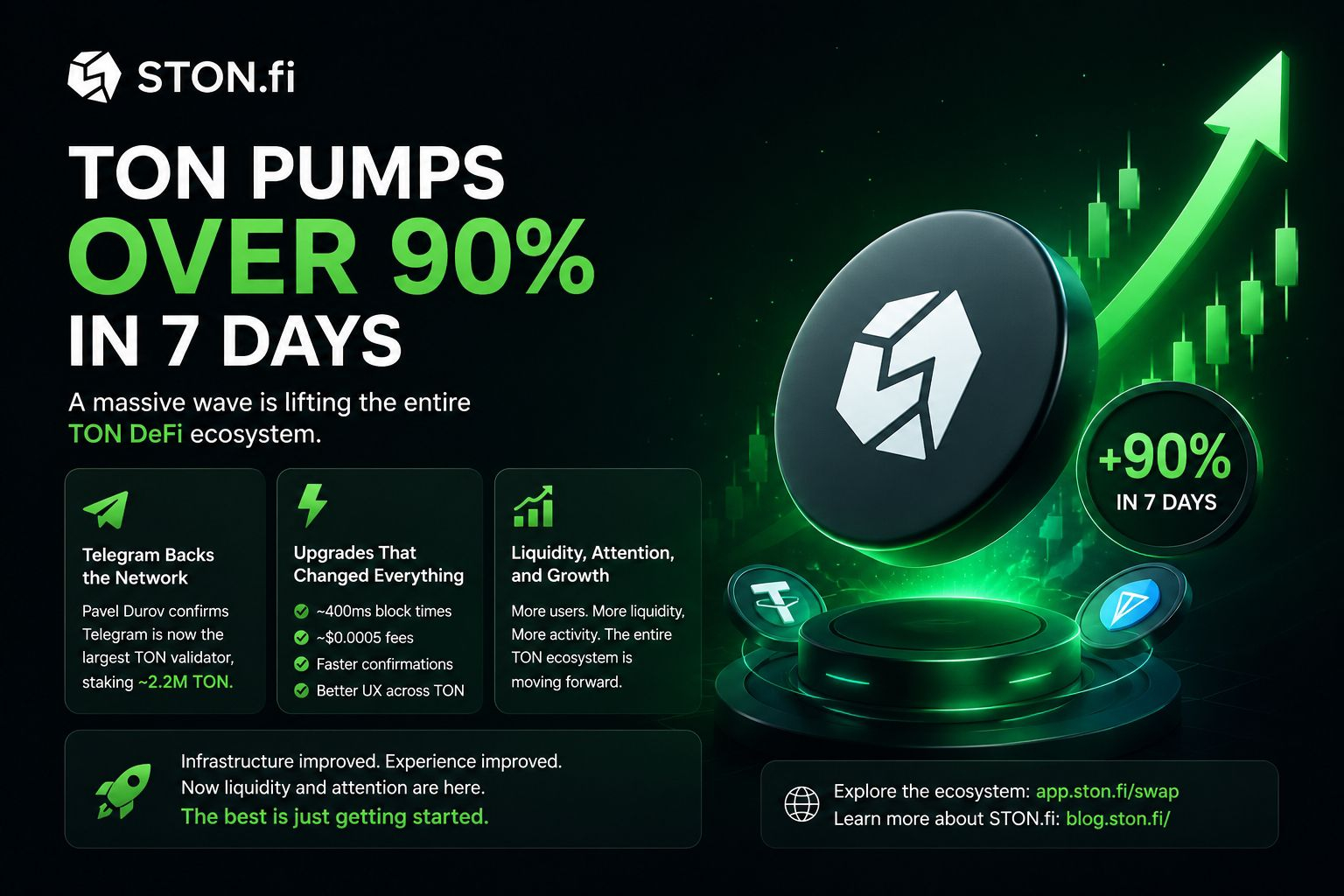
At the protocol level, TON has also made a meaningful leap in performance. TON’s official documentation and network announcement say Catchain 2.0 brought block times down to about 400 milliseconds, with finality improving to around one second. The result is a noticeably faster chain, one that is better suited to consumer-scale applications, trading, and high-frequency interaction.
Lower fees strengthen that story. STON.fi’s own blog says TON network fees fell to roughly $0.0005 per transaction, around 6× cheaper than before. STON.fi also describes the upgrade as improving everyday swaps with near-instant confirmations, which makes the network more practical for regular DeFi usage rather than only occasional transfers.
That is where STON.fi becomes especially relevant. The project positions itself as a leading DeFi app and protocol on TON, and its press room says it supports token swaps, yield farming, liquidity provision, and staking, with more than $6.3B in trading volume and 28M+ operations. In other words, it is already built to absorb the kind of activity that tends to follow a network upgrade and a wave of new attention.
STON.fi’s recent messaging also fits the current market setup. The protocol says its routing and swap infrastructure are designed to deliver efficient execution, and its recent posts highlight lower-cost swaps and improved UX on the back of TON’s faster, cheaper network. That matters because DeFi growth is rarely driven by one headline alone; it usually comes from a sequence: infrastructure improves, user experience improves, and liquidity follows.
That sequence is what makes the current TON moment interesting. Telegram’s deeper validator role adds credibility, TON’s technical upgrade improves usability, and STON.fi provides the liquidity layer where new capital can actually move. If the ecosystem continues to compound on those three fronts, STON.fi is well placed to benefit as TON users swap, farm, and route liquidity across a faster and cheaper network.
The bigger takeaway is simple: this rally is not only about momentum. It is about a blockchain ecosystem becoming more usable, more credible, and more commercially relevant at the same time. For TON, that is a far stronger story than price alone. And for STON.fi, it may be the start of a much larger role inside the network’s evolving DeFi stack.
Read and explore more about STONfi here: blog.ston.fi/
Explore the ecosystem: app.ston.fi/swap