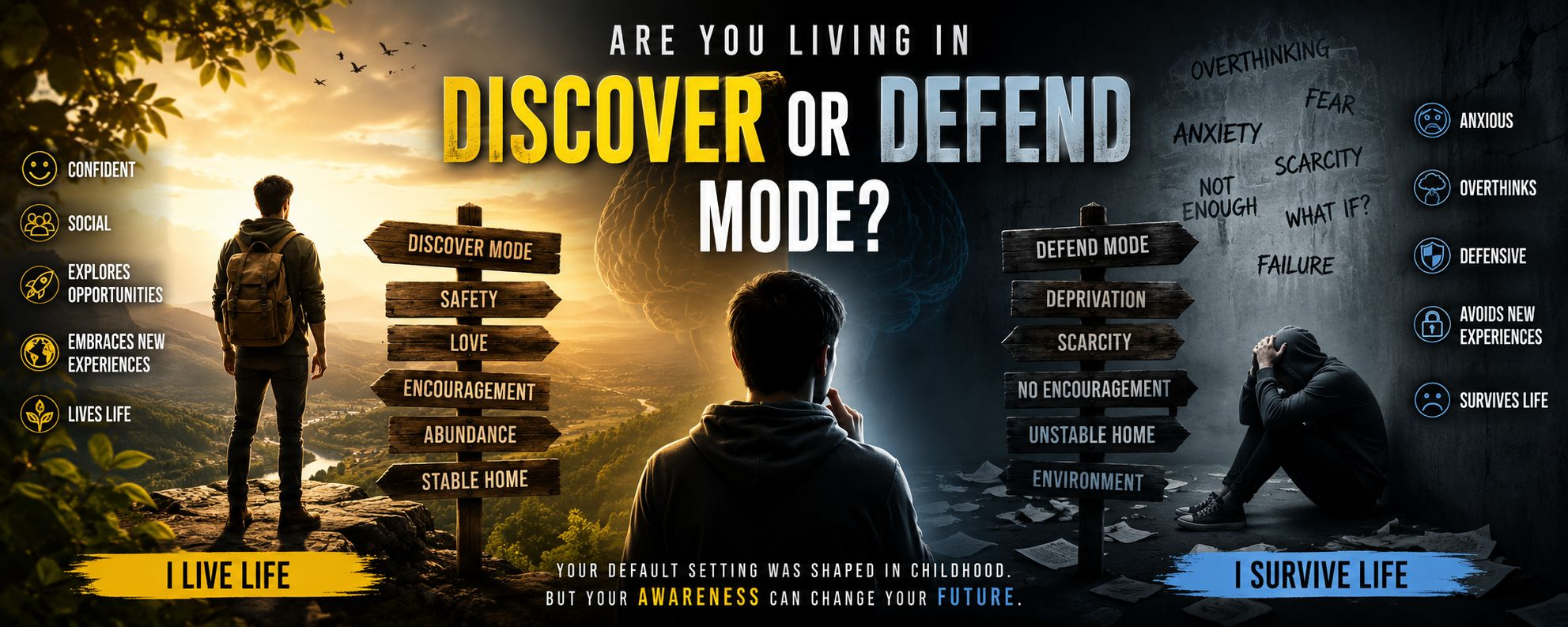
My friend, my class fellow, or my colleague — how are they so confident? Why do they get opportunities with a little effort that I still don’t get even after working hard? This is a question that is often asked and often comes into our minds. Jonathan Haidt tried to answer this and explain this dichotomy of human nature in his book The Anxious Generation through two modes: Discover Mode and Defend Mode.
Now what are these two modes?
If a person is confident, happy, social, explores new opportunities, and is not afraid of new experiences, then their default setting is Discover Mode.
On the other hand, if a person is afraid of new experiences, new people, and new places, stays anxious, overthinks everything, and remains defensive, then their default setting is Defend Mode. Meaning, their nervous system does not consider this world safe for them. They do not really live life — they only survive it.
The question is: when and how is this default setting decided?
Its foundation is formed during childhood and adolescence. If, during childhood, you received love, a safe environment, abundance, encouragement, and a stable household, then your default setting becomes Discover Mode.
But if you experienced deprivation, scarcity, and an environment where you could not grow or flourish, where there was no encouragement, then your default setting becomes Defend Mode.
An example of this is when you enter a room and, before even telling you consciously, your nervous system starts scanning for danger — asking whether you are safe there or not.
A mindset like this cannot become a growth mindset.
So take some time, observe yourself, and ask yourself honestly: are you living in Defend Mode or in Discover Mode?$EDEN