


For years, crypto investors loved telling the same story.
Bitcoin was supposed to be different. Independent. Detached from the old financial machine. A new monetary system built outside central banks, sovereign debt, and the politics of interest rates.
Then the bond market started shaking.
And suddenly, crypto looked far less isolated than many wanted to believe.
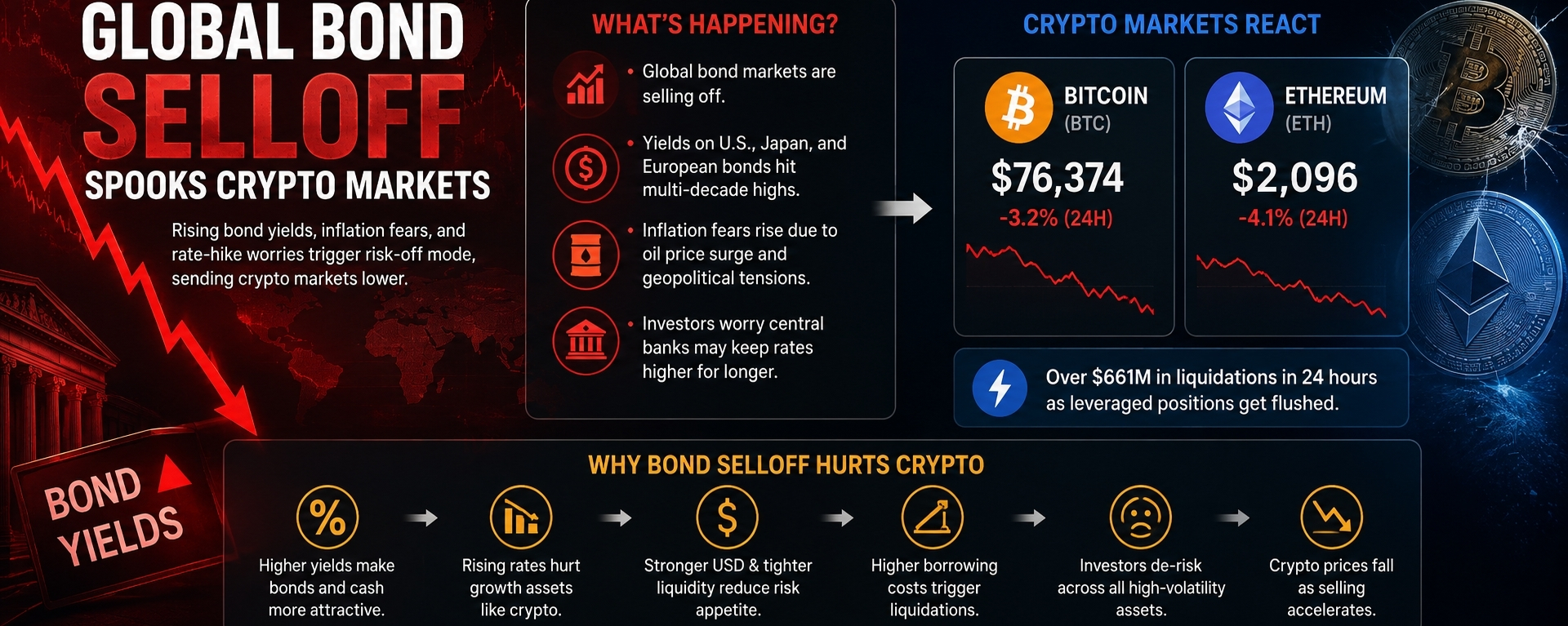
Across global markets, government bonds began selling off aggressively. Yields climbed higher in the United States, Europe, and Japan as investors reacted to inflation fears, rising oil prices, growing fiscal deficits, and uncertainty around central bank policy. The move was fast enough to unsettle nearly every major asset class.
Crypto was no exception.
Bitcoin slipped under pressure. Ethereum weakened. Altcoins bled harder. Liquidations surged across derivatives markets as leveraged positions unraveled in real time.
To outsiders, the reaction may have seemed strange.
Why would digital assets care about government bonds?
But that question only makes sense if crypto still exists in a separate universe.
It does not.
Not anymore.
The Market Nobody Can Ignore
The bond market rarely receives the same attention as stocks or crypto. It is not loud. It does not produce overnight millionaires or viral speculation.
But it quietly controls the foundation beneath modern finance.
Government bond yields influence borrowing costs, mortgage rates, corporate financing, equity valuations, and the flow of global liquidity. When bond markets move sharply, investors everywhere are forced to rethink risk.
That is exactly what happened.
As yields climbed, investors started asking uncomfortable questions:
Will inflation stay elevated longer than expected?
Will central banks delay interest rate cuts?
Could governments struggle under rising debt costs?
And perhaps most importantly:
Is too much money still sitting in risky assets?
Crypto immediately became part of that conversation.
Because despite all its revolutionary branding, the modern crypto market runs heavily on liquidity.
Cheap money helped build the last major crypto boom. Low interest rates pushed investors toward risk. Capital flooded into technology, startups, speculative assets, and digital currencies. In a world where cash earned almost nothing, investors searched aggressively for higher returns.
Crypto benefited massively from that environment.
But when bond yields rise, the entire equation changes.
Suddenly, safe assets begin offering attractive returns again.
The appetite for speculation weakens.
And highly volatile assets become harder to justify.
Crypto’s Identity Crisis
Bitcoin occupies a strange position during macroeconomic stress.
Its supporters often describe it as digital gold — a hedge against inflation, currency debasement, and irresponsible government spending.
In theory, rising concerns about debt and inflation should strengthen Bitcoin’s appeal.
But markets rarely move according to ideology alone.
In reality, Bitcoin often trades like a high-risk technology asset during periods of financial stress.
When liquidity dries up, investors do not always run toward Bitcoin.
Sometimes they sell it first.
That contradiction sits at the heart of crypto’s current identity crisis.
Is Bitcoin a safe haven?
Or is it simply another speculative asset that thrives when money is easy?
The answer, increasingly, appears to be both.
Over the long term, Bitcoin’s fixed supply and decentralized structure attract investors worried about the future of fiat systems.
But in the short term, Bitcoin still depends heavily on investor confidence, risk appetite, and liquidity conditions.
When bond yields rise sharply and markets become nervous, even strong long-term narratives struggle to hold prices up.
The Liquidity Machine Starts Reversing
The deeper issue is not simply interest rates.
It is liquidity.
Modern markets are interconnected through enormous flows of capital. Pension funds, hedge funds, banks, sovereign wealth funds, and asset managers constantly rebalance portfolios based on risk and return.
When government bond yields rise meaningfully, money begins moving.
Investors who previously felt forced into speculative trades suddenly have alternatives.
Why hold extremely volatile assets if safer instruments now generate competitive returns?
That shift may sound simple, but its consequences can be brutal.
Crypto markets are especially sensitive because they operate with significant leverage.
Traders borrow aggressively.
Derivatives dominate trading activity.
Positions become crowded.
And once prices begin falling, forced liquidations amplify the decline.
That is what makes crypto different from traditional markets.
Volatility in crypto does not merely reflect investor fear.
It often becomes mechanically self-destructive.
A price decline triggers liquidations.
Liquidations push prices lower.
Lower prices trigger more liquidations.
The cycle feeds itself.
During the latest selloff, billions in leveraged positions came under pressure as traders rapidly reduced exposure.
What began as a macroeconomic shock quickly evolved into a crypto-specific cascade.
Why Altcoins Suffer Even More
When markets panic, investors simplify.
That is why smaller cryptocurrencies often collapse harder than Bitcoin during risk-off periods.
Bitcoin at least benefits from institutional recognition and a relatively mature narrative.
Ethereum has utility through decentralized finance, stablecoin infrastructure, and staking.
But many altcoins rely almost entirely on momentum.
Their valuations depend on optimism, future promises, and speculative excitement.
When liquidity contracts, those narratives become fragile.
Investors stop asking which blockchain could dominate the future.
They start asking which positions they can exit fastest.
That transition is devastating for weaker assets.
Memecoins, low-liquidity tokens, and highly speculative ecosystems usually experience the worst damage during global financial stress.
And the problem becomes psychological as much as financial.
Crypto markets run heavily on sentiment.
Once confidence weakens, fear spreads quickly.
Retail traders disappear.
Volume dries up.
Social media optimism turns into panic almost overnight.
The same momentum that drives euphoric rallies works in reverse during corrections.
Japan’s Quiet Role in the Chaos
One of the less understood parts of the global bond story involves Japan.
For decades, Japan maintained extremely low interest rates.
That environment encouraged massive global borrowing and investment strategies built around cheap Japanese capital.
Money flowed from Japan into higher-yielding assets around the world.
Including crypto.
But as Japanese bond yields rise and the Bank of Japan slowly shifts away from ultra-loose monetary policy, global liquidity dynamics begin changing.
Investors who once searched abroad for returns may now find better opportunities at home.
That matters because financial markets are deeply connected.
Crypto does not exist outside those flows.
It reacts to them.
When global liquidity tightens, crypto often feels the pressure earlier and more violently than traditional assets.
Because unlike many markets, crypto trades nonstop.
There are no closing bells.
No overnight pause.
No time for emotions to cool.
Fear moves through crypto in real time.
Inflation Fears Return
The bond selloff also reflected growing concern that inflation may not disappear as quickly as markets hoped.
Rising energy prices, geopolitical tensions, and supply-side uncertainty have complicated the outlook for central banks.
For months, investors expected rate cuts and easier financial conditions.
Crypto markets partially priced in that optimism.
But if inflation remains stubborn, central banks may keep rates higher for longer.
That possibility changes everything.
High interest rates drain speculative energy from markets.
They reduce available liquidity.
They increase financing costs.
And they force investors to become more selective.
Crypto performs best when capital is abundant and risk-taking feels rewarding.
It struggles when investors become defensive.
The latest bond selloff reminded markets that inflation is still capable of reshaping the entire financial landscape.
Institutional Adoption Cuts Both Ways
Crypto enthusiasts once believed institutional adoption would stabilize the market.
To some extent, it has.
Large firms now hold Bitcoin.
Spot ETFs brought new pools of capital into digital assets.
Major financial institutions openly discuss tokenization, blockchain infrastructure, and stablecoins.
But institutional participation also changed crypto’s behavior.
As more professional investors entered the space, crypto became increasingly tied to broader macroeconomic trends.
That means digital assets now move alongside global risk sentiment more often than before.
When institutions reduce exposure across portfolios, crypto gets caught in the process.
In other words, crypto gained legitimacy.
But it also inherited Wall Street’s vulnerabilities.
That tradeoff is becoming impossible to ignore.
Stablecoins May Be the Real Survivors
Ironically, one part of crypto could actually benefit from higher interest rates.
Stablecoins.
As volatility spreads through the market, traders often move capital into dollar-backed stablecoins instead of exiting crypto entirely.
That keeps liquidity inside the ecosystem.
At the same time, many stablecoin issuers hold reserves in short-term government debt.
Higher yields can increase the income generated from those reserves.
While speculative tokens suffer during tighter financial conditions, stablecoin infrastructure quietly becomes more important.
That trend says something significant about crypto’s evolution.
The industry may still be volatile.
But beneath the speculation, digital dollar systems continue expanding.
The Bigger Reality
The latest crypto decline was not just about fear.
It was about dependency.
Crypto markets still depend heavily on global liquidity conditions.
They depend on investor confidence.
They depend on the broader financial system remaining stable enough for capital to flow freely into risk assets.
That reality frustrates people who want crypto to function as a completely independent monetary alternative.
But markets do not care about ideology.
They care about capital flows.
And right now, bond markets are driving those flows.
The global selloff sent a clear message:
The price of money still matters.
Deeply.
For all the talk about decentralization and financial disruption, crypto has not escaped macroeconomics.
It has simply become another arena where macroeconomic stress reveals itself.
That does not mean crypto is failing.
It means the industry is maturing.
And mature markets do not exist outside the financial system.
They become part of it.
What Happens Next?
The direction of crypto now depends heavily on whether bond markets stabilize.
If inflation cools and yields ease, risk appetite could return quickly.
Liquidity would improve.
Institutional flows could strengthen again.
Bitcoin and Ethereum would likely recover first.
But if yields continue climbing and global financial conditions tighten further, crypto may remain under pressure.
Especially the most speculative corners of the market.
The next phase will reveal something important.
Whether crypto can eventually evolve into a true macro hedge.
Or whether it will continue behaving primarily as a liquidity-sensitive risk asset.
For now, the answer remains unresolved.
But one thing is increasingly obvious.
Crypto no longer lives outside the global financial system.
It rises with liquidity.
And when the bond market panics, crypto feels the shock almost instantly.