
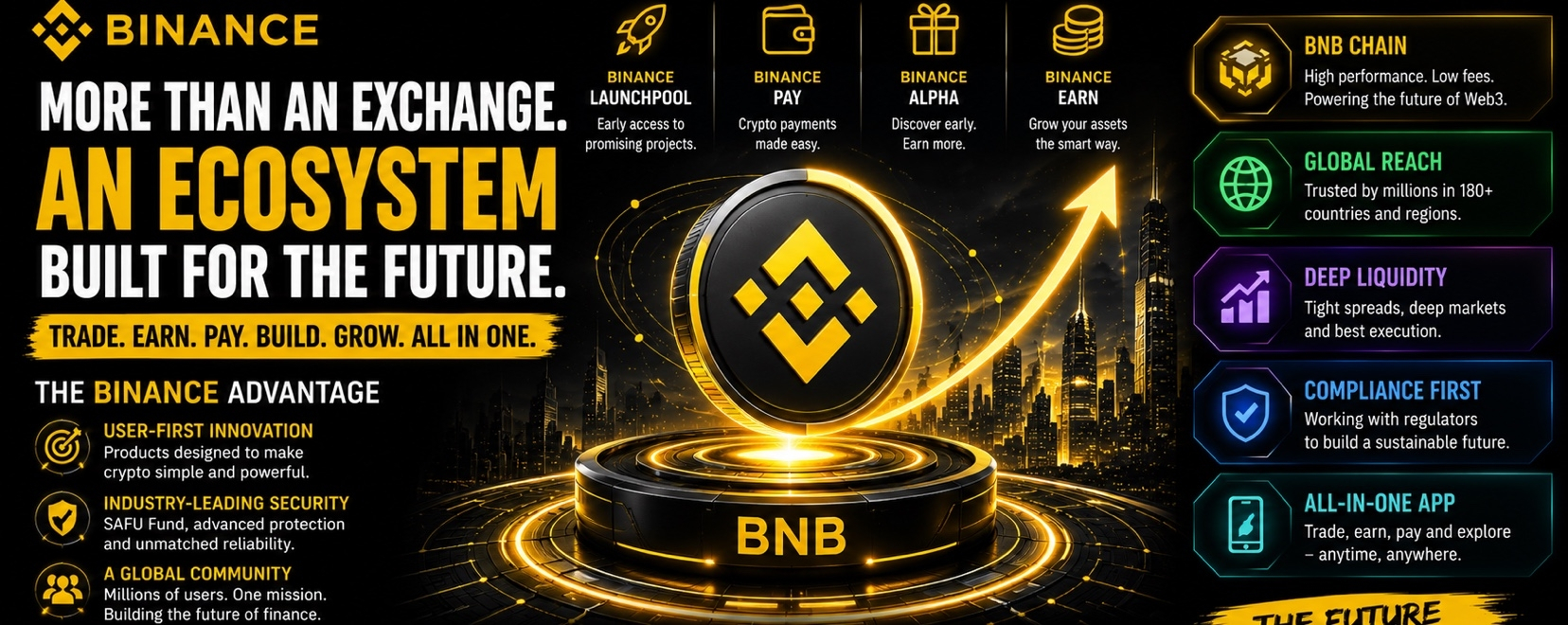

While most people in crypto keep chasing the next trending token, I think one of the biggest stories developing right now is much closer to home — the Binance ecosystem itself. Not in the obvious “Binance is big” way that everyone already knows, but in how the platform is quietly evolving from a trading destination into something that feels much closer to a full crypto financial operating system.
And honestly, I think many people are underestimating how important that shift could become.
For a long time, Binance was viewed mainly through one lens — trading. Buy, sell, rotate, repeat. That was the identity. But if you look at how user behavior in crypto is evolving, platforms that only solve one problem may struggle to hold attention long term. Modern users want convenience, access, opportunities, payments, earning tools, ecosystem rewards, and smoother ways to participate without constantly jumping between fragmented apps.
That is where Binance’s story becomes much more interesting.
Because this is no longer just about exchange volume.
It is about ecosystem gravity.
The more features Binance adds that keep users inside its ecosystem, the stronger that gravity becomes. Binance Pay makes digital payments more practical. Launchpool keeps feeding the early access psychology that crypto users love. Binance Alpha creates engagement incentives that encourage participation rather than passive observation. Binance Earn appeals to users looking for simpler ways to make assets productive. And BNB Chain extends everything beyond centralized products into actual blockchain infrastructure.
That combination matters because platforms become powerful when their products reinforce one another.
And ecosystems become dominant when leaving them feels inconvenient.
I think that is one of the most overlooked strategic advantages in crypto.
Because user attention is expensive.
And retention is even more valuable.
What makes BNB especially interesting inside this narrative is that it sits near the center of the ecosystem itself. It is not just another token people speculate on. It has actual utility tied to participation, transactions, access, and ecosystem activity. That changes how people think about it. Instead of existing only as a market asset, it becomes part of the operating structure.
And operating assets often get viewed differently.
There is also something psychological happening here that matters. Crypto users are increasingly tired of fragmentation. Too many wallets, too many bridges, too many disconnected experiences, too much friction. The platforms that simplify participation may gain more attention over time simply because convenience wins.
That is exactly why I think Binance’s ecosystem narrative feels stronger right now.
Not because hype is loud.
But because usability matters.
And usability tends to scale.
The most powerful technology companies in history rarely won only because they had the most advanced features. They won because they made complex systems feel seamless.
That is what I increasingly see Binance trying to become in crypto.
A place where multiple financial actions happen naturally inside one environment.
Trading, earning, payments, early opportunities, ecosystem rewards, blockchain participation.
That is much bigger than an exchange story.
My view is simple. While the market keeps obsessing over what token pumps next, one of the more important long-term narratives may already be happening through ecosystem consolidation. And Binance appears to be one of the clearest examples of that shift.
Because sometimes the strongest growth story is not the loudest narrative.
It is the infrastructure people quietly use every day.