
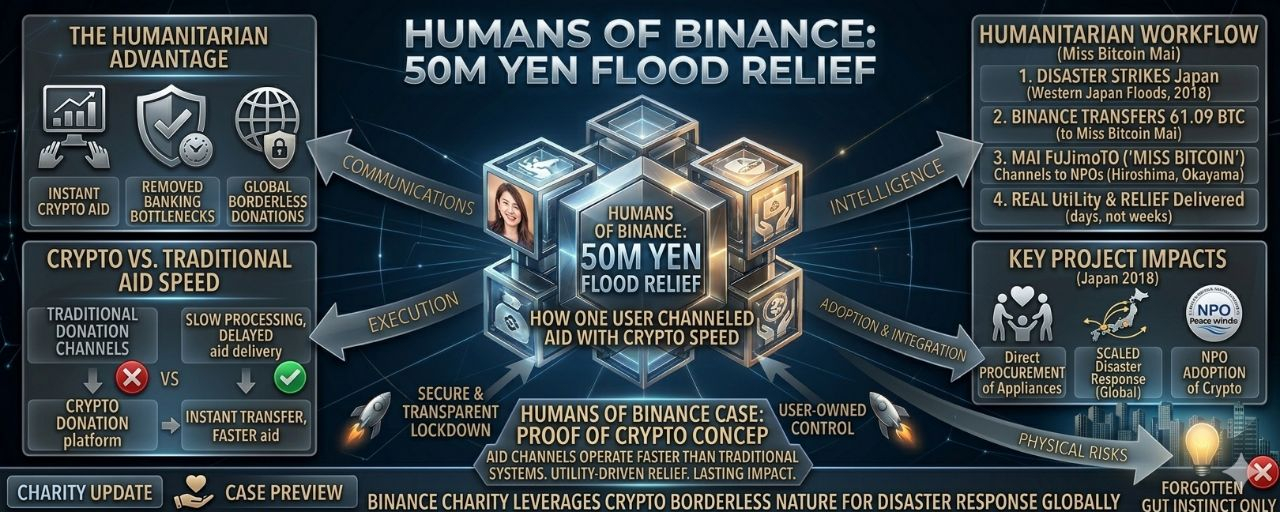

Some people use crypto to trade. Some use it to build. And some — in the right moment, with the right tools — use it to save lives.
This is one of those stories.
When Disaster Struck Western Japan
In late June through mid-July 2018, successive heavy downpours across southwestern Japan triggered devastating floods and mudflows on a scale the country hadn't seen in decades. More than 8 million people were advised or urged to evacuate across 23 prefectures. By July 20, 225 people had been confirmed dead across 15 prefectures, with a further 13 reported missing. Around 17,000 homes were damaged. It was the deadliest freshwater flood-related disaster in Japan since the 1982 Nagasaki flood.
The need was immediate. The geography was scattered. And traditional donation channels — slow, paper-heavy, limited by banking hours — were not built for a crisis moving this fast.
Enter Miss Bitcoin Mai
Mai Fujimoto — widely known in Japan as "Miss Bitcoin" — had been involved in crypto since 2011. In 2017 she launched KIZUNA, Japan's first cryptocurrency donation platform, with the explicit goal of using blockchain technology for social good. She became an ambassador for Binance Charity Foundation and one of Japan's most prominent voices at the intersection of crypto and humanitarian work.
When the West Japan floods hit, Mai was ready — and Binance moved fast.
Due to the immediate need to support victims, the first round of donations was carried out through Mai. Binance transferred 61.09 BTC — equivalent to 50 million JPY at that time — directly to her Bitcoin account. She then converted the bitcoin (BTC) to Japanese yen and bank-transferred 25 million JPY to Peace Winds Japan and 25 million JPY to the Momotaro Fund, two officially registered NPOs actively providing on-the-ground relief in Hiroshima and Okayama prefectures.
The entire first round — from crypto transfer to yen conversion to NPO distribution — happened in days, not weeks.
What Made Crypto the Right Tool
The speed was not accidental. It was structural.
Traditional cross-border donations in disaster scenarios often get held up in bank processing windows, currency conversion layers, and intermediary compliance checks. Crypto removed most of those bottlenecks. In a second round of donations, volunteer organization Open Japan opened a cryptocurrency account directly, and Binance transferred 169.85 ETH — equivalent to approximately 5.3 million JPY. Open Japan later said: "It was carried out instantly, and after confirming the transfer we were able to convert it to Japanese yen. Receiving this donation left us with a deep impression of cryptocurrency: both its growing effect on our world and its potential."
Binance also directly procured home appliances for temporary shelters in Kure City by transferring 1.94 BTC to Bic Camera to purchase goods for disaster victims — an unconventional use of crypto that went straight from donation to utility without touching a bank at all.
In total, Binance completed donations worth approximately 56.7 million JPY — a combination of 63.03 BTC and 169.85 ETH — helping more than 41,200 victims across three prefectures: Okayama, Ehime, and Hiroshima.
A Model That Has Kept Growing
Binance recently highlighted Mai's pivotal role in channeling over 50M yen in crypto donations to disaster-hit areas during the crisis. She has since driven Japanese non-profits to embrace crypto for faster aid delivery — a lasting shift in how humanitarian organizations in Japan think about digital assets.
The impact didn't stop with Japan. Binance Charity has since scaled its disaster-response efforts globally, leveraging crypto's borderless nature — including a $200,000 contribution to the Sri Lanka Red Cross Society for flood and landslide response in December 2025, $1.2 million in BNB allocated to Taiwan flood relief in August 2025, and $3 million to Spain's Red Cross following devastating floods in Valencia in November 2024.
The West Japan case was not just a successful charity campaign. It was a proof of concept — demonstrating that crypto infrastructure could move faster than traditional systems when the stakes were highest
Your Story Could Be Next
The #HumansOfBinance series exists because the most important things crypto has made possible are often the ones that don't make headlines in price trackers or trading volume reports. They are in the lives that were reached, the communities that were supported, and the people who saw a problem and used the tools available to do something about it.
If you have a story about how crypto made a real difference in your life or your community, Binance wants to hear it.
Read the full Humans of Binance story here:
👉 https://www.binance.com/en/blog/charity/4416870007213799450
Disclaimer: This article is for educational purposes only and does not constitute financial advice. All activities involving digital assets carry risk. Please do your own research before making any decisions.