

I did not come to this idea through theory. It started from noticing a pattern that kept repeating in different places. Every AI system I touched felt powerful on the surface, but underneath it felt disconnected, like pieces of intelligence floating without ownership, without accountability, and without a clear way to trace where value actually came from.
At first, I assumed this was just how AI works. But the more I explored, the more I realized something deeper. AI is not missing intelligence. It is missing infrastructure that understands intelligence as an economic asset.
That is where the idea of an AI specific blockchain starts to make sense.
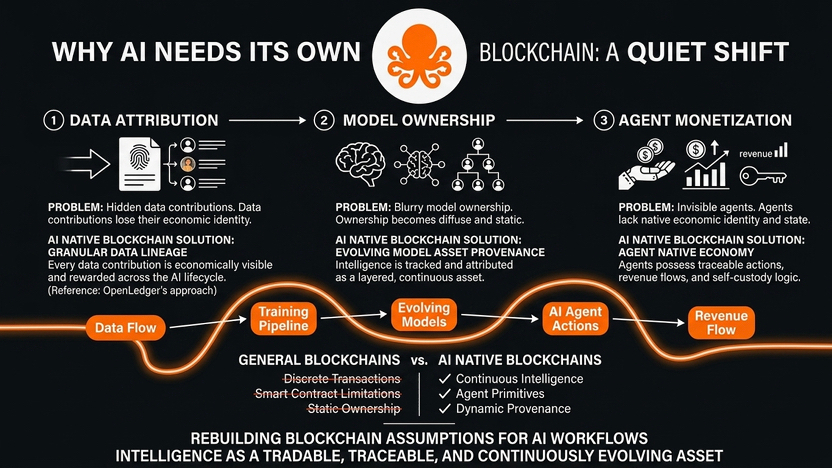
Most blockchains today were not built for AI. They were built for transactions, for value transfer, for smart contracts, for decentralized finance. That structure works well when you are moving tokens, executing agreements, or storing proofs. But AI is not a simple transaction system. AI is continuous, layered, and deeply dependent on data lineage.
When I started thinking about this seriously, I kept coming back to three broken layers in the current system: data attribution, model ownership, and agent monetization.
The first fracture I noticed was data attribution
AI systems are trained on massive datasets. Text, images, behavior logs, code, and more. But once data enters the training pipeline, it effectively disappears from the economic map. The system learns from it, but the contributor is no longer visible.
In a general blockchain environment, you could technically store hashes or proofs, but the chain is not designed to track millions of granular contributions across evolving models. It becomes too heavy, too slow, and too disconnected from the actual AI lifecycle.
What I found interesting in OpenLedger’s approach is that it treats attribution as a first class citizen. Instead of trying to force AI data into generic ledger structures, it assumes that every contribution should carry a traceable identity from the start. That changes the mindset completely.
It is not about storing data on chain. It is about making data economically visible across the entire AI pipeline.
The second fracture is model ownership
This one is more subtle.
In most AI ecosystems, models are trained, fine tuned, and deployed, but ownership becomes blurry. Who owns the trained intelligence? The organization? The contributors? The infrastructure provider?
Traditional blockchains can store model hashes or versions, but they cannot naturally represent the evolving nature of a model that is continuously retrained, updated, and influenced by external inputs.
This is where general purpose chains start to feel stretched. They are not optimized for continuous learning systems. They are optimized for discrete events.
An AI specific blockchain changes that assumption. It treats models not as static artifacts but as evolving assets with provenance. That means ownership is not just about who deployed it, but who contributed to its intelligence over time.
When I first understood this framing, it changed how I looked at AI entirely. A model is not just software. It is a layered economic construct built on invisible inputs.
The third fracture is agent monetization
AI agents are no longer just tools. They are starting to act like autonomous participants. They execute tasks, make decisions, interact with systems, and in some cases generate revenue.
But here is the problem. In most systems today, these agents do not have native economic identity. They cannot truly own value, distribute revenue, or maintain persistent economic state across ecosystems.
General blockchains allow wallets and smart contracts, but they do not inherently understand what an AI agent is doing in context. Everything must be manually structured into contract logic, which quickly becomes rigid and fragmented.
What OpenLedger tries to address is this missing layer of agent native economy. Instead of forcing AI into financial primitives, it tries to build primitives that understand AI behavior directly.
That means an agent is not just a script calling APIs. It is an entity with traceable actions, revenue flows, and attribution paths.
Why general purpose chains start to fail here
When I step back, the limitation becomes clearer.
General blockchains assume:
Transactions are discrete
State changes are event based
Ownership is static per wallet
Logic is deterministic and bounded
AI breaks all of these assumptions.
AI is continuous, probabilistic, and layered across time. It does not fit cleanly into isolated transactions. A single output may depend on thousands of upstream contributions, dynamic model states, and evolving datasets.
Trying to force that into a traditional blockchain is like trying to record a flowing river as individual photographs. You lose continuity.
That is why AI needs its own blockchain design philosophy, not just AI applications on existing chains.
Where OpenLedger fits into this shift
From what I understand, OpenLedger is not just trying to “add AI to blockchain.” It is trying to rebuild blockchain assumptions around AI workflows.
The focus is not only on storage or execution. It is on:
Data attribution as a native layer
Model ownership as an evolving structure
Agent monetization as a built in economy
This creates a system where intelligence is not just used, but tracked, attributed, and rewarded across its entire lifecycle.
The important shift here is psychological as much as technical. It reframes AI from being a centralized product into being a distributed economic system.
My perspective after seeing this pattern
The more I think about it, the more I feel that AI without attribution is incomplete.
We are building systems that can think, but not systems that can remember where their intelligence came from in an economic sense.
That missing memory is what creates imbalance. It concentrates value at the top while the underlying contributors remain invisible.
An AI specific blockchain tries to fix that imbalance by embedding memory into the economic layer itself.
Not memory in the human sense. Memory in the accountability sense.
The bigger picture
If this direction continues, we are not just talking about better AI infrastructure. We are talking about a new kind of economy where intelligence itself becomes a tradable, traceable, and continuously evolving asset class.
In that world, data is not just fuel. It is capital. Models are not just tools. They are living economic entities. Agents are not just software. They are participants.
And blockchains are not just ledgers anymore. They become the backbone of intelligence coordination.
That is the shift I did not expect to take seriously until I started seeing how broken the current model actually is.
Once you see it, it is hard to unsee.
And that is exactly why the idea of an AI native blockchain does not feel like hype. It feels like an architectural correction that was always going to be needed, just delayed until AI became powerful enough to expose the cracks.