
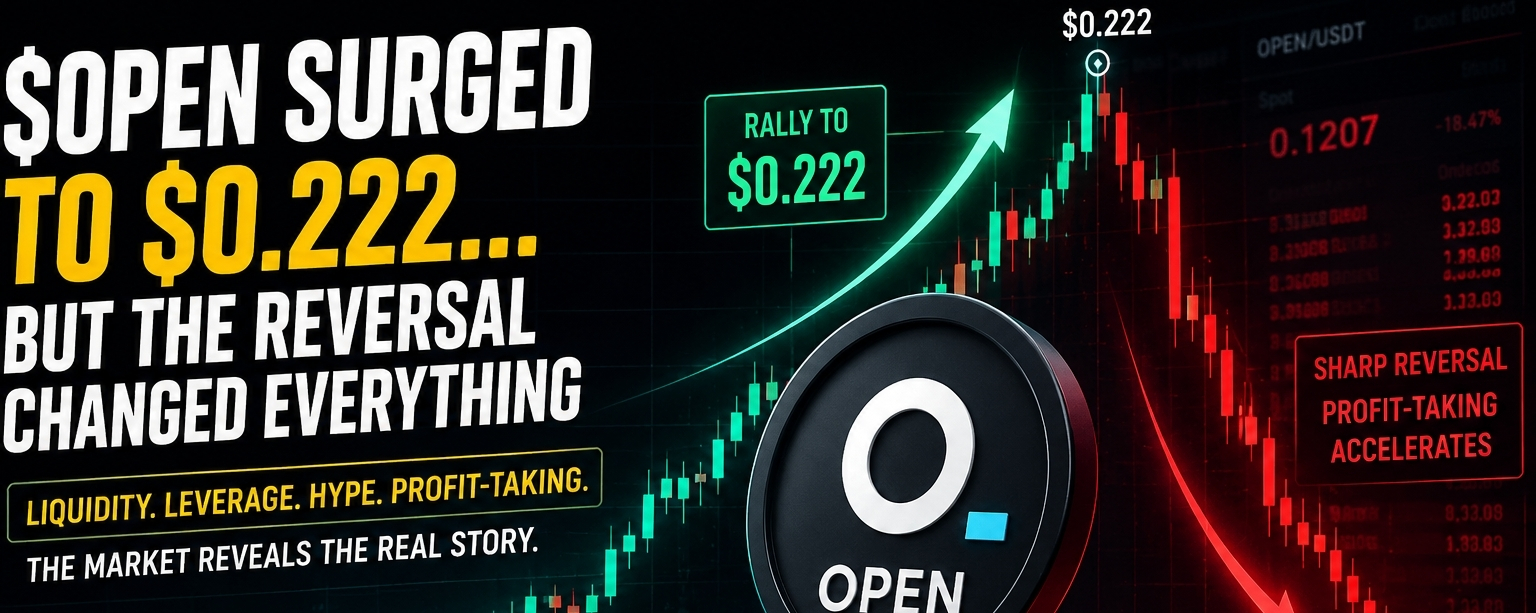
Over the past few days, I’ve been closely watching the price behavior of $OPEN, and to me, this move looked less like a sustainable breakout and more like a liquidity-driven momentum cycle fueled by short-term speculation
The rally toward $0.222 came fast. Volume expanded aggressively, social sentiment turned extremely optimistic, and the market suddenly treated $OPEN as if a major repricing event was underway. But when I looked deeper into the structure, I noticed something important — most of the momentum appeared to be coming from temporary exchange-driven activity rather than organic accumulation.
The CEX trading campaign clearly injected fresh attention into the market. These campaigns usually attract fast-moving traders looking for volatility, not long-term positioning. I’ve seen this happen many times with low-to-mid cap tokens: liquidity enters quickly, momentum traders pile in, price accelerates vertically, and social hype amplifies everything within hours.
That environment can push prices much higher in a very short time, but it also creates unstable market structure.
As $OPEN approached the $0.222 area, I started noticing signs that the rally was overheating. RSI conditions became stretched, while buy pressure gradually lost efficiency. Even though trading volume remained elevated, the market no longer had the same aggressive follow-through from buyers.
To me, that was the first warning.
The breakout initially attracted momentum chasers and leveraged traders who were entering positions purely because price was moving quickly. But once upside momentum slowed near resistance, those same traders began rotating profits aggressively. In crypto, especially in smaller-cap assets, the participants chasing the breakout are often the first ones to exit when momentum weakens.
That’s exactly why the reversal became so sharp.
I also think leverage played a major role in accelerating both sides of the move. During the rally, traders were clearly using high-risk positioning to maximize exposure to the breakout narrative. The problem with leverage is that it works like fuel during expansion phases — but once momentum stalls, it becomes fuel for the downside as well.
When price failed to extend higher near $0.222, emotional positioning started unwinding rapidly. Long liquidations, panic exits, and profit-taking all began stacking together. The market shifted from aggressive greed to defensive behavior almost instantly
Another thing I noticed was how social hype started distorting price discovery
As volume exploded, sentiment across trading communities became excessively bullish very quickly. Suddenly, traders were projecting continuation targets everywhere, even though the market structure underneath still looked fragile. In my experience, when narratives move faster than liquidity quality, volatility usually becomes unstable.
That’s what happened here.
The price expansion looked impressive externally, but internally the rally lacked the kind of slow, healthy accumulation that stronger trends usually build on. Instead, the move became heavily dependent on attention, momentum, and short-term positioning.
Still, I don’t think the pullback automatically means the trend is broken.
Right now, I see two possible scenarios developing. The first is a healthy reset after an overheated rally. If $OPEN stabilizes with declining sell pressure and more balanced spot demand, the current correction could simply become a consolidation phase before the market decides its next direction
The second scenario is more cautious. If liquidity continues fading while every rebound becomes weaker, then the market may slowly transition from profit-taking into broader weakness. That would suggest the rally was mostly campaign-driven rather than structurally sustainable.
Personally, I’ll be watching trader positioning very carefully from here.
I want to see whether fresh buyers enter naturally or whether the market immediately falls back into another leverage-heavy momentum chase. Sustainable trends usually rebuild slowly after volatility spikes. Weak trends, on the other hand, try to force another breakout too quickly.
For now, I think OPEN is at an important psychological stage. The excitement brought attention, the campaign created momentum, but now the market has to prove whether real conviction still exists once the emotional buying and speculative pressure cool down.