
I’ve been watching how the crypto market keeps changing its mood, almost like it never stays in one mindset for too long. One cycle it’s driven by hype and fast speculation, and the next it suddenly tries to convince itself that infrastructure is what matters again. But underneath all of this switching back and forth, there’s a slower movement happening that doesn’t really get much attention until it’s already too big to ignore.
That’s where OpenLedger started to feel interesting to me, not because it is loud or aggressively marketed, but because it sits right at the intersection of two things that are clearly growing whether the market is ready or not, AI and blockchain.
At first, I honestly didn’t give it too much weight. The space has seen so many AI themed crypto projects that most of them start to feel interchangeable after a while. It becomes easy to assume everything is just trying to ride the same narrative wave. But the more I kept observing how OpenLedger positions itself, the more it felt less like a trend follower and more like an attempt to build a structure around something that is already happening in the background of the internet.
AI is no longer a separate tool you occasionally use. It is slowly becoming part of how people think, work, and create. Whether it is writing, coding, research, design, or even decision making, AI is already embedded into daily behavior in ways most people do not fully notice. But what feels more important, and what often gets overlooked, is how little ownership exists in that process.
People generate data constantly. They interact with systems that learn from them. They help improve models indirectly just by using them. Yet the value created in that loop does not really flow back to the users in any meaningful way. It feels like participation without ownership, contribution without recognition in economic terms. That imbalance has always been there in the digital world, but AI makes it more visible because the scale of contribution is so much larger now.
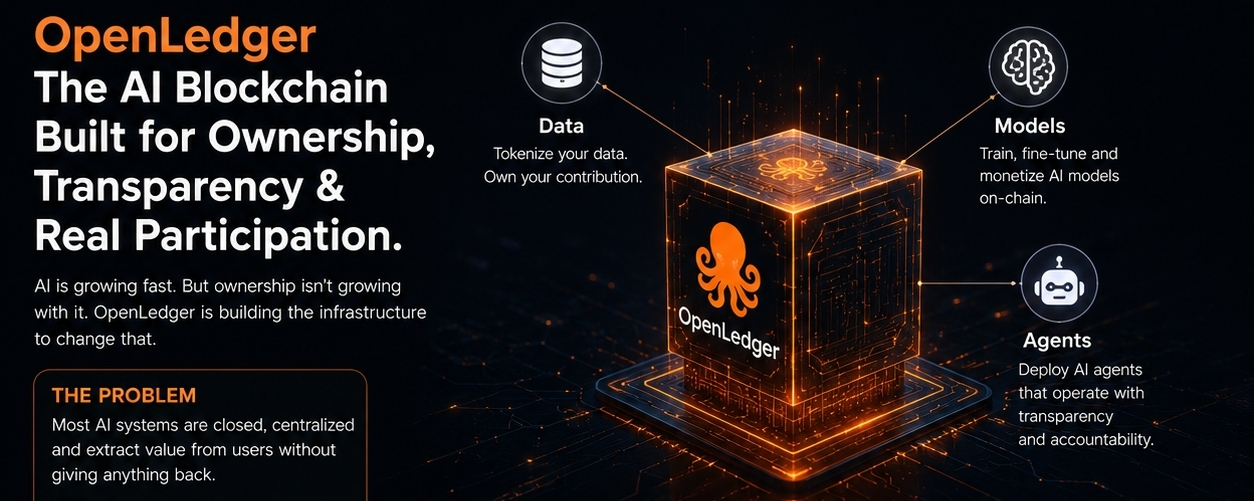
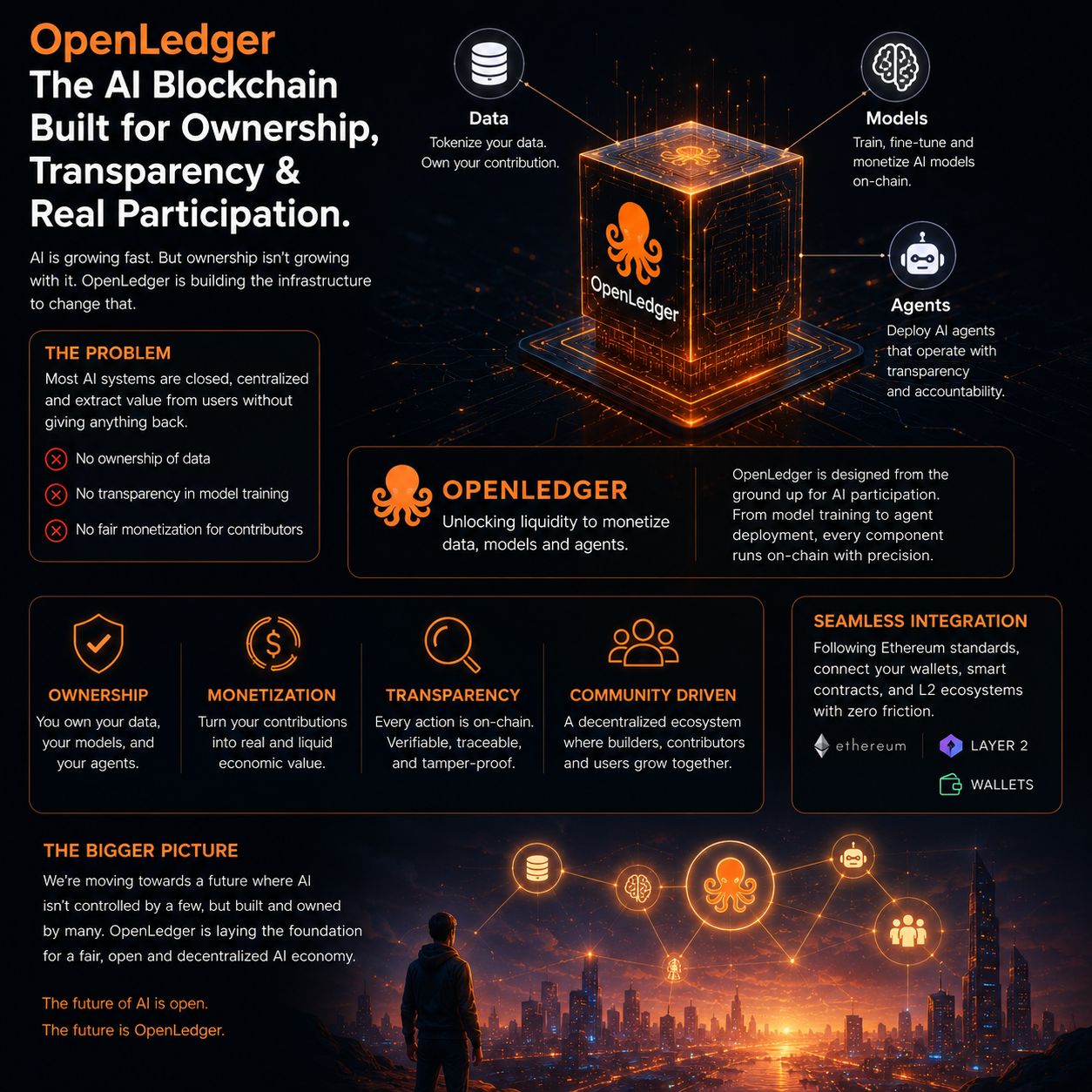
When I think about OpenLedger in that context, I see it as an attempt to reframe that relationship. Not just by putting AI on blockchain as a concept, but by trying to make participation itself something that can be tracked, structured, and potentially rewarded in a more transparent way. The idea of data, models, and agents existing within an on chain environment creates a different way of thinking about who actually owns what in an AI driven system.
What also makes this timing feel important is the state of the broader market. Crypto has gone through enough cycles now that people are less impressed by storytelling alone. There was a time when a strong narrative could carry a project far, even without much real usage behind it. That phase is fading slowly. Now there is more pressure on actual utility, actual usage, and systems that can survive beyond early excitement.
At the same time, AI is accelerating at a speed that traditional systems are struggling to keep up with. It is not just a technological shift, it is a behavioral one. People are adapting to AI faster than institutions can regulate or fully understand it. That creates a kind of gap between how fast technology is evolving and how slowly ownership structures are adapting. And whenever that kind of gap appears in technology history, new infrastructure usually starts to form around it.
That is why the overlap between AI and crypto feels less like a marketing narrative and more like a natural convergence. Blockchain brings transparency, coordination, and ownership models. AI brings automation, intelligence, and rapid scaling of digital output. When you put those together, the conversation shifts from simple speculation to something closer to digital economic systems that operate continuously.
OpenLedger’s focus on integrating with established standards like Ethereum also matters more than it might seem at first. In crypto, fragmentation has always been one of the biggest barriers to real adoption. Too many isolated ecosystems, too many incompatible tools, too much friction for both developers and users. Projects that manage to reduce that friction usually have a better chance of surviving long term because they do not force people to rebuild their entire workflow just to participate.
But even with all of that potential, I keep coming back to one simple thought. Execution is everything.
The crypto space is full of ideas that made sense on paper but never turned into real ecosystems. Vision alone has never been enough, especially in a market that becomes more skeptical with each cycle. People have seen too many promises that never matured into products that actually worked at scale. Because of that, attention is becoming harder to hold and easier to lose.
That is why I do not look at projects like this through hype anymore. I look at whether they are quietly building something that can exist even when the narrative fades. Whether developers stay when incentives slow down. Whether users find real value beyond speculation. Whether the system continues to function when attention is not at its peak.
What stands out in this current phase of crypto is that the strongest signals are no longer the loudest ones. They are the ones that feel aligned with where technology is already heading outside of crypto itself. AI is not slowing down. Data ownership is becoming a bigger discussion. Digital systems are becoming more autonomous. These shifts are happening regardless of market cycles.
So when I look at OpenLedger, I do not see a finished product or a guaranteed outcome. I see a direction that fits into a much larger transition happening across both AI and blockchain. It feels like part of an early layer of experimentation where the real question is not whether the idea sounds good, but whether it can survive long enough to become useful when the rest of the world catches up.
And maybe that is what this phase of the market is really about. Not chasing the loudest narrative, but noticing the quieter systems forming underneath everything else, long before they become obvious to everyone else.