

Most people still think AI infrastructure is just GPUs, APIs, and bigger models.
I think they’re missing the more important layer entirely.
Coordination.
That’s the real bottleneck.
Not intelligence itself — but the ability for autonomous systems, developers, data providers, and execution environments to actually work together without relying on centralized gatekeepers.
That’s why I’ve been spending more time researching @OpenLedger lately.
Especially after digging into what they’re building around Octoclaw and the broader AI execution stack.
The interesting part isn’t just “AI onchain.”
We’ve heard that narrative too many times already.
The interesting part is how OpenLedger seems to be positioning itself as infrastructure for AI-native coordination rather than another consumer-facing AI product.
And honestly, that changes how I look at the project entirely.
Most crypto x AI projects today are still stuck in one of two buckets:
speculative AI tokens with weak infrastructure
centralized AI wrappers pretending to be decentralized
Very few are thinking deeply about what happens when autonomous agents actually need to operate across decentralized environments at scale.
That’s where things get complicated.
You suddenly run into:
execution reliability
orchestration
compute distribution
deployment friction
incentive alignment
cloud abstraction
cross-agent communication
And this is where Octoclaw starts becoming interesting.
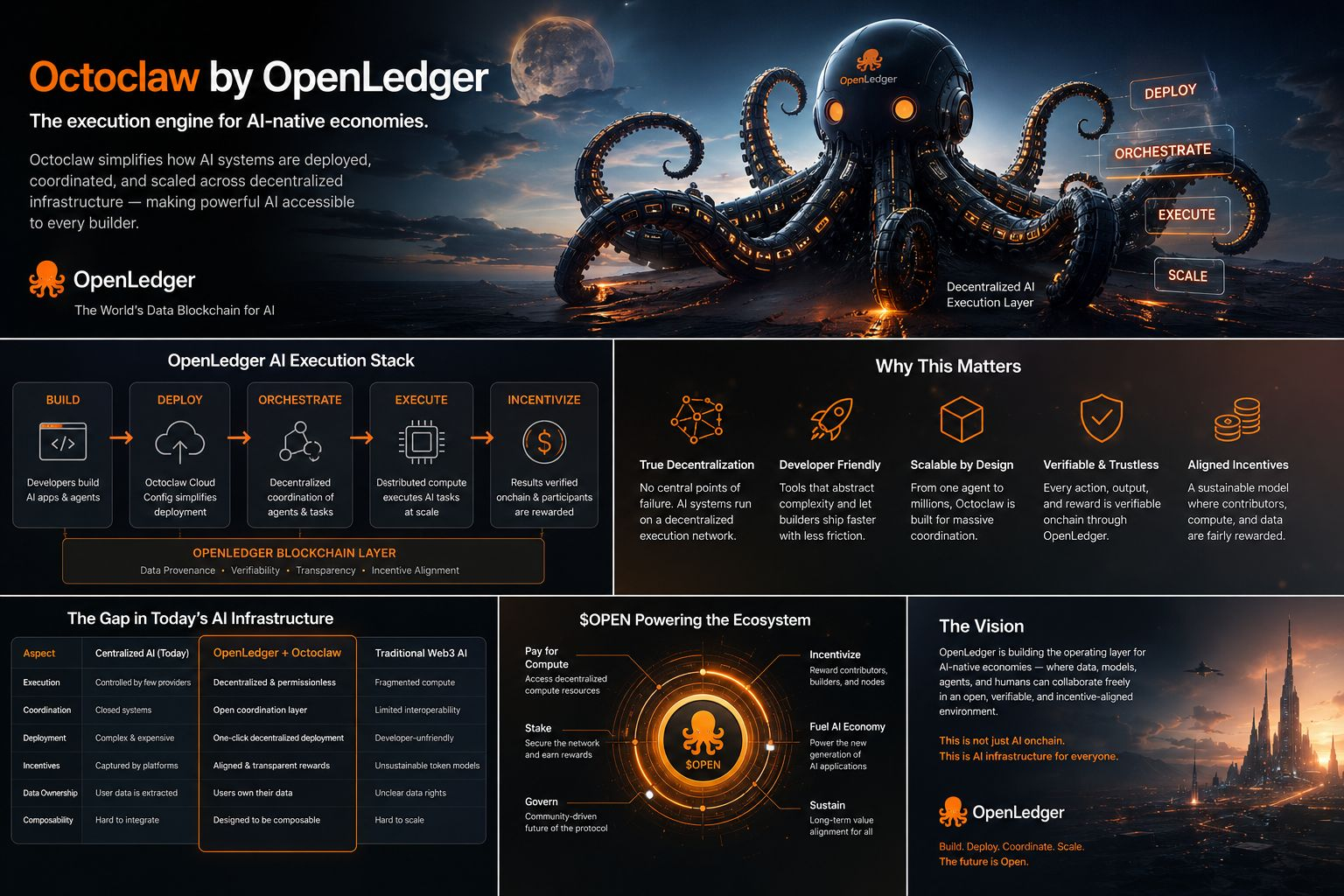
The market is underestimating how important deployment infrastructure becomes once AI agents move from experimentation into actual usage.
Right now, most builders still rely heavily on centralized cloud pipelines because decentralized tooling is fragmented, difficult, and painful to scale.
Developers tolerate decentralization ideologically.
But they choose convenience operationally.
That’s the uncomfortable truth.
So if OpenLedger can reduce the friction between decentralized infrastructure and real developer usability, that becomes incredibly valuable.
Not because it sounds futuristic.
Because developers always migrate toward environments that let them ship faster.
Always.
The best infrastructure usually wins quietly at first.
Ethereum won developers. AWS won developers. Docker won developers. Kubernetes won developers.
Distribution follows tooling.
Not the other way around.
And OpenLedger seems to understand that.
The Octoclaw direction feels less like a “feature launch” and more like an attempt to simplify AI execution coordination itself.
That matters much more than people realize.
Especially now that AI agents are starting to become persistent actors instead of one-off chatbot interfaces.
Once agents begin operating continuously:
they need environments
they need memory coordination
they need scalable execution
they need deployment layers
they need economic incentives
Suddenly this becomes infrastructure, not just software.
That’s the bigger shift happening across AI right now.
We’re slowly moving from: “people using AI tools”
to
“AI systems interacting with other systems autonomously.”
And crypto actually becomes extremely relevant in that world because blockchains are naturally good at coordination, incentives, verification, and permissionless interaction.
That’s the part many AI-only people still underestimate.
Centralized AI companies optimize for closed ecosystems.
Crypto infrastructure optimizes for open coordination.
Those are very different futures.
One creates AI products.
The other creates AI economies.
I think OpenLedger is leaning toward the second direction.
And if that thesis plays out, the implications get much larger than most current market narratives.
Because then the value isn’t just: “does this app have users?”
The value becomes: “does this infrastructure become necessary for AI-native ecosystems?”
That’s a much bigger category.
Another thing I find interesting is the timing.
The industry is entering a weird phase where everyone suddenly wants AI agents, autonomous workflows, and AI-powered execution layers…
…but most infrastructure still feels early.
Very early.
Builders can prototype quickly now thanks to vibecoding and AI-assisted development workflows.
But production-grade decentralized AI coordination is still messy.
There’s still enormous friction between:
experimentation
deployment
orchestration
monetization
That gap creates opportunity.
Massive opportunity.
Because the projects that reduce complexity for builders usually become foundational infrastructure later.
Not immediately.
Later.
Quietly at first.
Then suddenly everyone depends on them.
You can already see hints of this across the broader AI stack.
People obsess over models because models are visible.
But infrastructure layers capture enormous long-term value because they become deeply embedded into workflows.
And once developers build around infrastructure, switching becomes painful.
That creates ecosystem gravity.
I don’t think the market fully appreciates how important developer experience becomes in decentralized AI.
If deploying AI systems remains complicated, adoption stalls.
Simple as that.
The winners won’t necessarily be the projects with the most advanced models.
They’ll likely be the projects that make decentralized AI systems easiest to coordinate, deploy, monetize, and scale.
That’s why OpenLedger feels more important than its current attention level suggests.
The project seems less focused on short-term narrative farming and more focused on building the connective tissue for future AI ecosystems.
And honestly, that’s probably the harder path.
Infrastructure narratives are rarely exciting early.
They become obvious later.
Personally, I think we’re still extremely early in understanding what AI-native crypto infrastructure will actually look like 3–5 years from now.
But I’m increasingly convinced that execution coordination layers will matter far more than most people expect.
Not just models.
Not just agents.
The orchestration layer around them.
That’s where things start getting very interesting.
@OpenLedger is one of the few projects I’m watching closely because they seem to understand this shift earlier than most.
And if decentralized AI coordination becomes a real market category…
the infrastructure race is only just beginning.
