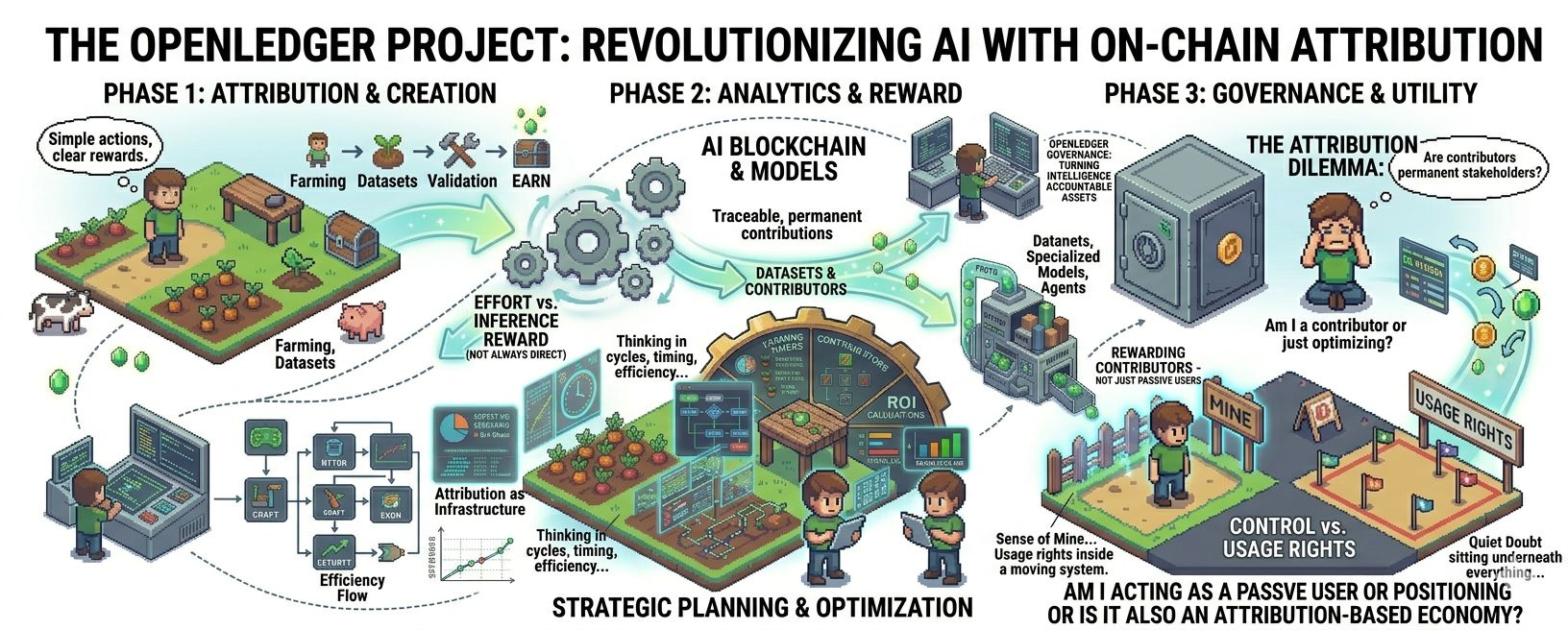

i keep coming back to that question because the more i look at OpenLedger, the less it feels like a normal blockchain project.
from the outside, it still looks familiar enough…
AI, blockchain, models, datasets, contributors, token economics…
all the words we already keep seeing everywhere in Web3. but inside the structure, something feels slightly different. most systems today treat AI like a product.
you use it.
it gives output.
the platform captures most of the value somewhere in the middle. simple enough.
but OpenLedger keeps pulling attention toward something most AI systems quietly ignore…
who actually contributed to the intelligence in the first place?
because AI doesn’t really appear from nowhere.
there’s always invisible labor underneath it…
datasets,
human corrections,
fine-tuning,
feedback loops,
evaluation,
specialized knowledge,
people shaping outputs without ever really being remembered afterward. and honestly… that part of AI always felt strange to me.
the systems become more intelligent over time
but the people feeding those systems slowly disappear from the story.
that’s why OpenLedger’s idea around attribution keeps standing out.
not just rewarding contributors
but permanently linking contribution to the lifecycle of the model itself.
that changes the feeling of the whole system. suddenly AI stops looking like a closed machine…
and starts feeling more like an economy built around intelligence.
because once contribution becomes traceable…
ownership changes.
incentives change.
behavior changes.
people stop acting like passive users.
they start positioning themselves inside the system differently.
you can already feel the shift happening in how OpenLedger talks about Datanets, specialized models, validators, inference rewards, governance. none of it really feels isolated. it feels interconnected
like every layer is trying to answer the same underlying question:
how do you build AI without losing the people who helped create it? and maybe that’s the real thing here.
not AI itself. not even blockchain.
maybe the real idea is turning intelligence into something economically accountable.
because right now most AI systems behave like black boxes.
they absorb contribution endlessly
but visibility and monetization stay concentrated.
OpenLedger seems to be challenging that structure by turning attribution into infrastructure itself. and the strange part is
once attribution becomes permanent
AI stops being just software.
it starts becoming a living economic system.
contributors . validators. models. agents. feedback
inference usage..
everything starts feeding into each other like a flywheel instead of a static platform.
which makes me wonder something else.
if intelligence can now be tracked,
rewarded . governed
and monetized on-chain
then maybe future economies won’t be built around information anymore.
maybe they’ll be built around attribution itself. and honestly
that feels much bigger than just another AI blockchain.