

What first pulled me toward autonomous on-chain systems was not the intelligence people kept advertising, but the strange calmness of the infrastructure underneath them. I spent weeks watching how agents moved through Ethereum L2 environments, routing liquidity between protocols, rebalancing staking positions, participating in governance execution, shifting collateral during volatility events, and coordinating treasury behavior across chains with almost no visible human involvement. On the surface, everything looked efficient. Quiet, even. A treasury contract reallocates stablecoins to optimize yield. A liquidation engine reacts before panic spreads through the market. A routing agent discovers temporary inefficiencies between rollups and bridges, executes arbitrage, then disappears back into the flow of transactions. Most people see speed when they look at these systems. What I started noticing instead was hesitation.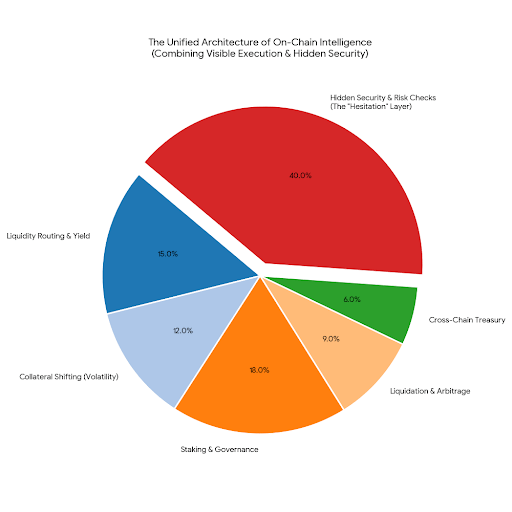
The deeper I looked, the more obvious it became that the real architecture was not built around autonomous action. It was built around invisible doubt.
That realization changed the way I viewed projects like and the broader direction of AI-driven blockchain infrastructure. The conversation around autonomous agents usually focuses on capability — how independently they can execute, how efficiently they can coordinate capital, how intelligently they can interpret market conditions. But beneath every visible action, there is another layer operating almost defensively, constantly trying to answer a quieter question: should this action even be allowed to happen?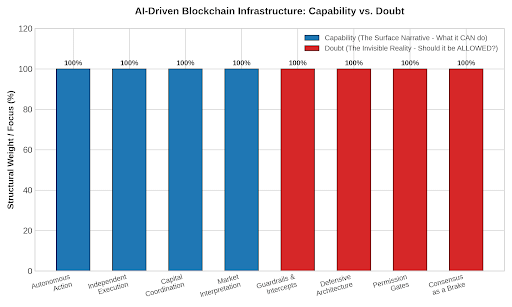
I started seeing modern crypto infrastructure less like an automated machine and more like a nervous system. Every movement triggers validation somewhere else. A staking rebalance gets simulated before execution. A governance transaction passes through behavioral scoring. A cross-chain routing decision gets compared against oracle confidence intervals. Treasury movement thresholds adapt depending on volatility conditions. Entire transaction flows are shadow-tested inside simulation environments before touching mainnet liquidity. None of this is visible when people talk about “autonomous agents.” But to me, this hidden layer is the actual story.
What struck me most was how security has quietly shifted away from defending code execution itself and toward defending interpretation. Earlier generations of exploits mostly targeted isolated weaknesses: reentrancy flaws, contract vulnerabilities, permission escalation, faulty accounting logic. Those risks still exist, but autonomous systems introduced something structurally different. Now attackers increasingly try to manipulate what machines believe is true.
An oracle can be distorted long enough to trigger incorrect treasury movement. Liquidity can be temporarily reshaped through flash loans to alter how routing agents perceive market depth. MEV environments can manipulate execution ordering in ways that completely change the meaning of an otherwise rational transaction. Cross-chain bridges can present asynchronous states that confuse decision engines operating on stale assumptions. The attack surface is no longer only technical. It has become cognitive.
That shift feels important to me because autonomous systems compound exposure across multiple protocols simultaneously. A single agent no longer operates inside one isolated environment. It exists inside an interconnected web of bridges, lending markets, staking protocols, governance systems, liquidity pools, and execution layers. One distorted signal propagates outward into multiple reactions. A misread oracle triggers collateral migration. That migration affects liquidity balance. Liquidity imbalance reshapes arbitrage conditions. Arbitrage execution alters validator incentives. Validator ordering influences MEV extraction. Suddenly the original distortion becomes difficult to isolate because the ecosystem itself starts amplifying it.
I noticed this especially while studying how AI-assisted execution tooling behaves during periods of volatility. Under normal conditions, many systems appear highly intelligent. But adversarial markets expose something uncomfortable: machines optimize aggressively for pattern recognition until the environment itself becomes strategically deceptive. In highly manipulated conditions, efficiency can actually increase fragility. The faster an agent acts on corrupted interpretation, the faster instability spreads across connected systems.
That is probably why the most sophisticated infrastructure increasingly spends enormous effort slowing itself down.
At first, I found that counterintuitive. Crypto culture spent years glorifying latency reduction and instant execution. But modern autonomous infrastructure often introduces intentional friction beneath the surface. Confidence thresholds delay uncertain actions. Circuit breakers temporarily isolate protocols during abnormal conditions. Transaction simulation layers test execution against multiple future states before broadcasting. Oracle validation systems compare external feeds against behavioral expectations rather than trusting a single source of truth. Some systems quietly route sensitive execution through private mempools to reduce MEV visibility. Others continuously monitor deviations in user behavior, liquidity structure, and validator participation to identify anomalies before actual damage occurs.
The strange thing is that most users never see these systems working. They only notice when something breaks.
To me, that invisibility says a lot about where blockchain infrastructure is evolving. The industry still markets automation as freedom from human involvement, but what I kept finding underneath these systems looked less like independence and more like layered skepticism. Autonomous agents are constantly being watched by other autonomous systems. One machine proposes action, another simulates consequences, another validates environmental consistency, another monitors whether the behavior itself deviates from probabilistic expectations. The architecture increasingly resembles a society of machines questioning one another in real time.
And honestly, that feels necessary.
The more autonomous liquidity becomes, the more adversarial the surrounding environment also becomes. Markets adapt to machine behavior. MEV searchers exploit predictability. Validators gain subtle influence through ordering power. Cross-chain latency creates informational asymmetry. Flash liquidity can manufacture false confidence long enough to redirect millions in capital allocation. Even governance participation starts becoming vulnerable to timing manipulation once agents begin voting autonomously based on external interpretation layers.
What unsettled me was realizing that many of these attacks do not need to fully compromise a protocol. They only need to slightly distort perception.
A machine does not panic the way humans do, but it also does not intuitively doubt context unless doubt itself has been architected into the system. That distinction stayed with me. I started viewing modern crypto security less as protection and more as behavioral intelligence. Static defenses alone no longer seem sufficient in environments where reality itself can be temporarily manipulated. The infrastructure that survives may not be the fastest infrastructure, but the infrastructure most capable of questioning what it sees before reacting to it.
That tension between execution speed and validation feels like one of the defining problems of autonomous finance. Everyone wants systems that can move instantly across Ethereum L2s, coordinate liquidity across bridges, rebalance exposure across staking layers, and react to market inefficiencies in milliseconds. But every additional layer of speed reduces the time available for skepticism. And skepticism, increasingly, is what keeps the system alive.
I think that is why projects building AI-integrated blockchain infrastructure are moving toward adaptive mitigation models instead of rigid rule sets. Static assumptions break too easily in adversarial environments. Behavioral baselines shift. Market structure changes. Liquidity patterns evolve. Threats mutate faster than predefined logic can anticipate. So modern defense systems increasingly operate probabilistically, continuously adjusting trust based on context, confidence, and environmental consistency rather than binary assumptions about what is safe.
The deeper I explored these systems, the less I saw autonomous agents as independent actors and the more I saw them as participants inside a fragile ecosystem of negotiated trust. Every transaction carries invisible verification layers beneath it. Every execution path contains hidden uncertainty calculations. Every major movement of liquidity passes through silent systems designed not merely to optimize action, but to question whether action still makes sense within the reality being observed.
And maybe that is the real direction this industry is heading toward.
Not machines that act without oversight, but machines surrounded by increasingly intelligent forms of skepticism.
To me, the future of autonomous on-chain intelligence may depend less on how independently machines can execute, and more on how carefully the systems beneath them learn to question the reality they believe they are seeing.