
Lately, I’ve noticed something about crypto that I can’t really ignore anymore. The market moves so fast now that people barely sit with an idea long enough to understand it before jumping to the next narrative. One week everyone becomes an expert on AI agents. Then liquidity rotates into modular infrastructure. Then RWAs. Then something else. The cycle repeats so often that eventually you stop reacting emotionally to headlines and start paying more attention to what actually survives once the excitement fades.
That’s probably why I’ve become more skeptical of anything connected to AI in crypto.
Most of it feels empty.
Not necessarily malicious, just surface-level. A lot of projects throw “AI” into their branding because they know attention follows it. But when you spend enough time around infrastructure, you start noticing how little substance exists underneath many of these narratives. Half the time it feels like people are selling futuristic language more than actual systems.
So when I first came across OpenLedger, I didn’t immediately think, “this changes everything.”
Honestly, I almost ignored it.
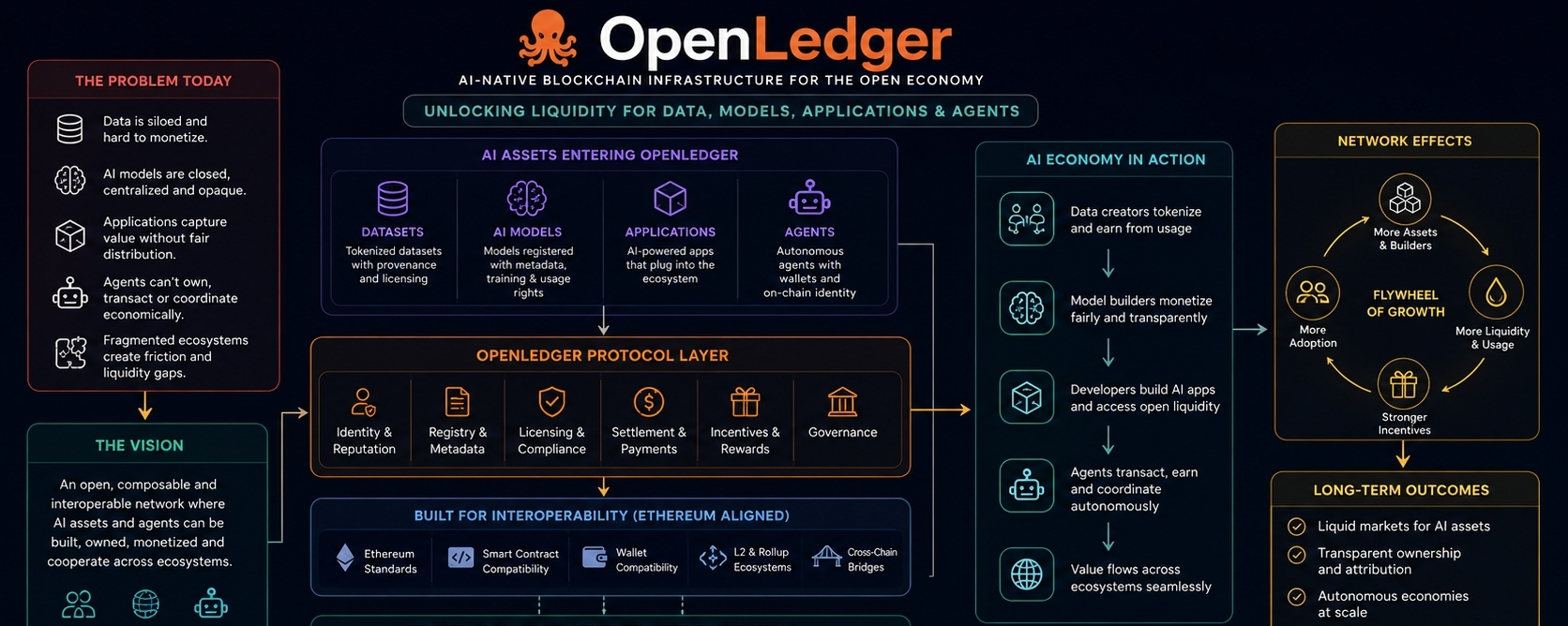
But over time, I kept coming back to it, mostly because the project seemed to approach AI from a different angle than most of the market. It wasn’t just talking about AI tools or AI-powered apps. It was thinking more deeply about what happens if AI itself becomes part of the on-chain economy.
And I think that’s a much bigger conversation than people realize right now.
The thing that stood out to me was the idea of building infrastructure specifically around AI participation instead of forcing AI into systems that were originally designed for completely different purposes. Most blockchains today were built around human activity. Trading, lending, payments, governance, speculation. Even smart contracts, despite how powerful they are, still mostly revolve around human-triggered interactions.
But if AI agents eventually become autonomous enough to transact, coordinate, deploy capital, interact with protocols, or even provide services independently, then the infrastructure requirements start changing.
That’s where OpenLedger started feeling interesting to me.
Not because it promises some utopian AI future, but because it seems to recognize that ownership, liquidity, coordination, and interoperability around AI-generated value may eventually become real infrastructure problems.
And crypto, at its core, has always been about coordination.
The more I thought about it, the more the idea of monetizing datasets, models, applications, and agents on-chain started making sense conceptually. Right now, most AI value is heavily centralized. The data sits inside private systems. The models are controlled by a handful of companies. Users contribute value constantly without really participating in ownership.
That imbalance probably becomes even more important if AI keeps evolving at the pace we’ve seen recently.
Because eventually the question won’t just be who builds the best models. It’ll also become who owns the economic activity those systems generate.
I don’t think the market fully understands that yet.
Most people are still trading the AI narrative itself instead of thinking about the infrastructure underneath it. But historically, infrastructure is usually where the deepest value gets built in crypto. The loudest projects often fade. The systems quietly solving coordination problems tend to matter longer.
Another thing I found genuinely smart about OpenLedger is its compatibility with Ethereum standards. That sounds technical and boring on the surface, but honestly, interoperability matters more now than almost anything else. Crypto is already fragmented enough. Liquidity is scattered. Users are exhausted from constantly moving between isolated ecosystems.
The last thing AI infrastructure needs is another closed environment pretending it can operate independently from the broader market.
If autonomous systems eventually interact across chains, access liquidity pools, execute transactions, or coordinate resources, then compatibility becomes essential. Machines won’t care about ecosystem tribalism. They’ll optimize for efficiency, accessibility, and execution.
That changes how I think about blockchain architecture entirely.
At the same time, I’m still cautious.
I think people underestimate how early all of this still is.
There’s a huge difference between an idea making sense intellectually and an ecosystem actually reaching meaningful adoption. Crypto has always had a tendency to price in future potential way too early. Sometimes the market acts like conceptual possibility is the same thing as proven demand.
It isn’t.
And AI narratives especially move faster than real-world infrastructure.
That creates risk.
OpenLedger could have a strong thesis and still struggle if developers don’t build around it, if demand never materializes, or if centralized AI platforms remain more practical for most use cases. That’s the uncomfortable part about infrastructure investing in crypto. You’re often betting on behavioral shifts that haven’t happened yet.
There are technical concerns too.
Scalability, coordination complexity, incentive structures, network demand — these are difficult problems even without introducing autonomous AI participation into the equation. Once you start imagining machine-driven economies operating continuously on-chain, the infrastructure requirements become massive.
Most people don’t think that far ahead because the market is still dominated by short-term speculation.
But I think eventually we’ll have to.
Especially if AI agents become capable of independently interacting with financial systems, applications, and digital marketplaces. At that point, ownership and coordination layers stop being theoretical discussions and start becoming necessary infrastructure.
And honestly, that possibility feels closer now than it did even a year ago.
What’s interesting is that this reminds me a little of earlier crypto infrastructure cycles. In the beginning, people mostly focused on price action because it was easier to understand. But underneath that speculation, entirely new systems were quietly being built. Smart contract platforms looked unnecessary to many people before DeFi emerged. Layer 2s sounded irrelevant until network congestion made scalability impossible to ignore.
Sometimes the market recognizes infrastructure late.
That’s partly why I keep watching projects like OpenLedger carefully.
Not because I’m fully convinced.
Not because I think every AI blockchain narrative deserves attention.
But because every once in a while, you come across a project that feels less focused on extracting hype from the current cycle and more focused on preparing for where the ecosystem might actually evolve long term.
There’s a difference between building for attention and building for future coordination.
I think OpenLedger is at least attempting the second.
Whether the market is ready for it yet, I honestly don’t know.
Maybe AI-native economies develop much slower than people expect. Maybe users continue choosing centralized convenience over decentralized ownership models. Maybe autonomous agents never become important enough to justify entirely new coordination layers.
Those are all real possibilities.
But I also think it would be a mistake to dismiss the broader shift happening underneath the noise. AI is becoming more autonomous. Crypto is becoming more programmable. Eventually those trajectories intersect in ways that probably reshape how digital economies operate.
The real question is which infrastructure survives long enough to support that transition when it arrives.
Right now, I don’t think anyone has a complete answer.
And honestly, that uncertainty is probably the healthiest way to look at this sector. The moment people become too certain in crypto, especially around emerging technology, the market usually humbles them eventually.
So for now, I’m mostly observing.
Watching how projects like OpenLedger evolve.
Watching whether real developers build around the ecosystem.
Watching whether actual usage appears underneath the narrative.
Because in the end, infrastructure only matters if people — or maybe eventually machines — actually use it.