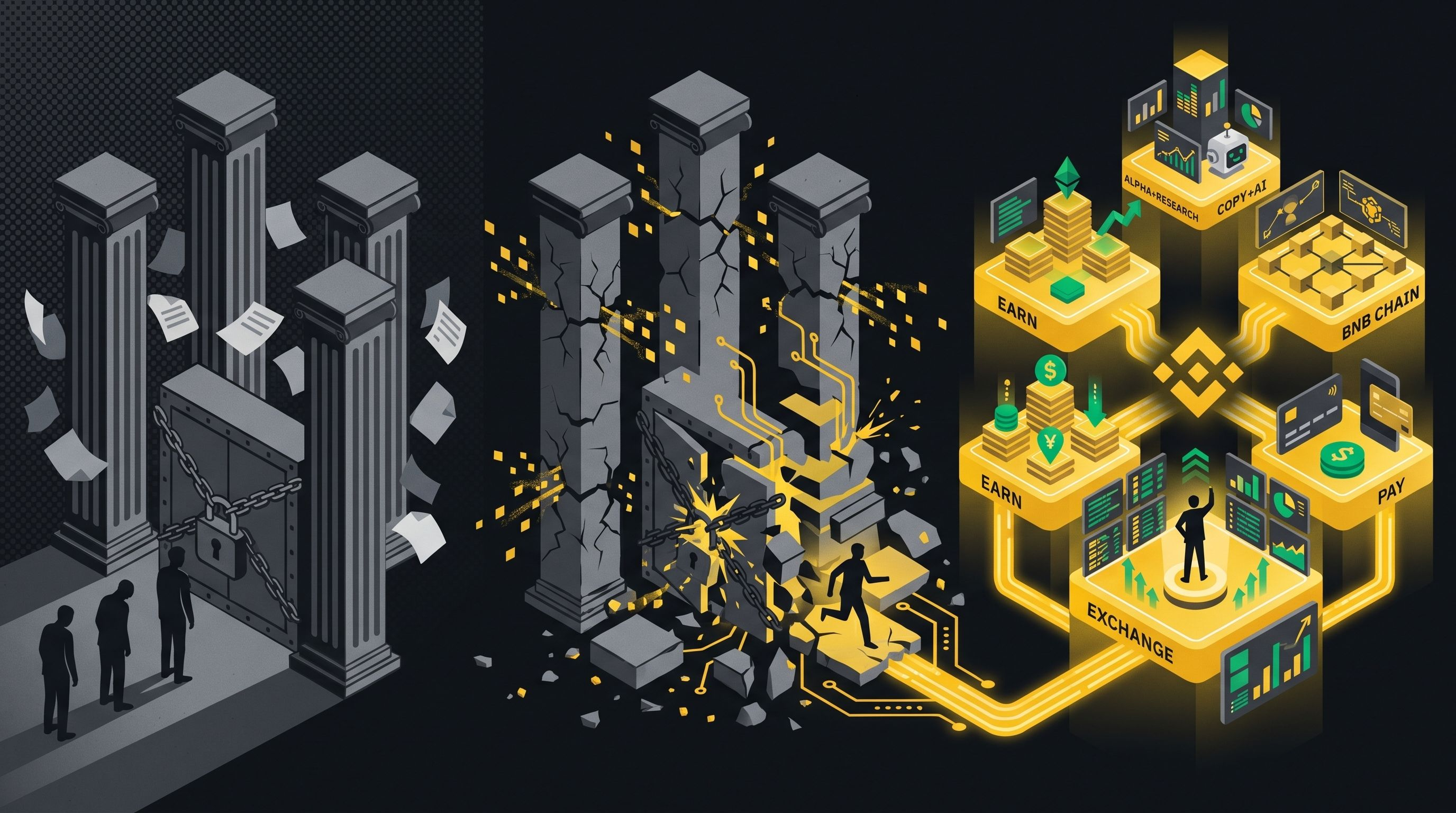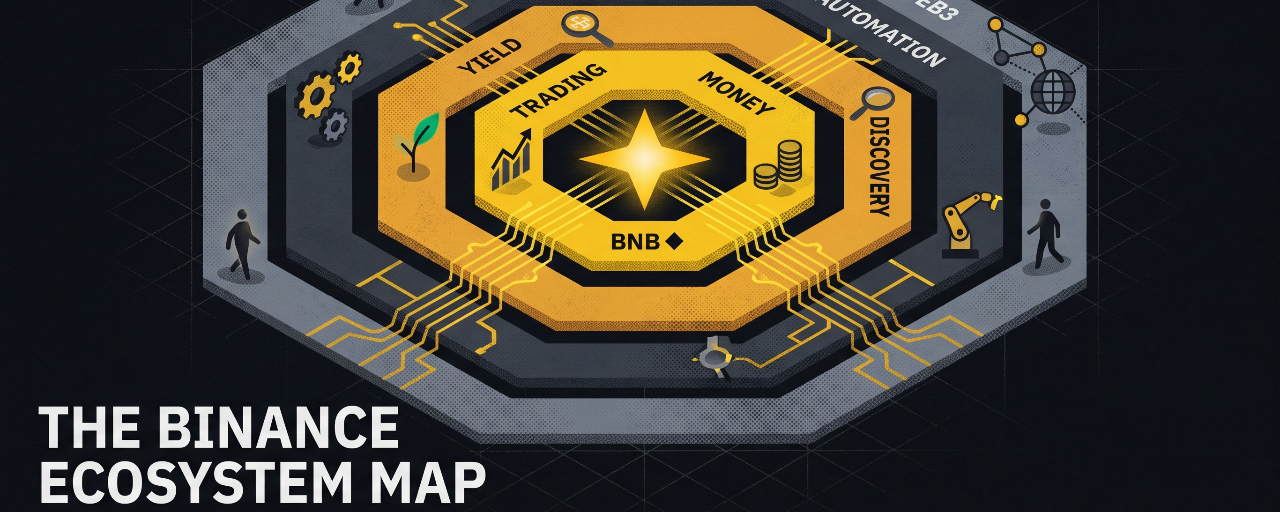
Most users are living in 10% of the building. Here's the floor plan for the other 90%.
Let's be honest about how most people use Binance.
You downloaded the app, passed KYC, bought some BTC or ETH, maybe set up a small Futures position when you were feeling brave, and called it a day. You use two, maybe three features. The rest of the interface is just… background noise.
Here's what's wild: that's how the majority of Binance's 270+ million registered users behave. And while that's happening, Binance has quietly assembled one of the most complex, tightly wired financial ecosystems on the planet — 20+ interconnected products spanning trading, yield, payments, social discovery, AI automation, and Web3 infrastructure — all routing through a single account and a single connective asset.
Most users haven't even scratched the surface.
This post is your map.
First, a Realization
Think about what WeChat is in China. You wake up, check messages, read the news, pay for coffee, hail a ride, transfer money to your cousin, book a doctor's appointment, and browse a store — all inside one app that never asks you to context-switch. WeChat doesn't "have features." It has a gravity field. Once you're in deep enough, leaving becomes genuinely inconvenient.
Now think about Grab in Southeast Asia — food, rides, payments, insurance, and savings all in one place. Or Alipay, which turned a payment button on Taobao into a financial services empire serving 1+ billion people.
Binance is building the same thing. But for global finance. With no geographic ceiling. And with crypto rails that move value across borders instantly, regardless of banking infrastructure, currency controls, or office hours.
The difference between Binance today and those super apps five years ago is mostly one thing: most users don't know yet. They're still treating it like an exchange.

The Six Layers (and Where You Probably Live)
To understand how Binance works as a unified system, you need to stop thinking in terms of "features" and start thinking in layers.
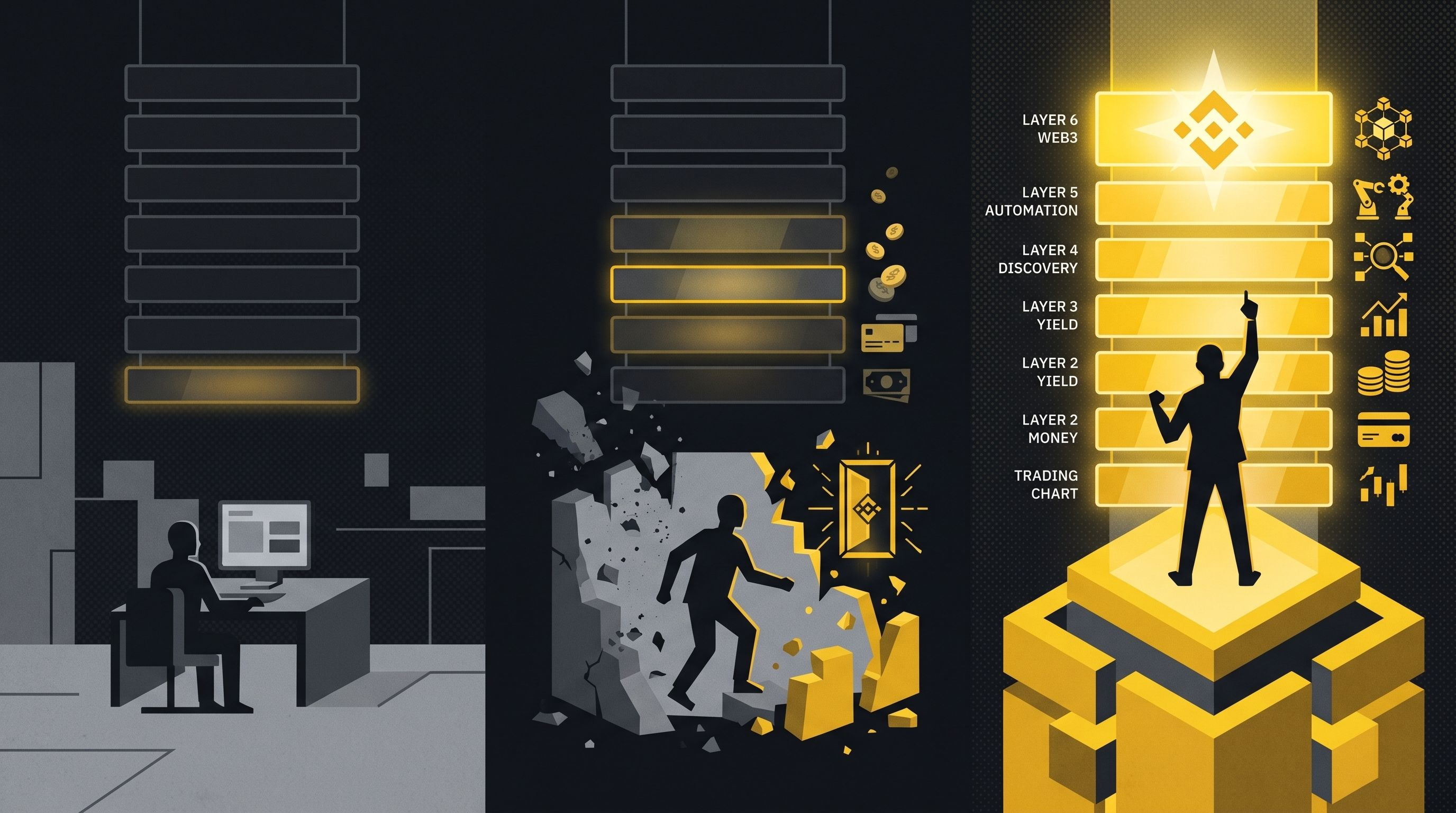
Layer 1 — Trading: Spot, Convert, Margin, Futures, Options. This is where most users live. Buy, sell, swap, leverage. Clean interface, deep liquidity, hundreds of pairs.
Layer 2 — Money In/Out: P2P, bank transfers, card purchases, Binance Pay, and the Binance Card. This is the financial plumbing — the on and off ramps, and the spending infrastructure that turns your crypto balance into something you can actually use at a café or send to a family member.
Layer 3 — Yield: Earn, Staking, BNB Vault, Launchpool, HODLer Airdrops, Megadrop. This is where idle balances stop being idle. Binance Earn covers flexible deposits, locked staking, and structured products across 180+ tokens. Stack BNB here and the platform starts doing more of the work for you.
Layer 4 — Discovery: Alpha, Research, Launchpad, Square. This is the information and signal layer — curated early-stage token access, institutional-grade research, and a social content feed of community insights, all tied to one-tap tradeable assets.
Layer 5 — Automation: Copy Trading, AI Pro, Auto-Invest, Grid Trading bots. This is where Binance gets genuinely interesting for anyone trying to stop watching charts all day.
Layer 6 — Web3: BNB Chain, opBNB, BNB Greenfield, DeFi, NFTs, on-chain dApps. This is the decentralized layer — your same BNB balance, repurposed as gas, governance power, and access token for an entire blockchain ecosystem.
Most users are on Layer 1. Some dip into Layer 3. A small minority has figured out that activating all six layers simultaneously is where the real compounding starts.
How One Product Feeds the Next
Here's the flow that makes the ecosystem click.
You start with Spot. You buy BTC, ETH, and a small position in BNB because you've heard it has uses beyond just trading. Good call.
You notice your USDT and BTC are just sitting there doing nothing between trades. You move them into Flexible Earn. Yield starts trickling in. You've turned a dormant balance into a working one.
Then you discover BNB Vault — a single-subscription product that automatically routes your BNB into Earn rewards, Launchpool allocations, and HODLer Airdrop eligibility without you having to actively manage anything. New project tokens start appearing in your wallet. You didn't buy them. You didn't click anything special. They arrived because your BNB was in the right place.
Now you're curious about those new projects, so you check Binance Alpha and Research for analysis on what's worth paying attention to. You start browsing Square — the content and social layer — and find experienced traders posting their theses, ecosystem maps, and market analysis. You start following a few.
You realize one of those traders has an excellent track record on copy-trackers inside the app. You allocate a small slice of your portfolio to Spot Copy Trading, mirroring their positions automatically with predefined risk controls. You go back to your life. Your portfolio is still moving.
Meanwhile, AI Pro is helping you screen market conditions, surface pattern alerts, and structure trade ideas during your actual research sessions — cutting the hours of dashboard-watching that used to eat your evenings.
You bridge a portion of your stack to BNB Chain to explore a DeFi yield play and an NFT project you read about. You pay gas in BNB. You earn on-chain rewards. You withdraw back to your Binance account.
At no point did you need another exchange, another wallet app, another research tool, or another payment service.
That's the product design intent. And it works.
BNB: The Connective Tissue
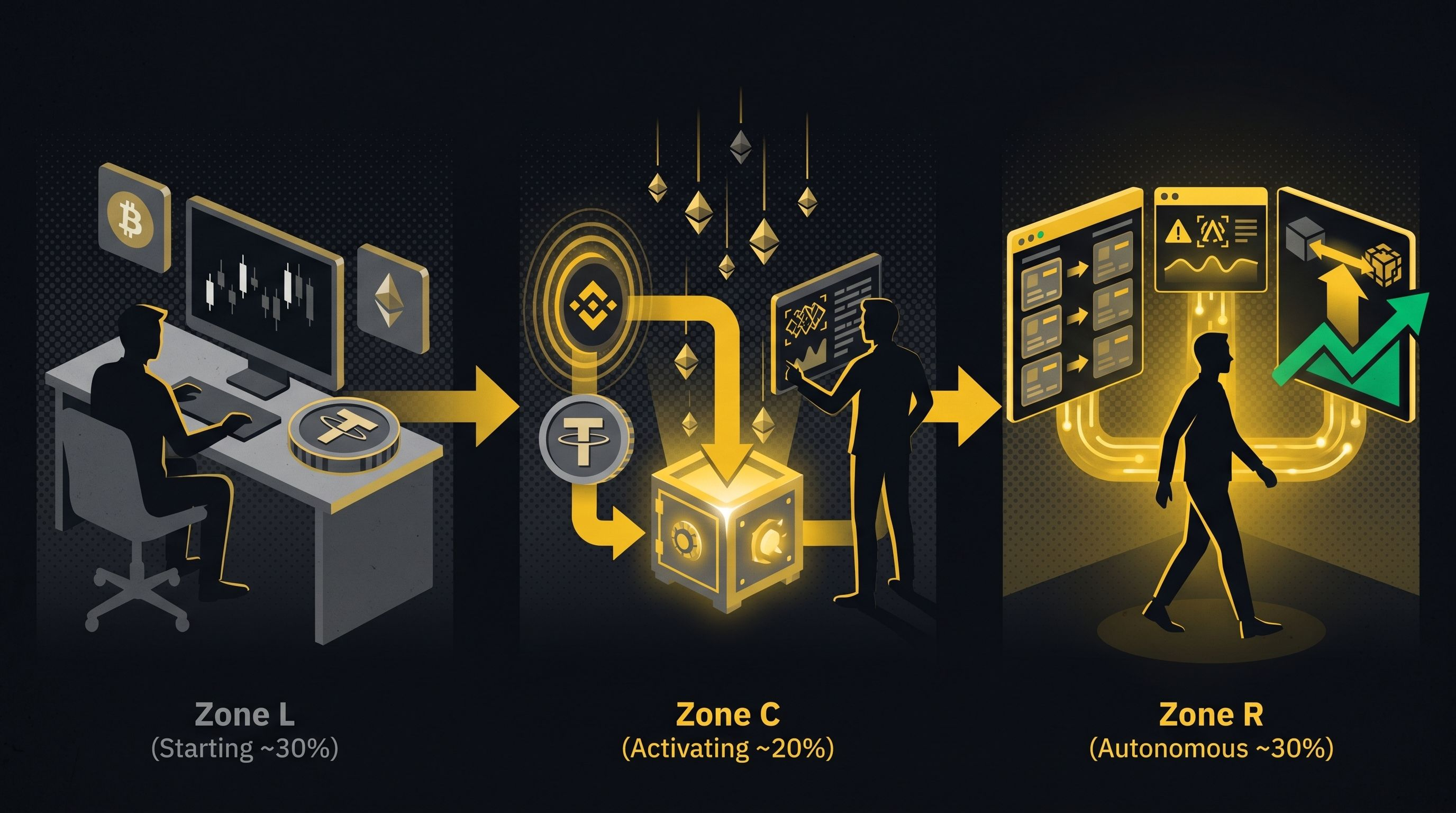
Every great operating system has a kernel — the piece of code that everything else routes through. In Binance's financial OS, that kernel is BNB.
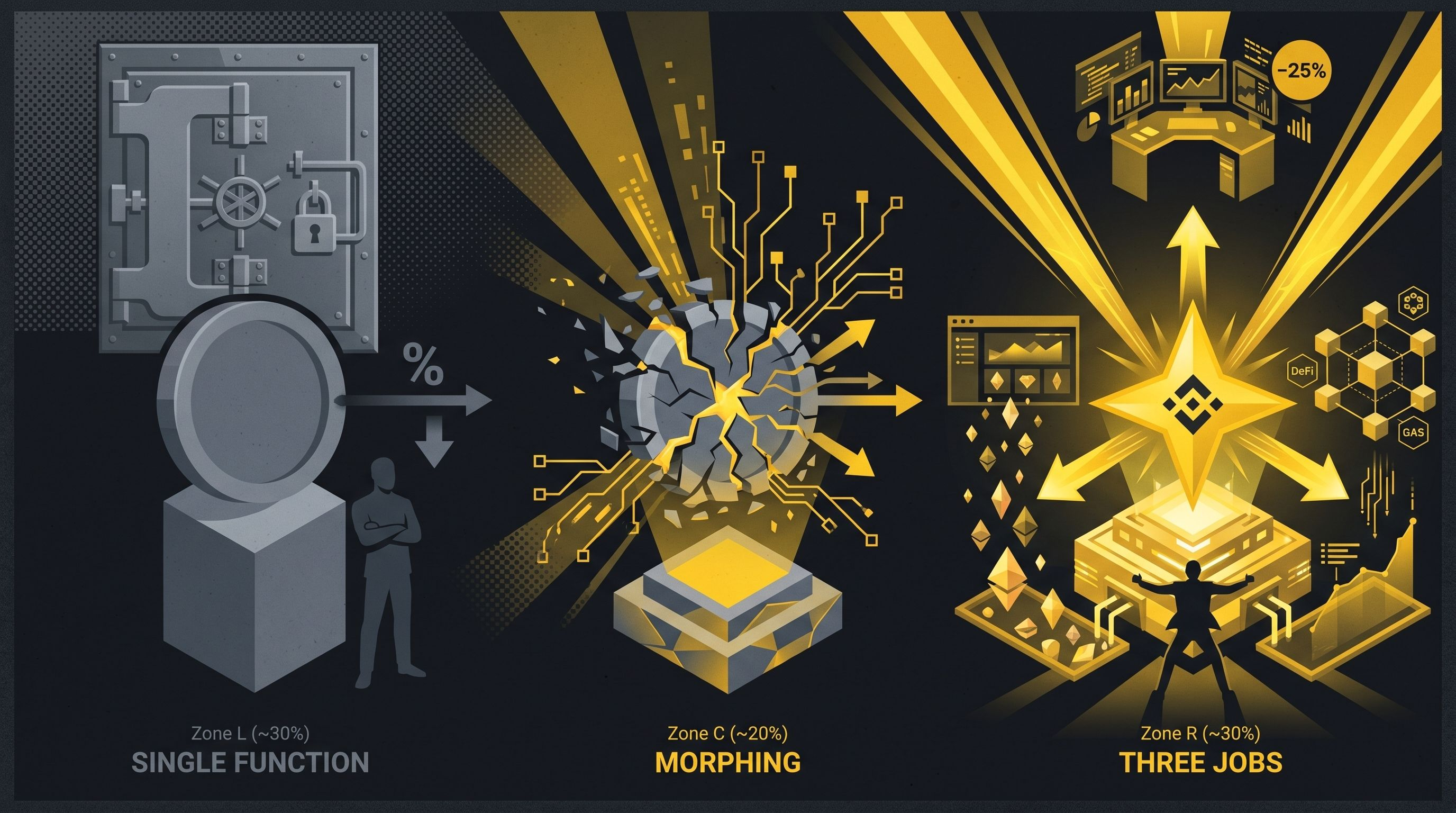
On the centralized side: BNB gives you trading fee discounts (up to 25% when paying fees in BNB), access to Launchpad token sales, Launchpool allocations, BNB Vault rewards, and various VIP and loyalty perks across the platform.
On the decentralized side: BNB is the native gas token for BNB Smart Chain and opBNB (the high-throughput Layer 2), the staking asset for validator nodes, and a governance instrument for protocol upgrades across BNB Chain.
That dual function — centralized utility and decentralized infrastructure role — is what makes BNB structurally different from most "exchange tokens," which exist mainly to offer a modest fee discount and nothing else.
Hold BNB, use Binance's ecosystem fully, and that BNB balance is simultaneously doing three things at once: saving you money on trades, generating yield and farming airdrops, and powering your on-chain activity. One asset, three jobs.
The Network Effect Nobody Talks About
Here's the part that explains why Binance keeps growing even as competitors spend aggressively to steal market share.
The more layers a user activates, the less likely they are to leave.
Not because of lock-in in the predatory sense — you can withdraw your funds any time. But because the value of the ecosystem compounds with depth. A user on Layer 1 only loses trade execution if they switch. A user active on Layers 1 through 6 loses their yield positions, their Launchpool allocations, their Copy Trading setups, their AI Pro context, their on-chain activity, their Square feed, and their BNB fee discount tier — all simultaneously.
Switching cost isn't a wall. It's a slow accumulation of value that becomes increasingly inconvenient to abandon.
This is the WeChat dynamic. This is the Grab dynamic. This is why super apps, once they reach critical feature depth, tend to become default infrastructure rather than apps that compete on a single dimension.
The difference is Binance is doing this globally, for finance, without the geographic constraints that limited WeChat to China or Grab to Southeast Asia.
Your 30-Day Starter Path
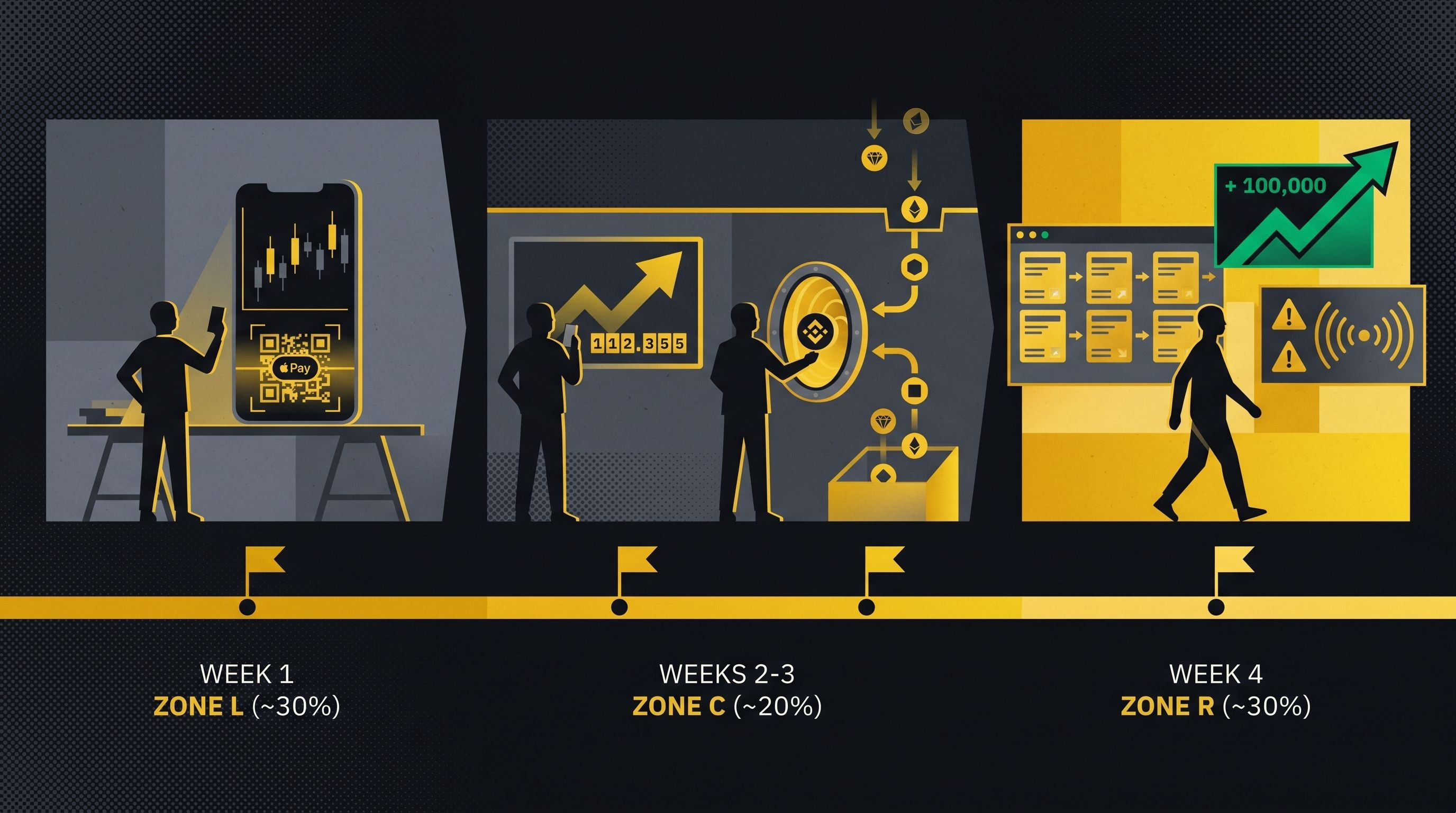
If you're reading this and realizing you're living in Layer 1, here's the fastest path to ecosystem depth without feeling overwhelmed. Five products. Thirty days.
Week 1 — Spot + Convert + Pay
You likely already have Spot. Add Convert for frictionless swaps on pairs where you don't need order book precision. Then send 5 USDT to a friend via Binance Pay. Just to feel how payments work on these rails. It takes 30 seconds and costs nothing.
Week 2 — Earn (Flexible)
Move idle stablecoins or BTC into Flexible Earn. It's not about the yield percentage. It's about the habit of not letting capital sit dormant. This is the mental shift that changes how you think about your balances.
Week 3 — BNB + BNB Vault
Build a starter BNB position. Enable fee discounts. Subscribe your BNB to BNB Vault and let it run. Watch the Launchpool and HODLer Airdrop allocations come in. This is where the ecosystem starts feeling like it's working for you rather than requiring constant input.
Week 4 — Copy Trading or AI Pro
Pick one based on how you learn: Copy Trading if you want to observe real strategies in action and understand how experienced traders structure positions. AI Pro if you want a smarter research workflow and an AI layer on top of your own trading ideas.
By the end of that 30-day window, you will have activated trading, yield, payments, discovery, and either automation or AI — the core five pillars — and you'll start to see the connections that aren't visible from the Spot screen alone.
The Bigger Picture
Here's the thesis, stated plainly:
Binance is not building features. It is building a financial operating system.
The exchange is the front door. Earn is the savings layer. Pay is the payments rail. BNB Chain is the infrastructure backbone. Alpha and Research are the intelligence layer. Copy Trading and AI Pro are the automation layer. And BNB is the access key that ties all of it together.
The vast majority of its 270+ million users are using the front door and calling it a tour.
The users who understand the full map — who activate multiple layers, accumulate BNB, and let the ecosystem compound — are extracting a fundamentally different level of value from the same account. Same platform. Different game.
And the floor plan is right there. Most people just haven't looked up from the Spot chart long enough to see it.
Already on Binance? The fastest next move is simple: check how many of the six layers you're actually using. Then pick one you've ignored and spend an hour understanding it. That's how the map starts to make sense — not all at once, but one layer at a time.