
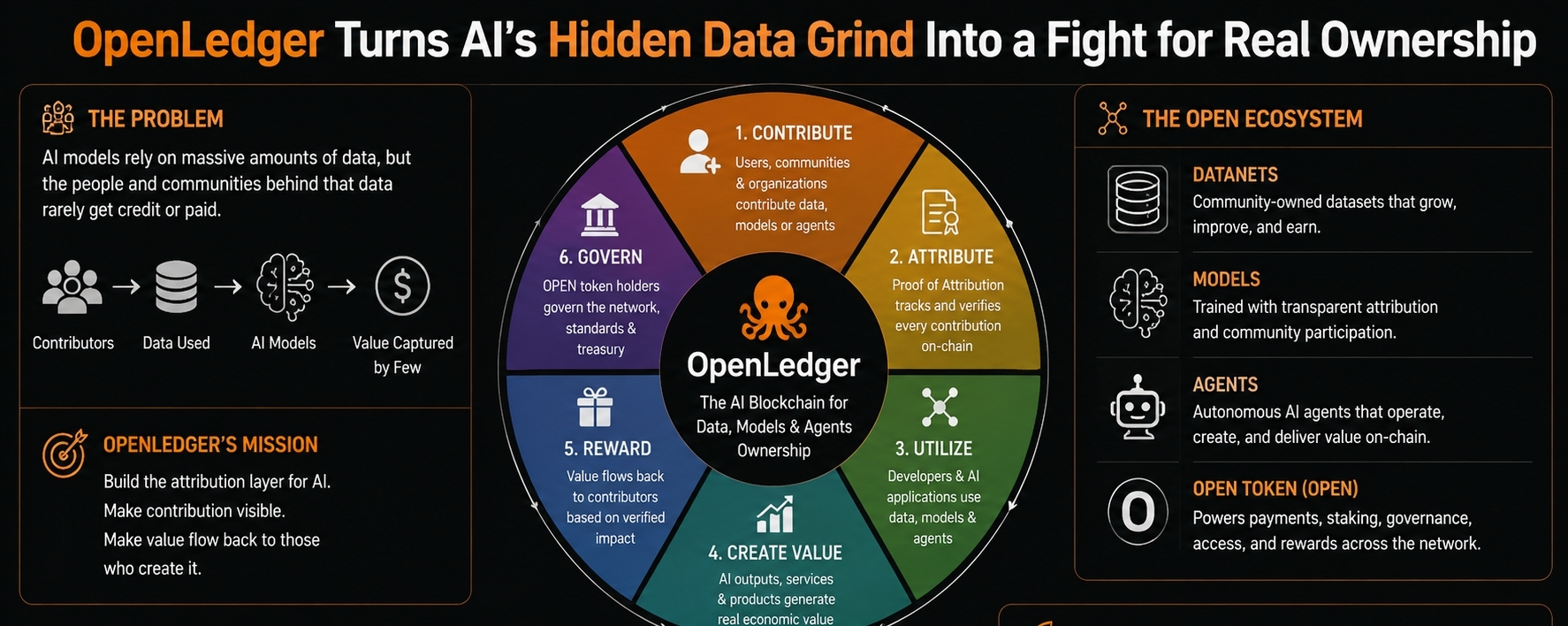

OpenLedger starts from a problem I’ve seen crypto projects talk around for years, usually with nicer words than they deserve.
AI does not create value from nothing. It eats data. It absorbs behavior, content, research, code, patterns, community work, and all the small invisible inputs that never make it into the investor deck. Then someone else monetizes the output.
That is the part OpenLedger is trying to touch.
Not the glossy part of AI. Not the clean demo. The dirty middle layer where data becomes model performance and nobody can clearly explain who should get paid.
I’ll give OpenLedger credit for picking a real problem. Most AI crypto projects still sound like they were built by recycling the same five buzzwords until a token came out the other side. Agents. Compute. Intelligence. Network. Future. Fine. We have heard it all. OpenLedger is at least aiming at something more uncomfortable: attribution.
OPEN, the native token, is supposed to sit inside that system. Rewards, access, payments, staking, governance, model usage, data activity — all of it is meant to move through the network in some form. That is the clean version.
The version I care about is rougher.
Can OpenLedger actually prove who contributed value to an AI model?
Because that is not a small technical feature. That is the whole fight.
A model is not a simple machine where one input creates one output. It is a messy pile of training data, weighting, fine-tuning, prompts, architecture choices, hidden dependencies, and user behavior. Anyone pretending attribution is easy has either not looked closely enough or is selling something.
OpenLedger is trying to build what feels like an economic memory for AI. That phrase sounds heavy, but it fits. The project wants data, models, agents, and contributors to stop being disconnected pieces floating around in the dark. It wants contribution to be tracked. It wants value to be assigned. It wants the people feeding the machine to have receipts.
Receipts matter.
Especially now.
The AI market has this strange moral tension underneath it. Everyone knows models are trained on oceans of human work. Everyone knows value is being extracted. Everyone also knows most contributors will never see a cent unless some new structure forces the issue. OpenLedger is trying to build that structure through Proof of Attribution.
That is the part I keep coming back to.
Not because it is guaranteed to work. It is not. I’ve seen too many projects confuse a good ethical argument with a working market. Crypto is brutal that way. A concept can be correct and still fail because nobody uses it, nobody pays for it, or the token economics slowly bleed the whole thing dry.
OpenLedger’s Datanets are probably the most important piece to watch. The idea is that datasets should not just sit there like dead files. They should become living economic networks. People contribute data, clean it, improve it, organize it, and connect it to model training. If that dataset becomes useful, the contributors are supposed to stay linked to the value it creates.
That is the pitch.
I like the shape of it. I’m not ready to trust it.
The reason is simple: data markets are hard. Really hard. People love talking about data as an asset, but the minute you try to price it, rank it, verify it, and reward it fairly, the whole thing turns into a grind. Bad data shows up. Spam shows up. Incentive farmers show up. People game the system. Contributors argue about value. Developers leave if the flow becomes too slow or too expensive.
This is where OpenLedger either becomes useful or becomes another noble machine nobody bothers turning on.
The project’s focus on specialized AI makes sense. That is one of the few areas where I think the market is still underestimating the shift. General models are impressive, but real economic value often lives in narrow datasets. Finance data. Healthcare data. Legal workflows. Robotics. Gaming behavior. Regional languages. On-chain activity. Enterprise processes nobody outside a company ever sees.
That kind of data is not just information. It is edge.
If OpenLedger can help communities turn that edge into usable models and recurring rewards, then there is something here. Something real. But that is a big if, and I have learned to respect big ifs.
OPEN’s future depends on whether the token is actually needed.
That sounds obvious, but crypto forgets it every cycle. A token can appear in every diagram and still have weak value capture. It can be used for governance nobody cares about. It can be paid out as rewards and instantly sold. It can sit beside a good product without becoming a good asset.
I’m looking for the moment this actually breaks into usage.
Not announcements. Not partnerships written like press releases. Not another clean graphic showing data flowing into models and rewards flowing back out. I want to see contributors earning enough to care. I want to see developers choosing the network because it solves a problem better than the easier centralized route. I want to see Datanets that are not just incentive farms dressed up as communities.
That is the real test.
OpenLedger has chosen a difficult lane. That is both the compliment and the warning. It is not chasing the loudest part of the AI trade. It is trying to price the input layer, the part most users ignore until ownership becomes impossible to avoid.
There is a strange kind of fatigue in this market now. People are tired of AI tokens. Tired of recycled promises. Tired of projects that talk like they are building the future but cannot keep users after the first reward campaign dries up. OpenLedger has to push through that noise with proof.
No shortcut there.
The stronger version of OpenLedger is compelling. Data stops being invisible. Contributors get linked to value. Models become less of a black box. Agents and applications create activity that can be tracked, paid for, and governed. OPEN becomes part of a real machine rather than just another ticker riding the AI cycle.
The weaker version is also easy to imagine.
Attribution stays too abstract. Datanets stay thin. Token rewards get farmed. Developers do not come back. The market loses patience. OPEN becomes one more chart people remember only when they talk about how wild the AI narrative used to be.
I have seen that ending too many times.
So yes, OpenLedger is interesting. More interesting than most AI crypto projects, honestly. But interesting is not enough. The project has to prove that AI attribution is not just a beautiful idea for people who are tired of extraction. It has to become a market people use when nobody is forcing them to.