
i m noticing something strange happening in the AI world lately.
The more powerful artificial intelligence becomes, the less visible humans seem inside the system.
When i start using AI tools every day, i noticed something uncomfortable… these models sound intelligent, but their intelligence doesn’t appear from nowhere. Behind every answer, every prediction, every generated sentence, there are millions of invisible human contributions buried underneath. Writers, researchers, coders, artists, conversations, datasets, behaviors all quietly feeding machines that are now becoming billion-dollar industries.
But almost nobody gets paid for that intelligence extraction.
That was the moment i started paying attention to OpenLedger.
At first, i honestly thought it was another “AI + blockchain” project trying to survive on buzzwords. Crypto has already flooded the market with exaggerated AI narratives. Every project suddenly claims to be building the future of intelligence. But when i start reading deeper into OpenLedger’s architecture, whitepapers, token mechanics, and infrastructure design, i noticed something different.
This project is not trying to compete with ChatGPT.
It is trying to redesign the economic system underneath AI itself.
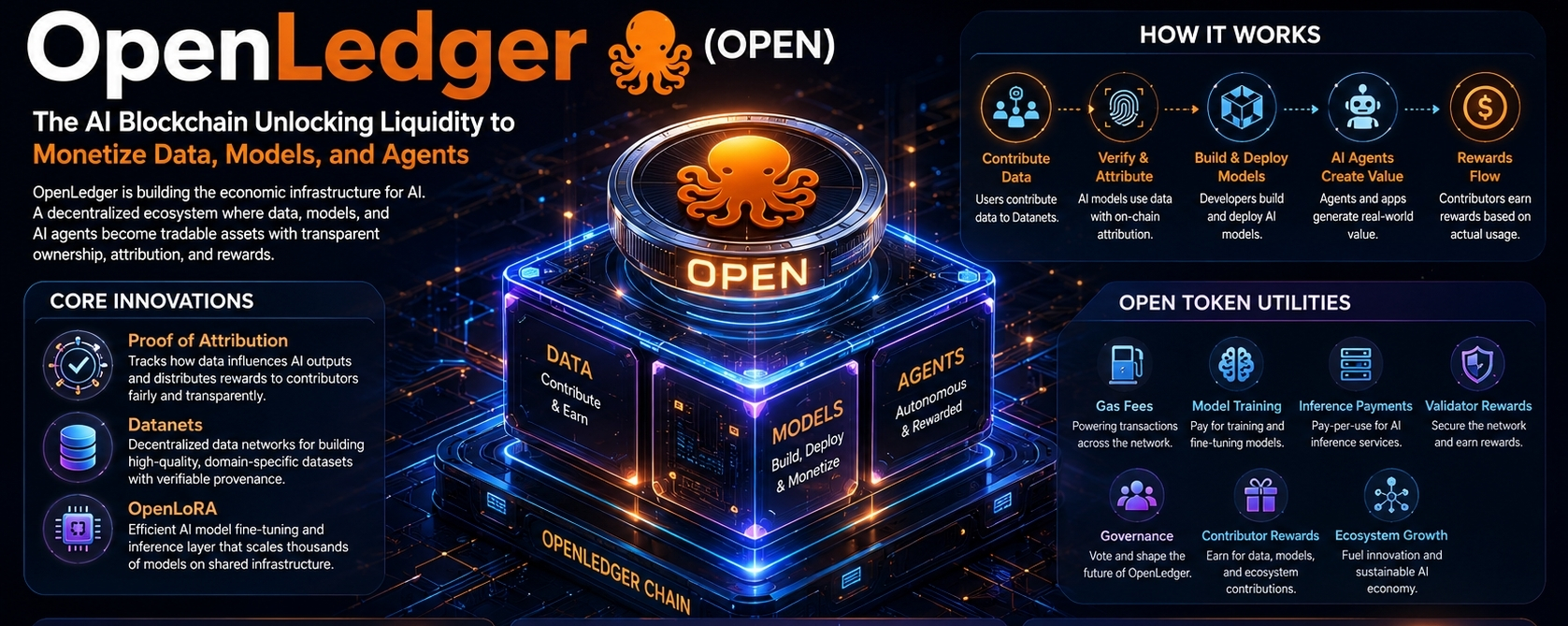
OpenLedger calls itself “The AI Blockchain,” but i think that phrase actually undersells what it is trying to build. The project is attempting to create a world where data, AI models, and autonomous agents become monetizable economic assets with transparent ownership and traceable contribution histories.
And honestly, the deeper i went, the more i realized this isn’t really a crypto story anymore.
It’s a story about ownership of intelligence.
When i start analyzing modern AI companies, i noticed the entire system works like a giant extraction engine. Data enters from millions of people, but value concentrates into a handful of corporations. The people generating the knowledge rarely receive recurring economic participation from the systems they helped create.
OpenLedger is trying to attack that exact imbalance through something called “Payable AI.”
The idea sounds simple when explained casually:
If your data helps power AI, you should earn from it.
But i noticed the real complexity begins after that sentence.
Because AI systems are chaotic. Training pathways overlap. Data influence becomes blurry. Models consume billions of signals simultaneously. So tracking which contributor influenced which output is an extremely difficult technical problem.
This is where OpenLedger’s biggest concept appears: Proof of Attribution.
And honestly, i think this mechanism is the true heart of the project.
When i first read about Proof of Attribution, i noticed many people describing it like a normal reward system. But it’s actually much more radical than that. OpenLedger is trying to create cryptographic attribution trails that track how datasets influence AI outputs and then distribute rewards accordingly.
That changes the psychology of AI completely.
Right now, data is treated almost like disposable fuel.
OpenLedger wants data to behave like productive capital.
That difference is massive.
Imagine a medical researcher contributing specialized datasets that help train an AI healthcare model. Every time the model generates valuable medical inference, contributors whose data shaped that intelligence could theoretically receive rewards automatically. The same idea could apply to legal AI, financial AI, robotics, autonomous agents, education systems, or even gaming ecosystems.
When i start thinking about that model deeply, i noticed OpenLedger is essentially trying to tokenize intellectual contribution itself.
Not attention.
Not memes.
Not speculation.
Contribution.
And maybe that’s why the project feels more philosophical than most AI crypto narratives.
One of the most interesting things i noticed is how OpenLedger keeps focusing on “Datanets.”
Most people talk about AI models constantly, but OpenLedger seems obsessed with the layer underneath models: specialized data.
That actually makes sense.
Because i noticing the AI industry slowly moving away from giant universal systems toward smaller domain-specific intelligence. Specialized healthcare AI needs healthcare data. Financial agents need financial behavior. Autonomous systems need contextual information. High-quality niche datasets may eventually become more valuable than generalized internet scraping.
Datanets are OpenLedger’s answer to that future.
These decentralized data ecosystems allow communities to build specialized datasets collaboratively while preserving attribution and ownership records on-chain.
And honestly, this may be one of the smartest parts of the architecture.
Because the real bottleneck in future AI may not only be compute power.
It may be trustworthy specialized data.
When i continue researching, i noticed another hidden layer most people barely discuss: OpenLoRA.
At first glance, it sounds technical and boring. But i think it quietly solves one of AI’s biggest economic problems operational cost.
AI deployment is insanely expensive. Running thousands of specialized models traditionally requires enormous GPU infrastructure. OpenLedger claims OpenLoRA allows many fine-tuned models to operate efficiently on shared hardware resources.
That matters much more than people realize.
Because decentralization only survives if economics work.
If decentralized AI becomes slower, weaker, and more expensive than centralized AI, then ideology alone won’t save it.
And this is where OpenLedger feels more serious than hype-driven projects. i noticed they are not only talking about fairness and decentralization. They are trying to solve infrastructure efficiency too.
The OPEN token itself also feels deeply embedded into network behavior instead of artificially attached for marketing purposes. OPEN powers gas fees, governance, model deployment, inference payments, attribution rewards, and validator coordination across the ecosystem.
That creates an interesting economic structure.
Every AI interaction inside the network potentially creates a flow of value between:
users,
models,
validators,
data contributors,
and infrastructure participants.
It almost starts looking less like a blockchain…
…and more like an economic nervous system for machine intelligence.
When i start exploring community discussions around OpenLedger, i noticed people describing it as a solution to the “data liquidity problem.”
Honestly, i think that phrase perfectly captures the entire vision.
Because data today behaves like trapped wealth.
Huge amounts of valuable information sit isolated inside corporations, research silos, private APIs, centralized platforms, and inaccessible systems. OpenLedger is trying to transform that trapped information into programmable economic infrastructure.
That could become extremely important in the future.
Especially because AI agents are evolving fast.
And i don’t think most people fully understand what AI agents will eventually become.
When i start noticing how autonomous systems are developing, i realized future agents won’t simply answer questions. They may negotiate contracts, manage treasuries, execute trades, coordinate logistics, conduct research, and operate semi-independently across digital economies.
But autonomous agents create a terrifying problem too:
Trust.
How do you verify what influenced an agent’s decision?
How do you audit reasoning?
How do you identify data provenance?
How do you prevent manipulation?
OpenLedger repeatedly focuses on explainability, verifiability, and attribution for exactly this reason.
And i think that becomes much more important once AI systems start handling real economic value autonomously.
Still, i don’t think the road ahead is simple.
Actually, the more i researched OpenLedger, the more i noticed how difficult its mission truly is.
Proof of Attribution sounds brilliant conceptually, but attribution inside massive AI systems is extremely complicated. Models are probabilistic. Data overlaps. Influence becomes blurry. Scaling transparent attribution across complex inference systems may become one of the hardest engineering problems in decentralized AI.
There’s also another uncomfortable reality i noticed:
Most users don’t care about ideology.
They care about speed.
Convenience.
Performance.
If centralized AI remains faster and cheaper, decentralized alternatives could struggle badly no matter how beautiful the vision sounds.
And this is where OpenLedger’s future probably depends on execution more than narrative.
Because the project is not competing against weak startups.
It is indirectly challenging some of the most powerful technology companies on Earth.
Still… i can’t ignore how important these ideas are becoming.
When i step back and look at the bigger picture, i noticing something deeper happening across the internet right now.
For years, the internet monetized human attention.
Now AI is beginning to monetize human intelligence.
That changes everything.
And the biggest question of the next decade may not be: “Which AI becomes smartest?”
It may actually become: “Who owns the intelligence economy?”
That’s why OpenLedger feels important to me.
Not because success is guaranteed.
Not because every technical promise will definitely work.
But because the project is asking the right questions before most people even realize the questions exist.
Questions about:
ownership,
attribution,
transparency,
contribution,
and economic rights in an AI-driven world.
When i first started researching OpenLedger, i expected another temporary crypto trend.
What i found instead was a project trying to build financial infrastructure for intelligence itself.
And honestly…
that may become one of the most important battles of the AI era.