

Everyone talks about making AI safer. Nobody talks about making ai accouuntable at the infRastructure level.
That Distinction Is Where Most of the Serious thinking stops.
Safety is a feature Accountability is architecture. You can add safety layers on top of any system. Accountability has to be built into the foundation nto how data moves how models learn and how outputs get traced back to their origins. Without that foundation every safety claim is essentially unverifiable.
The AI industry has a provenance problem that does not get discussed honestly. When you interact with any major AI system today, there is no mechanism zeroto trace which data influenced which output. The model ingested billions of data points from sources it never disclosed. The people whose writing, research, images, and creative work trained that model received nothing. No credit. No compensation. No visibility.
I find this more troubling the longer I think about it.
It is not just an ethical problem. It is a structural one. If you cannot trace where an AI answer came fromyou cannot audit it. If you cannot audit it, you cannot verify it. If you cannot verify it, every OUtput carries an invisible uncertainty that compounds across every downstream use in healthcare n law in financial decisions, in government policy.
OpenLedges answer to this is Proof of Attribution consensus mechanism that cryptographically links AI outputs to their original data and model sources, creating an immutable on chain record of contribution. Every data point that influenced a model output gets recorded. Every contributor gets a traceable, verifiable claim to their role in what the model produces.
This is not a transparency dashboard bolted onto an existing system. It is a different consensus mechanism entirely.
The implications are more significant than they first appear. When attribution is on chhain and immutable, it becomes possible to do things that are currently impossible. Audit the training history of any model. Verify the data sources behind any output. Hold AI developers accountable in ways that require actual evidence rather than self-reported disclosures. Pay contributors automatically when their data is used not as a Courtesy, but as a protocol llevel enforcement.
I have spent time thinking about what actually changes when attribution becomes infrastructure rather than policy.
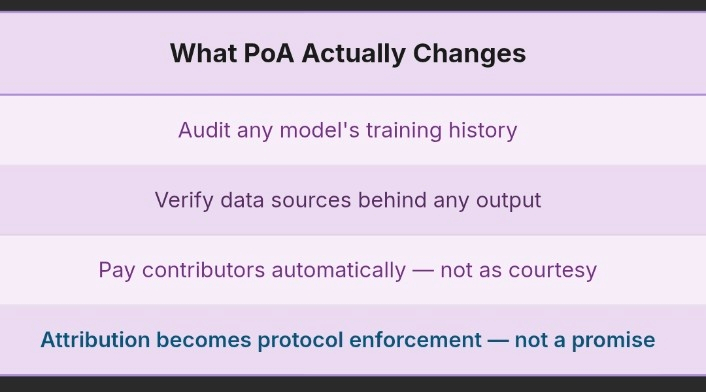
The answer is enforcement changes. Right now, attribution is something AI companies promise when it is convenient and ignore when it is not. When attribution is embedded in a consensus mechanism, it is not a promise anymore. It is a precondition for the network to function.
The challenge and this is the part worth sitting wit is adoption. A consensus mechanism for attribution only matters if the models being trained are actually using it. OpenLedger needs developers to build on the protocol, data contributors to use Datanets, and enterprises to care enough about verifiable provenance to make the transition from centralized systems.
That is a harder problem than the technical architecture.
The technical problem of building Proof of Attribution is genuinely difficult but it is a defined problem with a known solution space. The adoption problem is messier. Enterprises move slowly. Developers gravitate toward existing infrastructure. The ecosystem needs enough critical mass to be useful before it is useful enough to attract critical mass.
Whether OpenLedger can thread that needle building sufficient adoption before the window closes on decentralized AI infrastructure is the question that matters more than any whitepaper detail.
What would it take for you to trust an AI output more knowing the model was safer, or knowing exactly what data trained it?