It looks like a dataset sitting unused.
A small model trained for one narrow purpose.
An agent built for a task that only a few people understand.
A piece of knowledge inside a company that never becomes part of a wider system.
Most of it is quiet.
That is maybe the strange part. AI feels loud from the outside, because the products are everywhere now. New tools, new agents, new model releases, new promises. But underneath all of that, there is a lot of useful material that never really moves.
It exists, but it does not have liquidity.
And that word matters here.
Liquidity is usually used in markets. It means something can move, be priced, be exchanged, be used without too much friction. But with AI, liquidity is not only about tokens or trading. It is also about whether useful knowledge can actually find a path into something productive.
A dataset can be valuable, but only if the right model can use it.
A model can be valuable, but only if someone can access it, improve it, or build with it.
An agent can be valuable, but only if its work can connect to demand.
Without those paths, value stays stuck.
OpenLedger seems to be built around this stuck value.
That is a different way to look at it. Not just as an AI blockchain, and not just as another project trying to attach crypto rails to AI. More like an attempt to create movement around AI assets that are usually hard to move.
Data, models, and agents are becoming a kind of new productive layer. They are not physical goods, but they also are not just ideas. They can create output. They can reduce work. They can improve decisions. They can help other systems function better.
But they are difficult to treat as assets because they are often messy.
Data is hard to verify. Models are hard to compare. Agents depend on context. Ownership is not always clear. Usage is not always easy to track. And when something cannot be tracked or understood, it becomes harder to value.
That is where things get interesting.
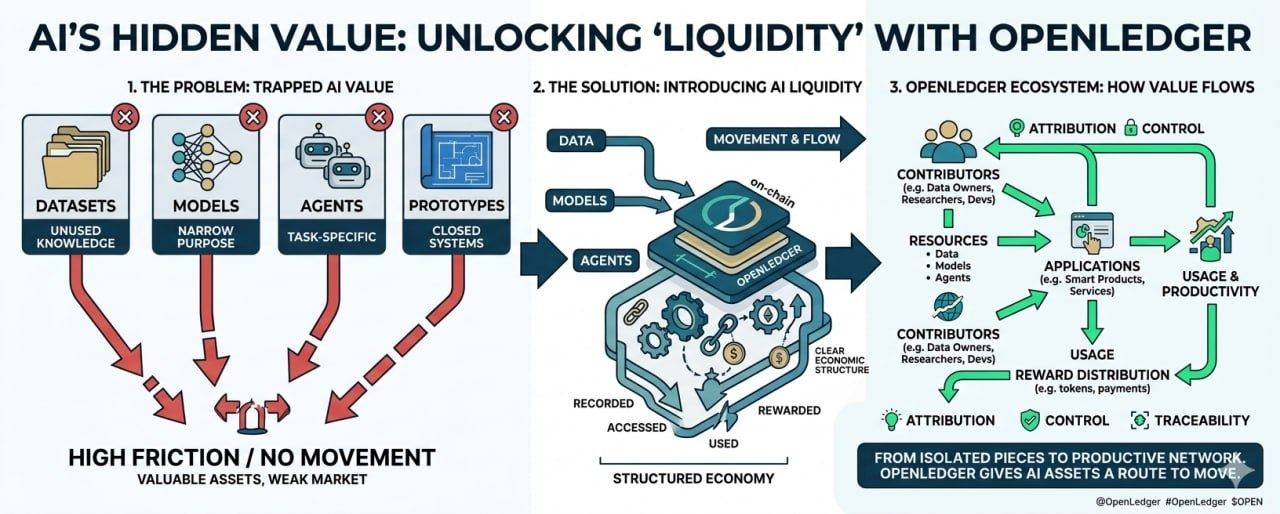
OpenLedger appears to be working on the idea that these AI pieces need a clearer economic structure around them. Not necessarily a loud one. Just something that lets them be recorded, accessed, used, and rewarded in a more open way.
Because right now, a lot of AI value is trapped inside closed places.
A company may have useful data but no simple way to monetize it without giving up too much control. A researcher may have a specialized model but no easy path to distribution. A developer may create an agent that solves a real problem, but the value of that agent may depend on many hidden resources. In each case, the asset exists, but the market around it is weak.
So the problem is not only creation.
It is circulation.
You can usually tell when a technology space is maturing because the question changes. At first, people ask, “Can we build this?” Later, they ask, “How does this flow?” How does value move between builders, users, contributors, and systems? How does one piece connect to another without everything becoming locked behind private walls?
AI is starting to face that question.
OpenLedger’s role seems to sit somewhere in that shift. It is trying to make AI-related assets more liquid by giving them a place where their use and contribution can be recognized. Data can be connected to models. Models can be connected to agents. Agents can be connected to real usage. And if those connections are visible enough, then value has a better chance of moving through the system.
That does not mean everything becomes simple.
It will still be hard to judge quality. A dataset is not valuable just because it exists. A model is not useful just because it is on-chain. An agent is not meaningful just because it can perform actions. Real value still depends on usefulness, demand, and trust.
But having a structure helps.
Without structure, useful AI assets can remain scattered. With structure, they can start to behave more like part of a larger network. Not in a dramatic way. More like roads being built between places that were already there.
That image feels closer to the point.
OpenLedger is not just about creating new AI things. It is more about giving existing and future AI things a route to move. A dataset can find a model. A model can support an agent. An agent can create activity. And that activity can flow back into the system as value.
The idea of monetization becomes less flat when seen this way.
It is not only “sell your data.” That phrase feels too simple. Most people do not want to just throw data into a market and hope something happens. They want control. They want attribution. They want to know whether the thing they contributed continues to matter after it is used.
The same goes for models and agents.
If a small model helps power a larger product, should it disappear from the value chain? If an agent uses specialized knowledge, should that knowledge become invisible? If data improves performance over time, should the reward happen only once?
These are not easy questions.
But they are the kinds of questions that appear when AI becomes more than a tool and starts becoming an economy.
OpenLedger seems to be looking at that economy from the infrastructure side. It is asking how AI assets can be made easier to use, easier to trace, and easier to reward. That is a quieter angle than talking about intelligence itself, but it may be just as important.
Because intelligence without movement can become trapped.
And value that cannot move is often undervalued.
Maybe that is why liquidity is such a useful word here. It points to the hidden issue behind many AI systems. Not only whether something is smart, but whether it can enter the right place at the right time, be used by the right people, and return value to the right contributors.
That is not a finished story.
It depends on builders, users, data owners, and whether the system can make participation feel practical instead of complicated. It depends on whether real demand forms around these AI assets, not just interest from people watching the sector.
Still, the direction is worth noticing.
OpenLedger is trying to give AI’s hidden value somewhere to move.
And maybe, as AI keeps growing, that movement becomes just as important as the models themselves…

Articolo
A lot of value in AI does not look like value at first.
Disclaimer: Include opinioni di terze parti. Non è una consulenza finanziaria. Può includere contenuti sponsorizzati. Consulta i T&C.