

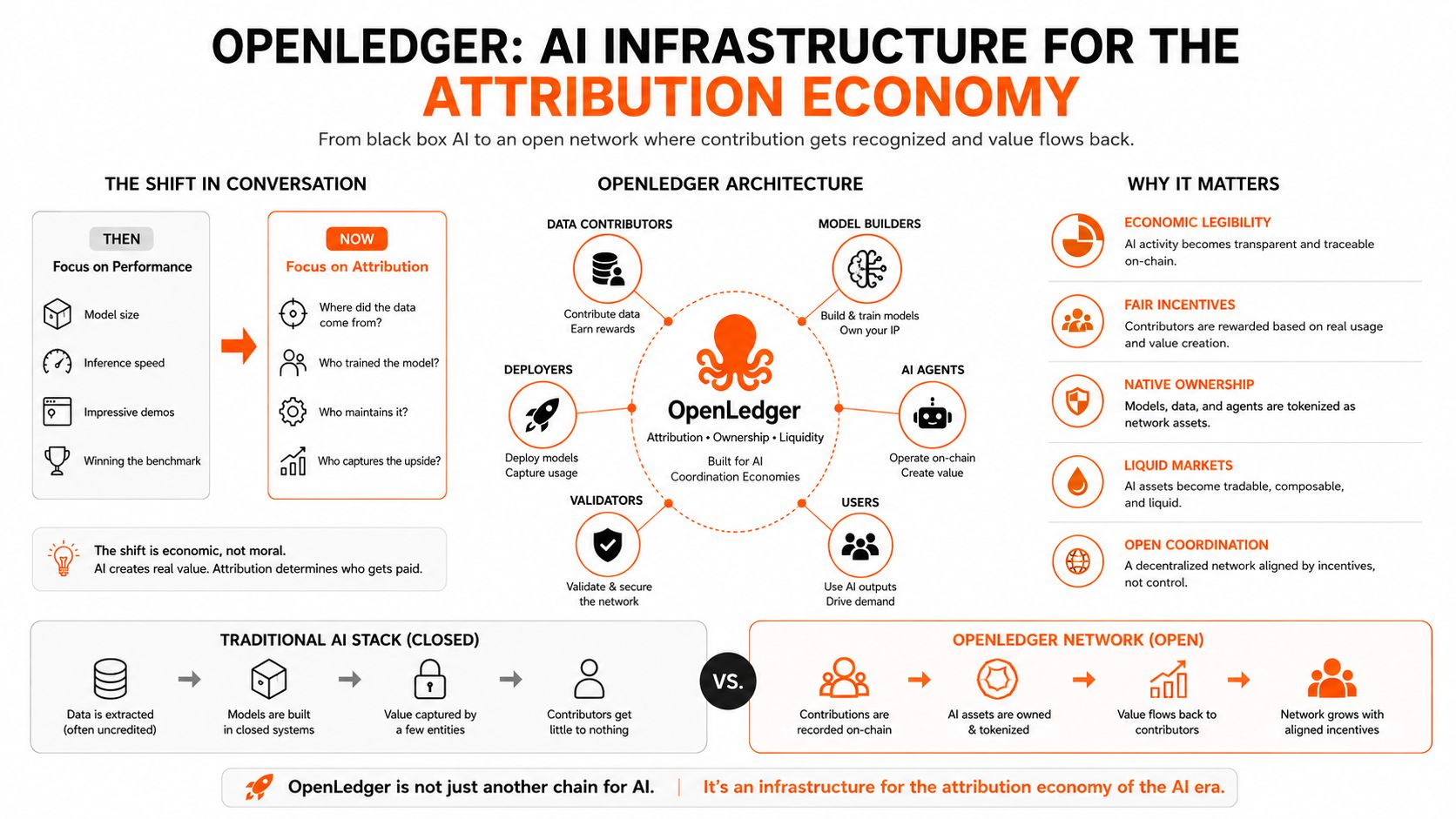
I keep noticing how the AI conversation is changing in crypto. A year ago almost everything was about model size, inference speed and who could push out the most impressive demo. Now the tone feels different. People still talk about performance, but underneath that there’s another layer entering the market quietly attribution.
Not because the industry suddenly became ethical. I honestly do not think most participants care much about ethics. The shift feels more economic than moral. Once AI started generating real money everyone began asking who deserves a piece of the value chain. Where did the data come from. Who trained the model. Who maintains it. Who captures the upside after deployment.
That is probably why OpenLedger started making more sense to me recently.
At first I thought it was just another AI blockchain trying to attach itself to the narrative cycle. There are too many of those already. Most of them talk about decentralization in abstract ways while still relying on closed systems underneath. But the more I looked into OpenLedger, the more it felt less like a hype project and more like an attempt to restructure incentives around AI itself.
The important part is not even the chain. It is the assumption behind the chain.
OpenLedger seems built around the idea that AI networks eventually become coordination economies. Not just software products. The value is not isolated inside one model anymore. It spreads across datasets, contributors, deployers, validators, agents and users interacting with outputs. Once that happens, attribution becomes financially important.
That changes infrastructure design completely.
OpenLedger’s architecture feels centered around this shift. Instead of treating AI as a black box that sits outside crypto, it pulls participation directly on chain. Data contributors, model builders and AI agents become part of the network economy itself. Ownership and liquidity are attached to AI assets in ways that look more native to crypto coordination.
I think that is the real distinction.
A lot of AI projects on chain still feel like wrappers around existing AI services. @OpenLedger feels more interested in creating a system where AI activity itself becomes economically legible. Models are not just APIs. They become network assets. Data is not treated as a free raw material forever. Contributors are supposed to receive incentives tied to usage and value creation.
Whether that actually works long term is still unclear to me.
Data monetization sounds attractive in theory. Everyone likes the idea of owning their contribution. But maintaining high quality data markets is difficult even in centralized systems. On chain incentives can easily attract spam, manipulation, or low effort participation if rewards become the primary driver.
I think OpenLedger understands this tension, which is why its incentive structure matters more than its branding.
The network keeps pushing this idea that contributors should be economically aligned with AI growth. That includes people supplying data, developers deploying agents, and participants helping models evolve inside the ecosystem. The interesting part is that OpenLedger does not frame AI participation as passive consumption. It frames it as network labor.
That feels very crypto native to me.
Crypto has always been better at coordinating strangers through incentives than through ideology. Bitcoin miners did not secure the network because they loved decentralization theory. Liquidity providers do not spend hours optimizing positions because they believe in financial freedom. Most systems scale when incentives become clear enough.
OpenLedger seems to apply that same logic to AI infrastructure.
The blockchain layer matters here because attribution needs settlement. If models, agents and data interactions generate value across thousands of participants, there has to be an ownership framework underneath. OpenLedger being Ethereum compatible makes this more practical than experimental. Wallet integration and smart contract support allow AI activity to plug directly into existing crypto behavior instead of building isolated ecosystems from scratch.
I think that compatibility is underrated.
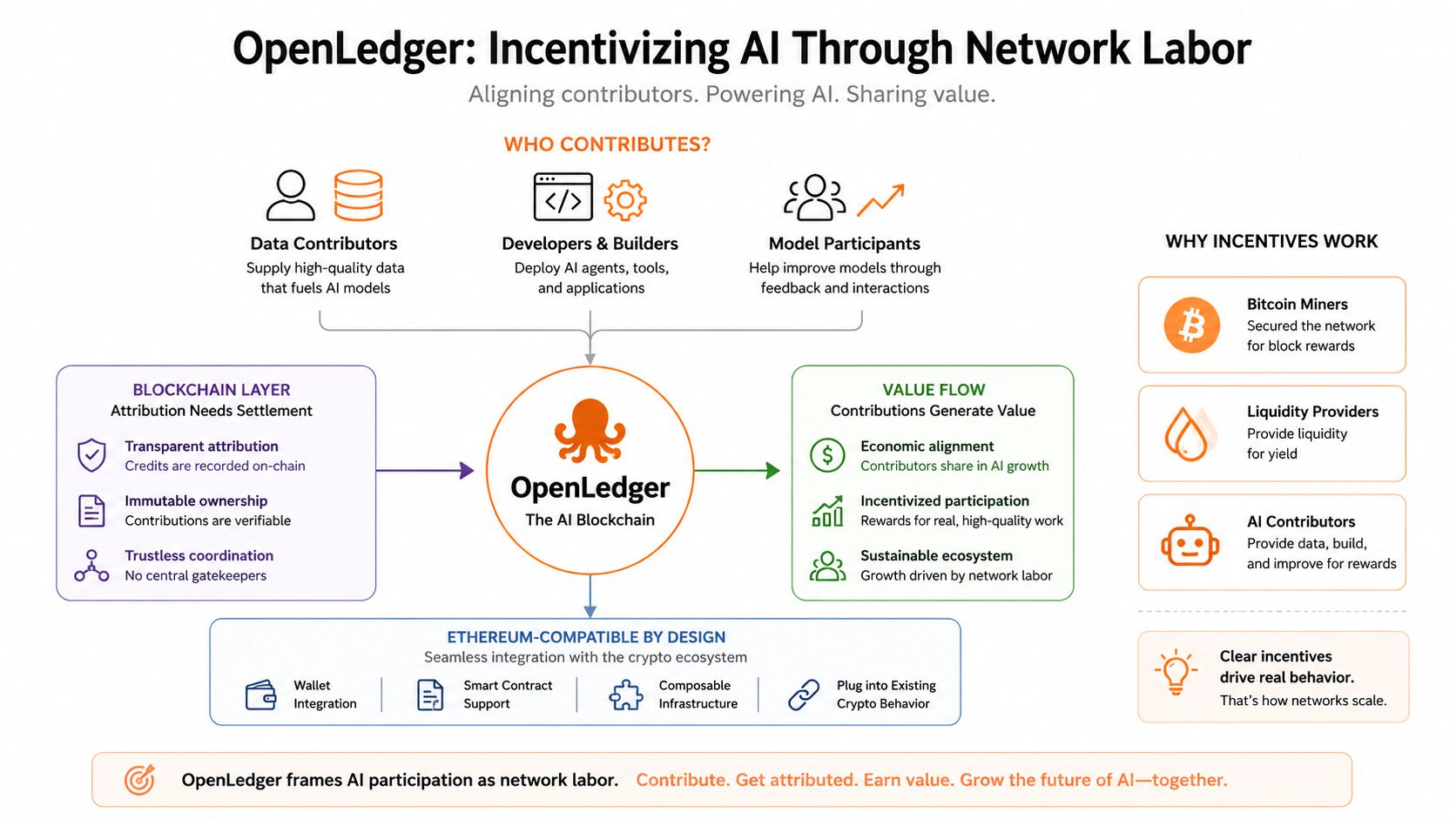
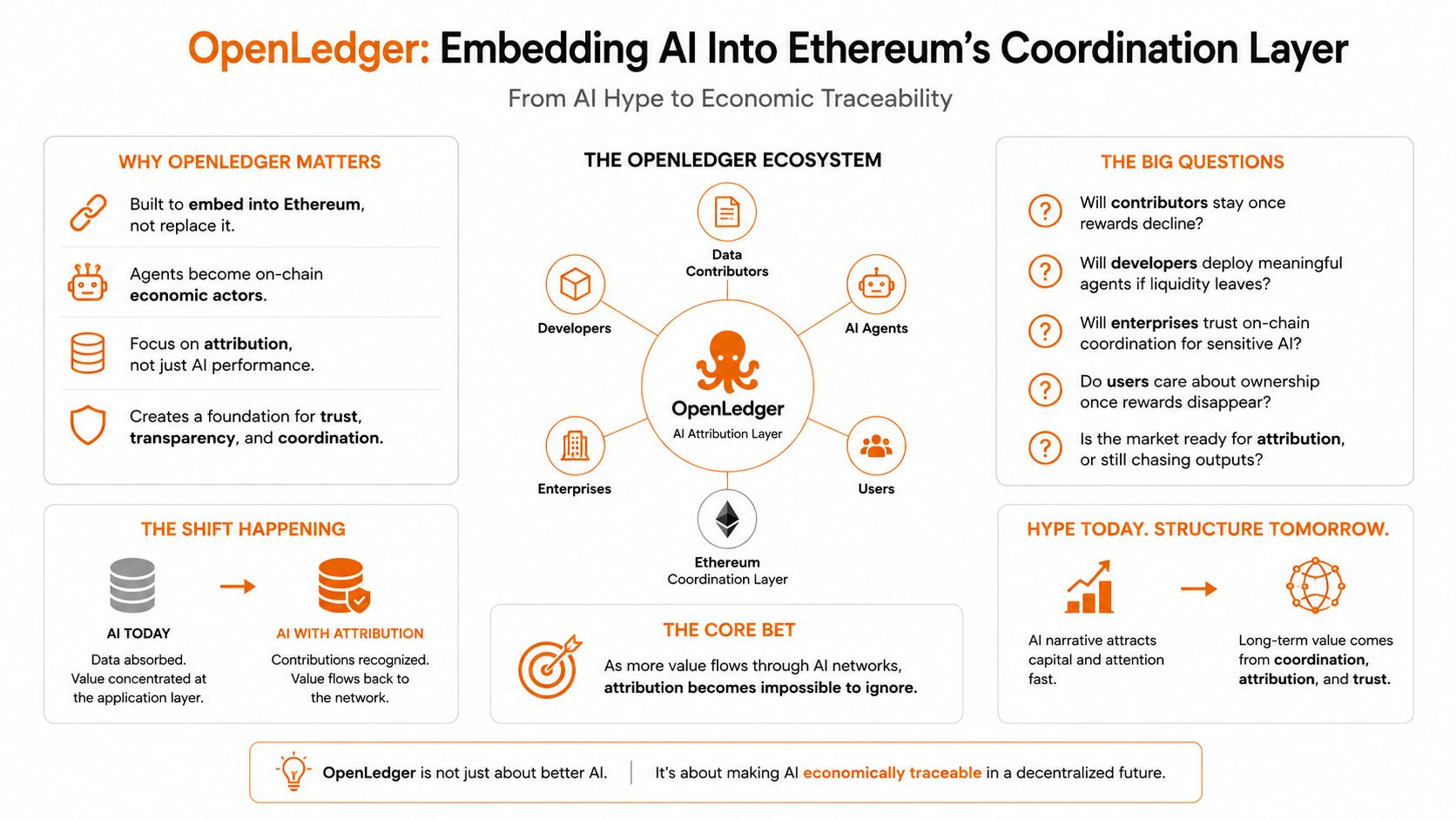
A lot of newer AI chains try to replace existing crypto infrastructure entirely. OpenLedger feels more interested in embedding itself into Ethereum’s coordination layer while specializing in AI participation. That is a much more believable path to adoption in my opinion.
The agent deployment side is also interesting because it changes how AI is perceived inside the network. Agents are not just tools running externally. They become active economic actors capable of participating in on chain systems. That sounds futuristic at first, but parts of crypto are already moving there slowly.
Still, I wonder how much of this demand is real versus speculative.
Right now AI attracts capital almost automatically. Projects connected to the narrative receive attention faster than they probably should. OpenLedger benefits from that environment too. There is no point pretending otherwise. But I also think reducing it to AI hype misses something more structural happening underneath.
The market is slowly realizing that AI without attribution creates unstable economics.
If models absorb public and private data endlessly while value concentrates only at the application layer, contributors eventually push back. Maybe not because they want fairness but because they want exposure to upside. OpenLedger feels positioned around that realization more than around pure AI performance itself.
The difficult question is whether users truly care about ownership once rewards disappear.
A lot of decentralized systems look sustainable while emissions are high. The real test comes later. Will contributors still provide useful data if speculative incentives cool down. Will developers deploy meaningful agents if liquidity leaves. Will enterprises trust on chain coordination for sensitive AI workflows.
I do not think those questions have answers yet.
But I also think OpenLedger is touching a more important layer of the AI conversation than most projects are. It is less focused on making AI louder and more focused on making AI economically traceable.
That might end up mattering more than people expect.
Or maybe the market is still too early for it. Maybe people still care more about outputs than origins. More about rewards than ownership. More about short term AI excitement than long term coordination systems.
I keep going back and forth on that.
Because OpenLedger does not really feel like a bet on better AI models to me. It feels like a bet that attribution eventually becomes impossible to ignore once enough money flows through AI networks.
I am just not fully sure the market has reached that point yet.
