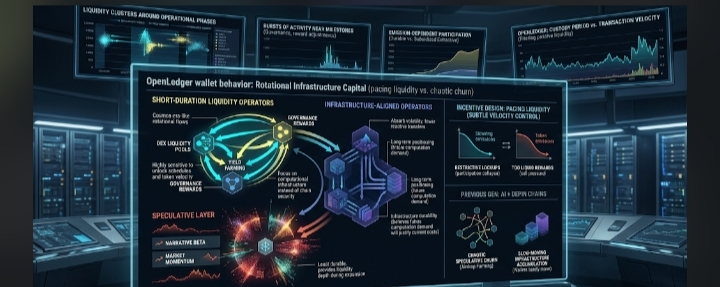
@OpenLedger #OpenLedger $OPEN When I first started watching OpenLedger activity onchain, the thing that stood out wasn’t transaction volume itself. It was the rhythm of wallet behavior. Most AI-related chains I’ve tracked over the last two cycles tend to show one of two patterns early on: either chaotic speculative churn dominated by airdrop farming, or slowmoving infrastructure accumulation where wallets barely move because operators are positioning for longduration participation. OpenLedger sits somewhere in between, and that middle ground tells you a lot about how the market currently values AI infrastructure versus AI speculation.
The wallets interacting consistently with the network don’t behave like pure DeFi mercenaries. They also don’t behave like early validator sets on traditional Layer 1 launches where operators aggressively lock capital for governance influence. Instead, what I see is rotational infrastructure capital participants willing to commit resources temporarily as long as computation demand, rewards, and liquidity depth remain synchronized.
That distinction matters.
In practice, AI-linked crypto networks live or die based on whether capital believes future computation demand will actually materialize. Markets are no longer pricing AI narratives purely on headlines. After the 2023–2025 AI token expansion, traders became far more sensitive to one question: does the protocol create recurring economic activity, or is it simply emitting tokens to simulate usage?
Watching OpenLedger over time, the interesting part is how liquidity tends to cluster around operational phases rather than purely speculative catalysts. Wallet activity increases noticeably when new model participation incentives or noderelated requirements emerge. You can tell the ecosystem participants are watching reward efficiency closely because capital rotates rapidly toward periods where infrastructure contribution generates measurable yield relative to token volatility.
That’s a very different behavioral profile from what we saw during earlier DePIN or AI infrastructure waves where participants blindly accumulated exposure under the assumption that “AI plus blockchain” alone would sustain valuation multiples.
The participants inside OpenLedger appear to fall into three broad categories.
First, there are short-duration liquidity operators. These are the wallets that move aggressively between staking opportunities, liquidity incentives, and governance-related reward windows. They are highly sensitive to unlock schedules and token velocity. Their behavior resembles the Cosmos-era rotational capital flows I watched during the 2021 validator expansion cycle except now the focus is computation infrastructure instead of chain security alone.
Second, there are infrastructure-aligned operators. These wallets behave differently. They absorb volatility rather than flee from it. You see longer holding periods, more stable staking patterns, and fewer reactive transfers during market stress. That usually signals participants who are less concerned with immediate token appreciation and more focused on future network positioning. In AI networks specifically, these operators matter disproportionately because infrastructure durability depends on whether contributors believe future computation demand will justify current operational costs.
Third, there’s the speculative layer perpetual traders and volatility participants who treat the token as a narrative beta instrument tied to broader AI market momentum. This capital is the least durable, but ironically it often provides the liquidity depth that keeps the ecosystem functional during expansion phases.
The interaction between those three participant groups creates the real economic structure of the network.
What I find most revealing is how OpenLedger’s incentive design subtly attempts to slow capital velocity without completely locking it in place. That balance is extremely difficult to achieve in crypto. If rewards are too liquid, emissions immediately become sell pressure. If lockups are too restrictive, participation collapses because crypto capital hates uncertainty around opportunity cost.
OpenLedger appears designed around pacing liquidity rather than maximizing immediate TVL optics. That’s an important distinction experienced market participants notice quickly. The network’s structure seems less focused on attracting maximum short-term deposits and more focused on encouraging recurring operational participation tied to AIrelated contribution and validation cycles.
In other words, the system appears aware that infrastructure participants need predictable economic throughput, not just speculative token appreciation.
This changes how capital behaves.
When operators believe future rewards depend on maintaining ongoing participation rather than simply parking tokens, the network begins filtering out purely passive liquidity. That creates higher-quality participation, but it also reduces headline growth metrics. Markets often misinterpret this during early phases because they’re conditioned to equate explosive TVL growth with success.
But historically, the more durable crypto ecosystems were rarely the ones with the fastest early liquidity spikes. They were the ones where infrastructure commitments gradually became economically rational independent of emissions.
The microstructure around liquidity flow is also telling. Activity appears to intensify around operational milestones rather than broad retail speculation alone. You can see bursts of participation near governance adjustments, reward recalibrations, or infrastructure expansion phases. That pattern suggests the market is trading future network utility expectations more than simple momentum.
I’ve seen similar structures before in networks where operational participation itself becomes the economic product.
The critical issue, though, is whether OpenLedger can transition from incentive-driven coordination into genuine demand-driven infrastructure usage. That’s the phase where most AI crypto protocols fail.
Emissions can bootstrap activity temporarily. They cannot manufacture durable computation demand indefinitely.
The market eventually tests every protocol the same way: what happens when rewards compress?
If participation collapses immediately after incentives weaken, then the network was primarily subsidizing extractive liquidity. But if operators remain active because infrastructure positioning still carries future economic value, then the protocol begins evolving into a real economic layer instead of a cyclical rewards machine.
Right now, OpenLedger looks structurally more resilient than many AI-linked networks precisely because participant behavior doesn’t appear entirely emission-dependent. There are signs that some operators are positioning for longer-duration exposure tied to future AI coordination markets rather than near-term token farming alone.
That doesn’t eliminate risk. AI infrastructure remains one of the most capital-intensive and narrative-sensitive sectors in crypto. Computation markets can become brutally competitive once speculative liquidity fades. And if operational costs outpace real usage growth, even well-designed systems eventually experience capital exhaustion.
But I think what the market may be underestimating is how important liquidity pacing has become in this cycle.
The previous generation of crypto networks optimized for growth speed. Increasingly, the surviving networks are optimizing for capital durability.
That’s a very different game.
When I watch OpenLedger, I don’t see a protocol trying to maximize short-term speculative reflexivity at all costs. I see a network attempting to engineer slower-moving infrastructure commitment around AI coordination and computational participation. Whether that becomes economically durable depends less on narrative momentum and more on whether the ecosystem can sustain meaningful activity once the incentive curve inevitably flattens.
That’s the real test every serious infrastructure protocol eventually faces