
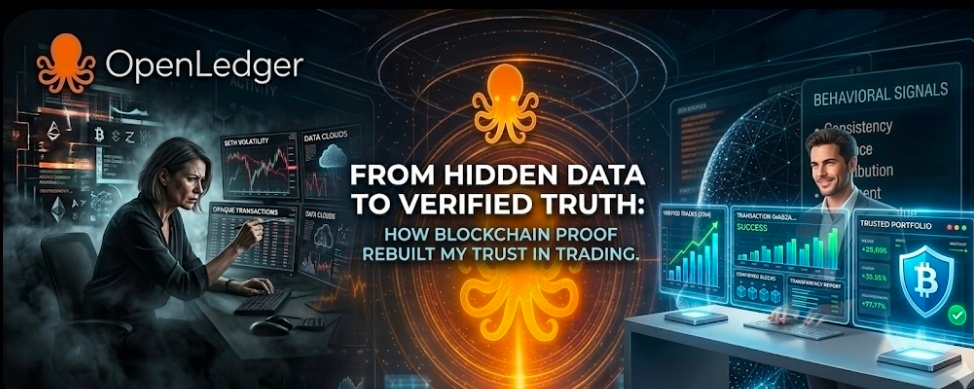

I need to tell you something that’s honestly changed the way I trade. I know how that sounds. In crypto, every project says it will change everything and then just gives you a fancy PDF.
I’ve been running trading bots for years, and I’ve bought plenty of tools that promised to make my models smarter and my profits bigger.
Almost all of them ended up being a pretty screen hiding someone else’s broken data.
So when I first heard about OpenLedger—a blockchain supposedly built just for data, AI models, and trading bots—I nearly laughed out loud.
What finally made me pay attention wasn’t a sales pitch. It was a costly mistake.
About eight months ago, a social media sentiment feed I was using in one of my trading bots started feeding me junk. I didn’t know it at the time. The numbers looked normal, my bot kept working, and everything seemed fine. Then, over two days, I lost a painful amount of money.
The “high-quality” data I was paying for had been quietly hijacked by a flood of fake bot activity. The labels were worthless, the people supposedly checking them didn’t exist, and no one—not my data seller, not their provider—could tell me where any of it actually came from. I was trading blind, and I’d paid for the privilege.
That night, staring at my losses, I decided I was finished with mystery-box data. I needed to know exactly where my information came from, and I needed real proof, not promises.
That’s the frustration I was carrying when I seriously dug into @OpenLedger .
The first idea that clicked for me was something called Data Capsules. I’ll explain it the way I actually use it, not the way a white paper does. Think of it like a sealed digital container for any dataset.
You take a spreadsheet of cleaned order book snapshots, a bunch of labeled tweets, satellite pictures for crop guessing—whatever.
You put it in the container. The actual files are stored on a scattered network like IPFS, but the container leaves a unique digital fingerprint on the blockchain: a code that proves the data is exactly what you say it is, plus a record of who made it, when, and under what rules. All of a sudden, the thing I’d been begging data sellers to give me for years—proof that this data was real and unchanged—was just there, locked on a public record that nobody could alter.
I took a dataset of Ethereum options prices that I’d spent six months cleaning by hand, wrapped it in a capsule, set a small fee in OPL tokens for anyone who wanted to use it, and turned it into a unique digital asset. It felt unreal. A few clicks and I had the kind of proof I’d thrown tens of thousands of dollars at and never got from supposedly professional data companies.
The second lightbulb moment happened when a group of data traders noticed my capsule. This group was focused on market swings, and they had their own datasets they were mixing and selling. They took my options data, blended it with theirs, and created a new shared capsule. The system automatically kept a public history of where everything came from, pointing straight back to my original work. Every time someone used that combined dataset, a tiny stream of OPL tokens trickled into my wallet. It wasn’t retirement money, but that wasn’t the point. For the first time ever, my data was being used by others, and I got paid without a single contract, invoice, or “just trust me” message. The credit trail was built in, automatic, and completely open to see.
Now, knowing your data’s history is great, but a trading model trained on dirty data is still a dirty model. The next piece that honestly surprised me was the idea of checkable training. Before, I’d rent a powerful computer from some cloud service, grab whatever data was lying around, run a training script, and hope I remembered to note which version of the data I actually used. Spoiler: I almost never did. With OpenLedger, you can rent computing power from a provider that uses a secure, protected area. You point the job at specific Data Capsules—proved by their blockchain fingerprints—and your training code. After it runs, you get back a proof that says: these exact model weights came from these exact datasets, using this exact code. That proof gets permanently stamped on the blockchain, tied to the model. So later, when I created a volatility prediction model and put it on the marketplace with a small per-use fee, anyone using it could check its full origin story. I wasn’t selling a mystery prediction; I was selling a model with a fully traceable history. For my own trading, that meant I could finally trust my models weeks after I built them, because I could actually see what went into them.
Then came the part that felt properly futuristic, in a quiet and practical way. I built a self-running trading bot inside OpenLedger’s system.
I named it Vega. Vega has its own wallet on the blockchain, holding USDC and OPL tokens.
I connected it to three different models: my volatility guesser, a sentiment tool built by someone else, and a cross-exchange price-gap spotter. I gave Vega one simple rule: if the combined signals showed a price mismatch big enough, calculate a safe position, pay the models their small fees, place the trade on a decentralized exchange, and exit within fifteen minutes. Vega started running, and I sat there watching with a coffee that went cold because I couldn’t look away.
What hit me wasn’t that the trades made money, though many did. It was that every single decision Vega made left a public, unchangeable trail.
I could look at a losing trade and follow it back through the model calls, to the model’s training proof, to the specific Data Capsules that gave the raw information. I could see if the sentiment tool had leaned too hard on a low-quality label, or if the order book data was slightly out of date. That isn’t just bug fixing. That’s a completely different way of managing risk. In my old setup, a losing trade was a dark mystery. Now, a losing trade is a specific problem somewhere in a clear chain I can actually inspect.
Something else happened that I didn’t expect: Vega started building a reputation. Because every trade and model call is checkable, the network can give a bot a score based on real performance and whether it sticks to risk limits. A bot that consistently does well and behaves safely could, in theory, borrow money from a lending pool or get access to faster, exclusive data capsules that aren’t open to unknown bots. It’s like a credit history, but for self-running code. That’s a new idea in decentralized finance, and it changes what a trading bot can become. Vega isn’t just a script looping commands; it’s a digital creature with a lasting identity, its own bankroll, and a reputation it has to maintain. It feels a little bit like managing a junior trader who happens to be made of code.
Is everything perfect? No. At times on the test network, the secure computing spaces got busy and a model call took over a second instead of a split second, which killed a couple of trade chances before Vega could act. The team is building a faster secondary layer to bundle and settle these proofs in batches, which should fix the lag for high-speed strategies. For my medium-speed setups, though, the current speed is already completely usable. I’ve moved a real chunk of my own money into strategies running on this system, and I sleep better knowing that when something breaks, I can actually find out why.
What I keep coming back to isn’t just one cool feature. It’s the whole economic circle. Data providers earn tokens when models use their capsules. Model builders earn tokens when bots call for predictions. Bots create activity and demand for the token. All of it is linked by public, checkable proofs, not by reputation systems that depend on some company’s goodwill. I’ve seen tokens that claim to put AI on the blockchain by wrapping a closed-door API and calling it decentralized. OpenLedger flips that completely. The blockchain isn’t a marketing sticker; it’s the backbone. I don’t need to trust a team or a promise. I just check the fingerprint, verify the proof, and trade.
I’m not writing this because I hold a bag of tokens or because someone asked me to. I’m writing it because I spent years furious at unclear data pipelines and black-box models, and finding something that actually fixes that anger at the deepest level felt like it deserved to be talked about plainly.
I’m joining a data group for market sentiment next month. I’ll lock up some OPL to run a light checking node. My next bot is already mapped out: a liquidity provider on a futures exchange that sizes its bets entirely from models whose full history I can inspect and trust. That sentence would’ve sounded like nonsense to me two years ago. Today, it’s just what I’m building, with a calm confidence I never had when I was trusting sellers instead of checking proofs. OpenLedger gave me that, and honestly, I think it’s the first thing in a long time that actually solved the problem it promised to solve.