
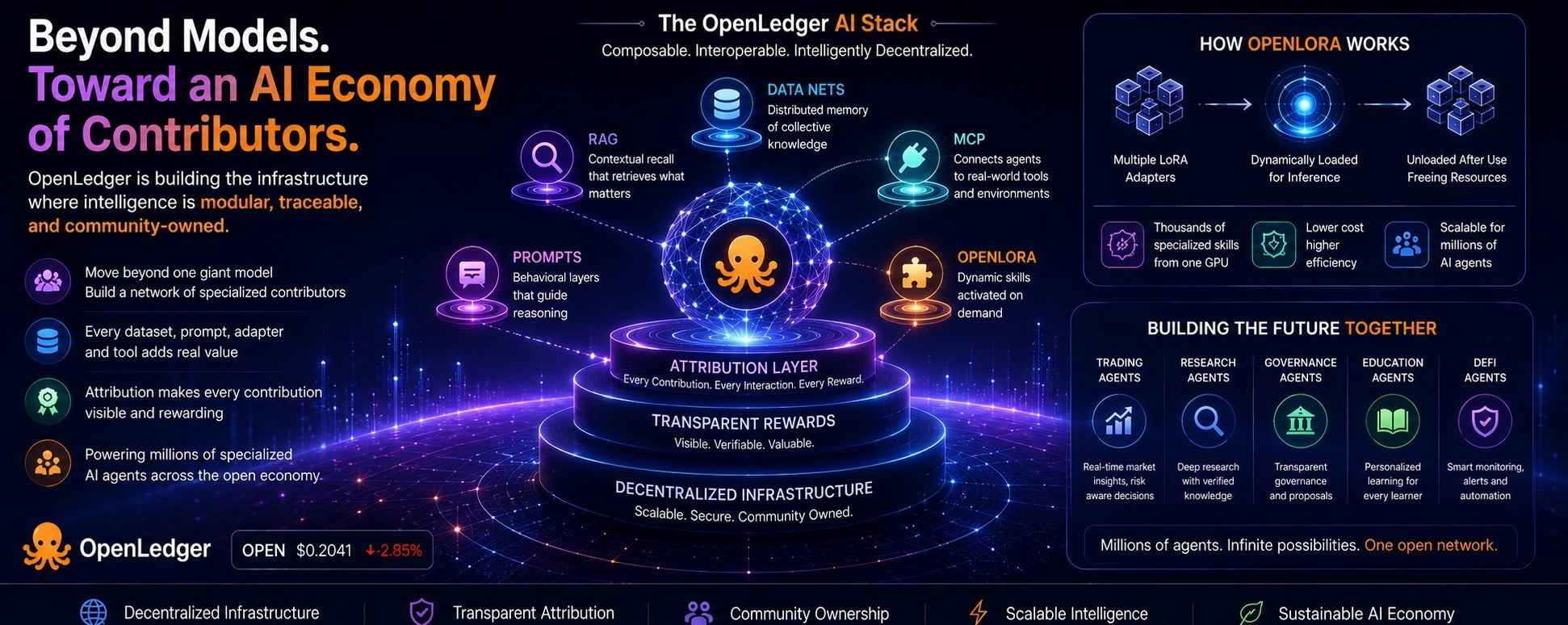
Last week I was scrolling through AI infrastructure projects late at night while the internet in my area kept cutting in and out every few minutes. Most of the projects started sounding the same after a while.
Bigger models. More GPUs. Faster inference. Another race toward building the most powerful centralized AI system.
Then I spent a few hours digging into OpenLedger.
At first I thought it was just another decentralized AI platform trying to enter an already crowded space. But the more I explored how the ecosystem actually works, the more I realized OpenLedger is approaching AI from a completely different angle.
Most AI companies today are obsessed with building one giant brain.
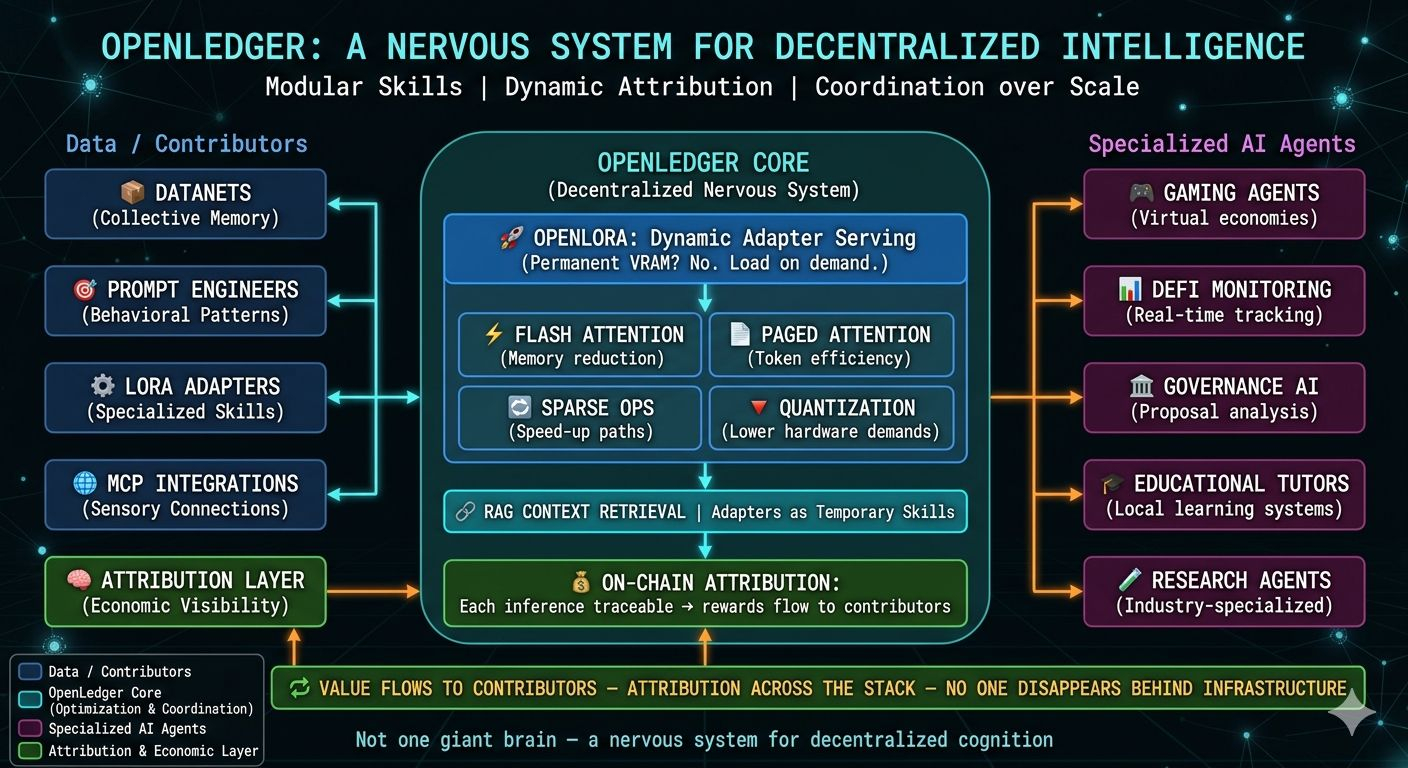
OpenLedger seems more interested in building an entire nervous system.
And honestly, that idea makes much more sense to me when thinking about where AI is heading over the next few years.
The current AI industry still follows a pretty traditional structure. Massive datasets get collected, giant models get trained, deployment stays centralized, and access becomes controlled by whoever owns the infrastructure.
Everything revolves around scale.
But OpenLedger shifts the focus toward coordination instead.
That difference may sound small at first, but it changes the entire architecture.
Inside OpenLedger, intelligence does not feel locked into one massive model. It feels modular. Almost like different pieces working together in real time.
Datasets become active parts of the system instead of forgotten training material. Prompts behave more like reusable behavioral layers. Adapters become temporary skills that can activate only when needed. Even inference itself becomes traceable across contributors.
The first thing that really caught my attention was OpenLoRA.
Normally, serving large numbers of fine-tuned AI models becomes expensive very quickly because every model continuously occupies GPU memory. Scaling specialized AI systems at that level creates huge infrastructure pressure.
OpenLedger handles it differently.
Instead of permanently loading every specialized model, OpenLoRA dynamically loads LoRA adapters only when requests arrive. Once the task finishes, the adapter unloads again.
Simple idea. Big impact.
One infrastructure layer can suddenly support thousands of specialized AI behaviors without needing massive permanent VRAM allocation.
The deeper I looked, the more interesting the optimization stack became.
Flash Attention helps reduce memory pressure during inference. Paged Attention improves token handling efficiency. Sparse operations speed up computation paths. Quantization lowers hardware demands while keeping performance practical.
None of these technologies are individually new.
But combining them into a decentralized serving architecture built specifically for modular intelligence creates something that feels very different from the direction most AI ecosystems are moving today.
It stopped feeling like “many models.”
It started feeling like “many skills.”
And that matters because I honestly do not think the future internet will rely forever on only a few universal AI assistants.
We are probably moving toward millions of narrow specialized agents instead.
Small research agents trained for specific industries. Governance agents analyzing proposals. Educational tutors built around local learning systems. Gaming agents optimized for virtual economies. Financial monitoring systems tracking DeFi activity in real time.
OpenLedger already feels designed for that kind of fragmented AI future.
But infrastructure is only part of the story.
What makes the ecosystem genuinely interesting is attribution.
Right now, most contributors inside AI systems disappear after training happens.
Datasets lose visibility. Prompt engineers rarely receive recognition. Context retrieval happens silently in the background.
OpenLedger introduces a structure where contributions can remain economically visible even during inference itself.
If a DataNet provides useful retrieval context through RAG, that interaction can remain attributable.
If a certain prompt structure consistently improves reasoning quality, its creator could potentially benefit from usage across the network.
If MCP integrations connect agents to external tools or live environments, those interactions can stay transparent too.
That changes the economics of AI completely.
Instead of value belonging only to whoever owns the biggest model, value starts flowing toward whoever contributes useful intelligence at the exact moment it becomes needed.
The ecosystem begins operating less like a closed AI company and more like a collaborative intelligence network.
And the more I thought about it, the more biological the whole architecture started feeling.
DataNets behave almost like memory systems storing collective experience.
RAG works like contextual recall pulling relevant information when needed.
MCP integrations act like sensory connections linking agents to external environments.
Prompts shape behavioral patterns.
OpenLoRA dynamically activates specialized reasoning abilities almost like a nervous system routing signals through different pathways.
Individually, every component makes sense.
Together, they start resembling an operating system for decentralized cognition.
That may end up being OpenLedger’s real advantage long term.
A lot of AI projects are still competing mainly on parameter size and benchmark performance.
OpenLedger seems focused on coordination scalability instead.
And in a world where AI agents become increasingly specialized, coordination may end up mattering far more than raw model size alone.
The most interesting part is that the system leaves room for communities to specialize deeply without needing to control the entire platform.
One group can focus on medical datasets. Another can optimize prompts for autonomous research systems. Another can build adapters specialized for governance analysis or DeFi monitoring.
Because attribution exists across the stack, contributors no longer disappear behind centralized infrastructure.
That creates a much more collaborative future for AI.
Not one machine replacing everyone.
But millions of interconnected systems continuously improving because people across the network keep contributing knowledge, context, reasoning, and specialized intelligence together.
And honestly, that future feels far more realistic than the idea of one perfect supermodel controlling everything.