
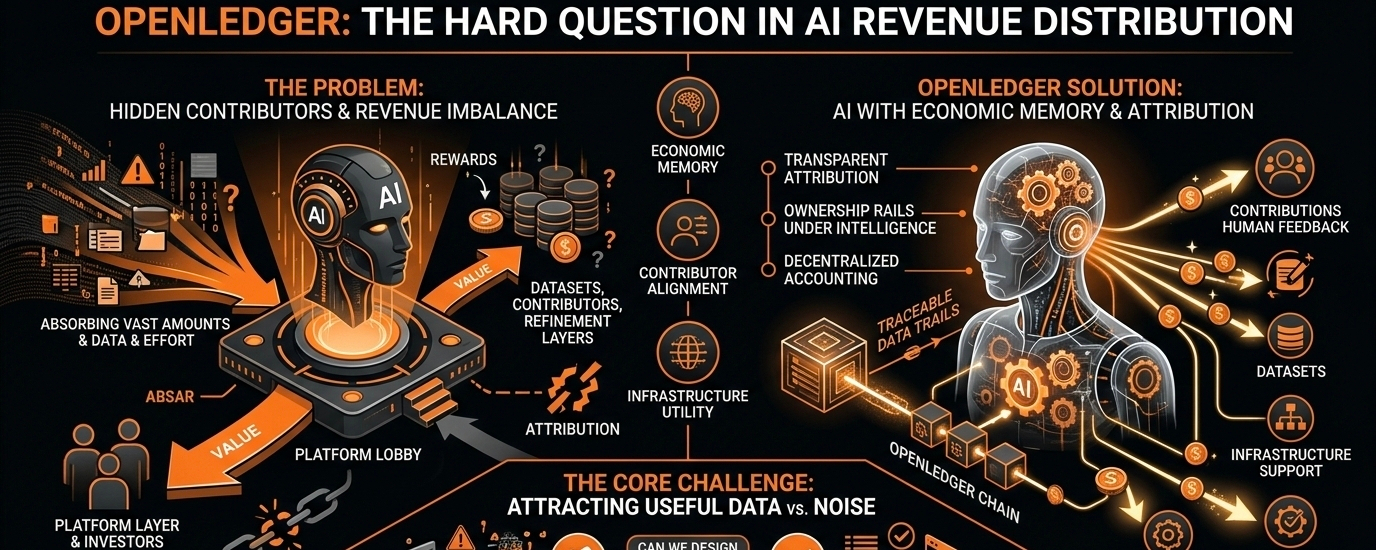
AI is moving so fast right now that most people barely stop to question the structure underneath it. Everyone is focused on outputs. Smarter models. Faster agents. Better automation. AI that can trade, write, analyze, build, optimize, and eventually replace entire layers of digital labor. Every week the market discovers a new reason to become excited again. New products launch, new models appear, new infrastructure narratives form around them, and capital starts rotating toward anything remotely connected to artificial intelligence.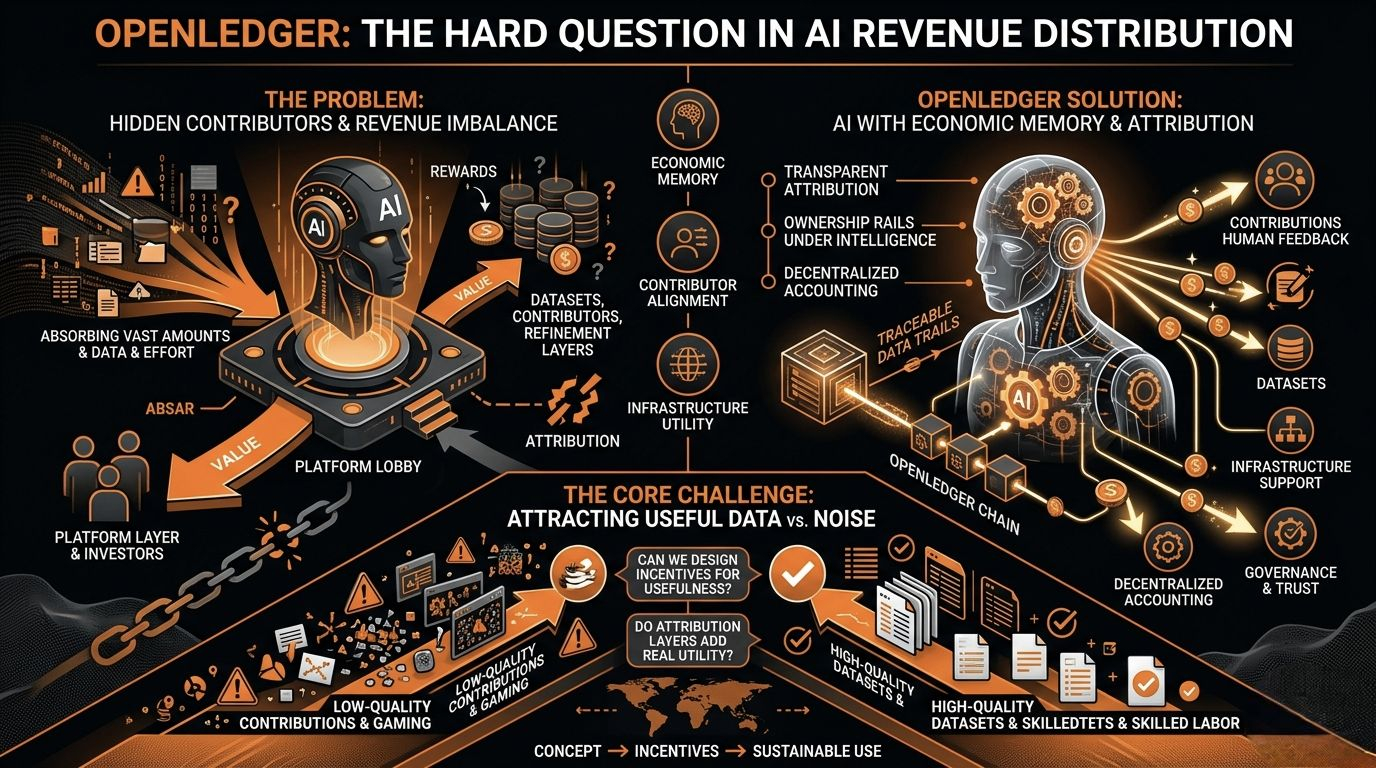
I understand why. The shift is real. But the deeper AI becomes, the more one uncomfortable question starts floating underneath the excitement: who actually gets paid when AI becomes valuable? Not the platform at the top. Not the investors sitting closest to the infrastructure. I mean the people and systems underneath the model itself. The datasets. The contributors. The refinement layers. The hidden labor that slowly shapes intelligence into something commercially useful.
That is the area where OpenLedger starts becoming interesting to me. Not because it is another “AI + blockchain” project. The market has already exhausted that phrase. I have watched too many projects borrow AI branding just to create momentum around a token that had no real infrastructure behind it. Some had unfinished products. Some had recycled narratives. Some were basically dashboards wrapped in buzzwords. The problem is that AI became a marketing shortcut long before it became a mature on-chain economy.
That is why most AI crypto projects start sounding identical after a while. They promise decentralized intelligence, autonomous systems, scalable compute, open models, agent economies, or some version of machine-driven productivity. But once you push past the pitch, the actual economic structure underneath those claims often feels weak. OpenLedger at least appears to be targeting a real fracture.
The project is centered around something most people inside AI conversations still avoid discussing directly: attribution. Where does intelligence come from? Who contributed to it? Who owns the economic value once the system becomes useful? And can that contribution history actually become traceable instead of disappearing inside centralized platforms?
Those questions matter more than people think. Because AI does not create value from nothing. Every model is trained on something. Every intelligent system absorbs layers of human input, data refinement, behavioral patterns, feedback loops, corrections, and infrastructure support. Yet most of the value ends up flowing toward the final platform layer while the deeper contribution chain becomes invisible. That imbalance is becoming harder to ignore.
And honestly, I think crypto was always going to collide with this problem eventually. I have spent enough time watching blockchain cycles to notice a pattern. Crypto tends to move toward areas where ownership, incentives, and coordination become messy. That is usually where decentralized systems attempt to insert themselves. Sometimes it works. Sometimes it creates something even messier. But the pattern repeats constantly.
We saw it with payments. We saw it with decentralized finance. We saw it with creator economies, gaming, storage, and distributed computing. Now AI is creating another giant value extraction layer, and naturally crypto wants to build rails underneath it. OpenLedger’s thesis seems to be that AI systems should carry economic memory with them. Data should not become detached from its contributors. Models should not appear as isolated black boxes. AI agents should not operate without transparent attribution layers underneath the outputs they generate.
Conceptually, that makes sense. The difficult part is everything after the concept. Because crypto has a terrible habit of taking good ideas and turning them into unsustainable incentive systems. I have watched this happen repeatedly across multiple cycles. Early-stage infrastructure projects usually begin with a genuinely compelling vision. Open participation. Better alignment. Shared ownership. Transparent systems. Then the incentives arrive. Then participation becomes financialized. Then activity starts getting optimized for rewards instead of usefulness. Eventually, the network becomes crowded with noise pretending to be growth.
That is one of the biggest things I would watch with OpenLedger. Can it attract valuable data instead of simply attracting activity? Those are completely different things. A blockchain can create transactions very easily. A token can create participation. Rewards can generate uploads, engagement, and on-chain movement. But none of that automatically creates useful intelligence.
Useful AI data is difficult. High-quality datasets are difficult. Reliable attribution is difficult. Filtering manipulation is difficult. This is where most idealistic systems start colliding with reality. Because once money enters the equation, people optimize behavior extremely fast. If contributors are rewarded for participation, low-quality contributions start flooding the network. If attribution becomes profitable, users begin gaming attribution. If agent deployment becomes incentivized, networks fill with unnecessary agents designed primarily to farm activity rather than solve problems.
Crypto has seen this movie too many times already. That does not mean OpenLedger fails automatically. It just means the real challenge is not creating a theoretical framework. The challenge is designing an economic environment where useful behavior consistently survives longer than exploitative behavior. That is much harder, especially in AI, where value itself is often difficult to measure clearly.
Take model training as an example. How do you accurately determine which dataset meaningfully improved a model? How do you measure contribution quality across thousands of inputs? How do you prevent duplicated or manipulated data from entering the system? What happens when the most valuable data is private, proprietary, or legally sensitive? These are not side problems. These are core structural problems.
And I think this is where OpenLedger becomes more interesting than the average AI narrative token. The project is not simply trying to create another AI application layer. It is attempting to build accounting rails underneath intelligence itself. That is a much more ambitious goal, and potentially a more important one too. Because if AI eventually becomes embedded across finance, commerce, gaming, logistics, research, and software infrastructure, then attribution and ownership become massive economic questions.
Right now, most users barely think about the underlying data economy behind AI systems. They interact with outputs, not origins. But over time, the origin layer may become impossible to ignore, especially if governments, enterprises, creators, and developers begin demanding transparency around how intelligence is produced. That is where OpenLedger could potentially matter. Not as a hype cycle asset. As infrastructure.
But infrastructure projects survive differently from narrative projects. Narratives survive on attention. Infrastructure survives on utility. That difference matters more than most crypto communities want to admit. A narrative can explode for months based entirely on excitement. Infrastructure has to survive years of boring execution before the market fully understands its value.
Most people underestimate how difficult that phase becomes. You need developers. You need integrations. You need systems that actually function under pressure. You need users who stay after rewards slow down. You need economic loops that remain alive when speculation cools. That is the part I am waiting to see from OpenLedger: the working loop. Not the whitepaper version. The real version.
Data enters the network. Models consume it. Developers build applications people actually use. AI agents generate activity or revenue. Contributors receive value based on measurable participation. The token exists because the system genuinely requires economic coordination rather than because traders need another AI ticker to rotate into. That loop is everything.
Without it, OpenLedger risks becoming another intellectually attractive project that struggles to convert theory into durable usage. And the market is already filled with those. One thing I do think OpenLedger understands correctly is friction. Its compatibility with Ethereum-style ecosystems matters more than some people realize. Developers do not want to learn entirely new environments just to experiment with AI workflows. Users do not want complicated onboarding. Liquidity rarely likes isolation.
Reducing friction gives projects a better chance of survival. But compatibility alone does not create adoption. It only removes excuses. The real question is behavioral. Will developers actually prefer building in a system where attribution and ownership are transparent? Will contributors trust decentralized accounting layers enough to provide useful data? Will enterprises participate if transparency exposes too much operational information? Will AI agents even need open on-chain coordination, or will centralized systems remain faster and easier for most commercial applications?
Those questions do not have simple answers yet. And that uncertainty is exactly why OpenLedger feels more real to me than projects pretending the future has already been solved. Too much AI crypto marketing sounds polished to the point of unreality. Everything is framed like inevitable success. Infinite scale. Seamless automation. Autonomous economies. Frictionless intelligence. Real systems are never that clean, especially systems dealing with incentives, ownership, privacy, and money at the same time.
OpenLedger is stepping into a category where every layer creates tension. Transparency conflicts with privacy. Open participation conflicts with quality control. Token incentives conflict with authenticity. Decentralization conflicts with efficiency. That complexity is precisely why the project deserves attention. Because even failure would teach the market something important.
Personally, I think the most valuable signal will not come from token performance or social engagement metrics. It will come from whether OpenLedger can demonstrate that useful AI coordination can happen on-chain without collapsing into spam, speculation, or unusable complexity. That is the actual test.
Can data remain valuable after becoming liquid? Can attribution exist without slowing systems down? Can agents operate transparently without destroying user experience? Can contributors earn without turning the network into a farming ecosystem? Those are infrastructure-level questions, and infrastructure questions usually take longer to answer than people expect.
That is another reason I remain cautious around every AI-related narrative right now. Markets tend to price the dream long before the infrastructure matures enough to support it. We have seen that pattern repeatedly across crypto cycles. Excitement arrives immediately. Functional systems arrive much later. Sometimes they never arrive at all.
Still, I think OpenLedger is touching a problem that eventually becomes unavoidable. AI value extraction is becoming increasingly centralized. The deeper models become integrated into everyday systems, the more important ownership and contribution tracking become. People are not going to remain comfortable forever with a structure where data enters giant systems, intelligence emerges, and nearly all economic upside gets absorbed at the platform layer.
At some point, someone was always going to try building accounting rails underneath AI. OpenLedger appears to be one of those attempts. Whether it succeeds is a completely different question. The project still has to survive execution risk, incentive pressure, speculative distortion, technical scaling problems, governance friction, and the usual crypto tendency to over-financialize everything too early.
That burden is heavy. And honestly, I think that burden is what makes the project worth watching in the first place. Easy narratives rarely produce durable infrastructure. The harder the coordination problem, the more meaningful the solution becomes if someone actually solves it.
I do not view OpenLedger as a guaranteed winner. I also do not dismiss it as another temporary AI token rotation. The honest position sits somewhere between optimism and skepticism. The project has a legitimate thesis. AI systems need better ownership rails. Contributors need clearer economic participation. Developers need open infrastructure layers that do not trap intelligence entirely inside centralized ecosystems.
But none of that matters unless the network proves it can survive contact with real usage. That is where most crypto projects fail. Not in vision. In sustainability after the vision.
So for now, I am watching OpenLedger less like a hype trade and more like an experiment around whether AI can carry economic history with it instead of only producing outputs at the surface layer.
Because eventually the market is going to ask a harder question than “What can AI do?”
It is going to ask: who actually deserves to earn from what AI becomes?
@OpenLedger #OpenLedger #openledger $OPEN
