
Most AI projects feel fake as hell now.
Every week it’s the same thing. New AI coin. New roadmap. New “revolution.” Same people posting rocket emojis pretending some random token is about to change humanity because it slapped “AI” next to “blockchain” in a whitepaper.
Meanwhile none of the actual problems get fixed.
AI right now is basically a giant vacuum cleaner sucking up human work from the internet. Articles. Forums. Code. Art. Conversations. Research. Memes. Tutorials. Years of people posting stuff online for free. All that gets scraped into giant models and then suddenly billion-dollar companies appear selling access back to everyone.
And the weird part is people just accepted this somehow.
That’s what makes OpenLedger more interesting than most of the garbage floating around this market right now. At least it’s trying to attack a real problem instead of pretending AI agents trading meme coins is the future of civilization.
The problem is ownership.
Nobody knows who actually deserves value in AI anymore.
A model gets trained on millions of pieces of human knowledge. Cool. But who gets paid? Who gets credit? Who even knows where the outputs came from anymore? Nobody. The whole thing is a black box. Data goes in. Money comes out somewhere at the top. Regular people get nothing except maybe a chatbot subscription.
That system feels broken already and AI hasn’t even fully scaled yet.
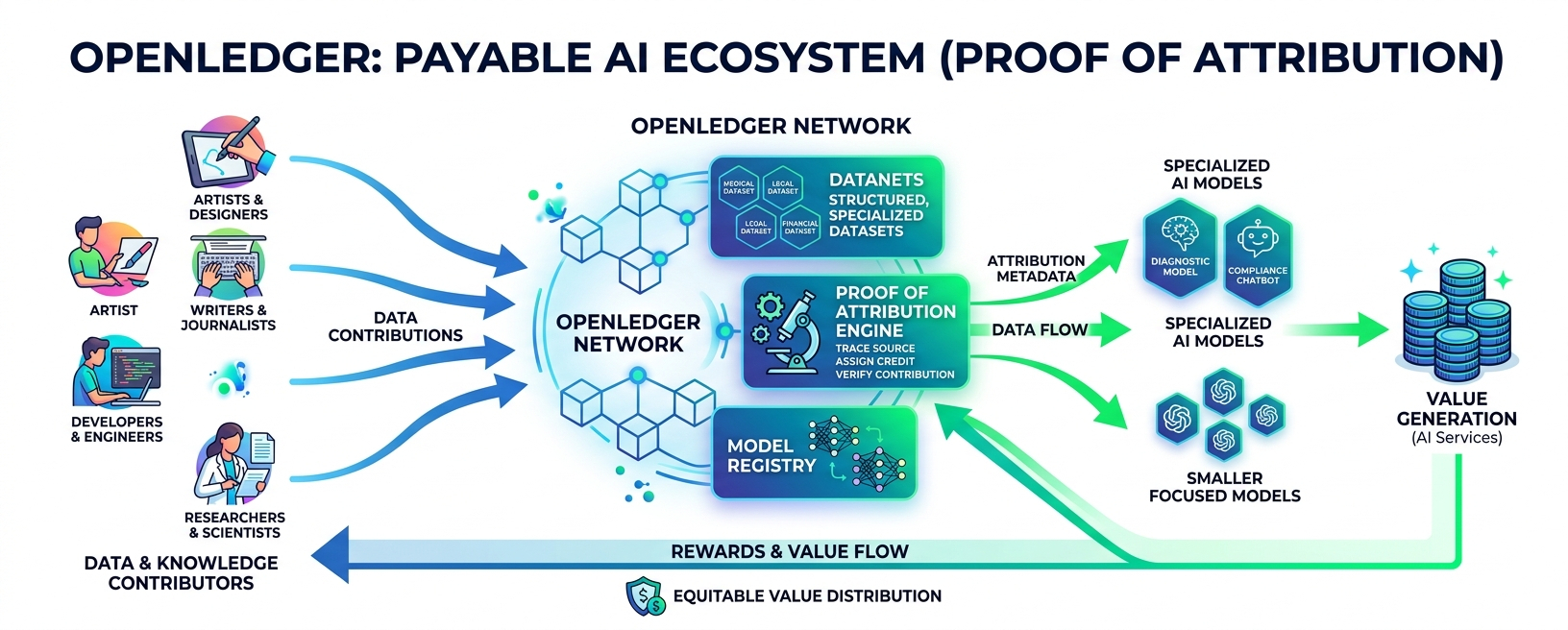
OpenLedger is trying to build around this idea called Proof of Attribution. Sounds like another annoying crypto buzzword at first. I thought the same thing honestly. But the basic idea is actually simple. Try to track where AI knowledge comes from and connect rewards back to contributors instead of treating people like invisible fuel for giant centralized models.
Which honestly should already exist by now.
Right now the AI economy feels like one giant extraction machine. Big companies take data from everywhere, train models behind closed doors, then tell everyone the future is decentralized innovation while controlling the entire stack themselves.
It’s weird.
And people are starting to notice it too.
Artists are angry. Writers are angry. Developers are angry. Even regular users are getting uncomfortable with how much power is getting concentrated into a handful of AI companies that basically decide what information systems the world uses.
That’s probably why projects like OpenLedger are even getting attention now. Not because crypto suddenly became smart overnight. Mostly because the current AI system already looks unsustainable if you think about it for more than five minutes.
The internet trained these models.
Human beings trained these models.
But somehow almost none of the humans own any meaningful piece of the economy being created around them.
That’s the part OpenLedger keeps pushing against.
Their whole thing is turning data, models, and AI agents into things people can actually monetize instead of just donating value upward forever. They have these Datanets where communities can build and organize datasets. They’re pushing smaller specialized AI models instead of only giant expensive mega-models. They want AI systems where contributions can actually be traced on-chain instead of disappearing into black-box infrastructure forever.
And honestly? That direction makes sense to me more than half the AI hype flooding crypto right now.
Because the “bigger model solves everything” narrative already feels shaky.
People act like AI is only a race toward giant trillion-parameter systems that consume infinite compute and infinite money forever. But real life usually doesn’t work like that. Specialized systems matter too. A medical AI trained on clean healthcare data might be more useful than a giant general-purpose model for hospitals. Same with finance. Same with law. Same with research.
Smaller focused models probably become a huge thing eventually.
And once you move toward specialized AI, suddenly data quality matters way more. Attribution matters more. Communities matter more. You can’t just endlessly scrape the internet and hope scale fixes everything.
That’s where OpenLedger’s idea starts looking less crazy.
Still risky obviously. Very risky.
Crypto people love acting like every project is guaranteed world-changing infrastructure when most of them barely survive one bear market. And AI moves insanely fast too. A lot of these projects could disappear within two years and nobody would remember them.
That’s reality.
OpenLedger also has the same problem every decentralized AI project has right now. Competing against centralized giants is brutal. OpenAI, Google, Anthropic, Meta… these companies have insane amounts of money, compute, engineers, and control over infrastructure. Decentralized systems sound nice philosophically but centralized companies move faster most of the time because coordination is easier when a few corporations control everything.
That’s the uncomfortable truth crypto people hate admitting.
But centralized AI also creates massive problems long term. Too much power. Too little transparency. Too much dependence on a handful of companies controlling intelligence systems that millions of people rely on daily now.
And honestly I think that’s why OpenLedger even exists.
Not because decentralization magically fixes everything. But because people are starting to realize AI itself is becoming economic infrastructure. It’s not just software anymore. It’s becoming the layer underneath work, search, research, content, communication, coding, education, maybe even decision-making eventually.
And once AI becomes infrastructure, ownership starts mattering a lot.
Who controls the models?
Who controls the datasets?
Who gets paid when AI agents start generating value nonstop online?
Who verifies where information came from?
Right now the answer to most of those questions is basically “large centralized companies.” That might work for a while. Maybe even a long while. But eventually people push back against systems where all the power flows upward forever while everyone else becomes disposable data suppliers feeding the machine.
That’s why OpenLedger’s whole “payable AI” idea sticks in my head.
Because AI companies keep talking about artificial intelligence while quietly building extraction economies underneath it. OpenLedger is basically saying maybe contributors should actually own part of the system too instead of just watching trillion-dollar industries grow around knowledge pulled from the public internet for free.
And honestly? That feels like a more important conversation than half the fake AI hype this market keeps recycling every day.#OpenLedger $OPEN @OpenLedger
