
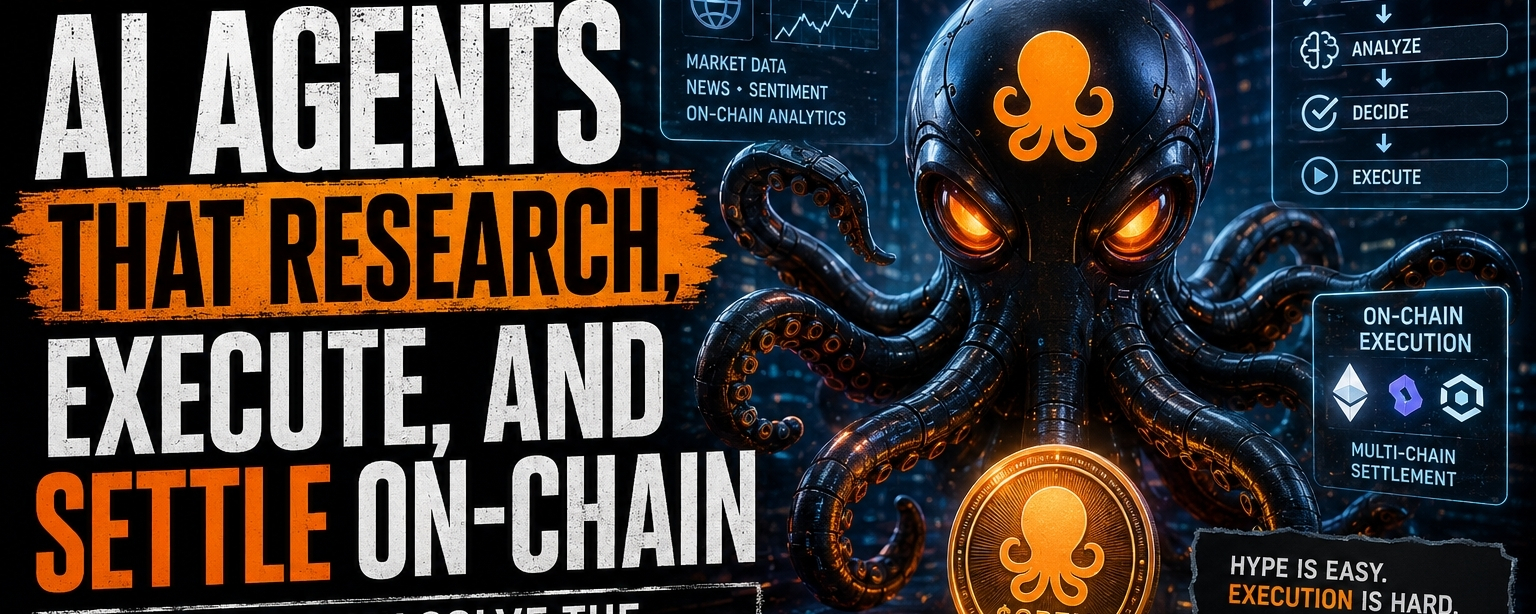
OpenLedger is trying to solve one of the uglier problems sitting under the AI boom, and I don’t mean that in the clean pitch-deck way.
Everyone wants smarter models. Everyone wants agents. Everyone wants AI that can trade, automate, build, answer, optimize, and print some kind of value from the background. But the moment you ask where the data came from, how an agent bridges real-time research with trustless on-chain execution, and why we still rely on a messy stack of web2 and web3 middleware to make it happen, the room gets uncomfortable.
That is the gap OctoClaw is walking into.
I’ve seen enough crypto projects dress up weak ideas with big words, so I’m not easily impressed by another “AI agent” label. The market has recycled that phrase to death. It has been used on real infrastructure, fake infrastructure, unfinished dashboards, and tokens that only existed because AI was trending that quarter.
OctoClaw at least has a sharper wound to point at.
The agent is built around the idea that data retrieval, real-time research, and on-chain action should not just float around like anonymous, fragmented pieces of software. They should have records. They should have unified pipelines. They should have some economic memory attached to them. If an intelligent agent pulls live market data, coordinates a cross-chain workflow, and executes an on-chain trade, that entire pipeline should not disappear into an opaque web2 server. The system should not pretend the execution came from nowhere.
That sounds fair.
Fair does not mean easy.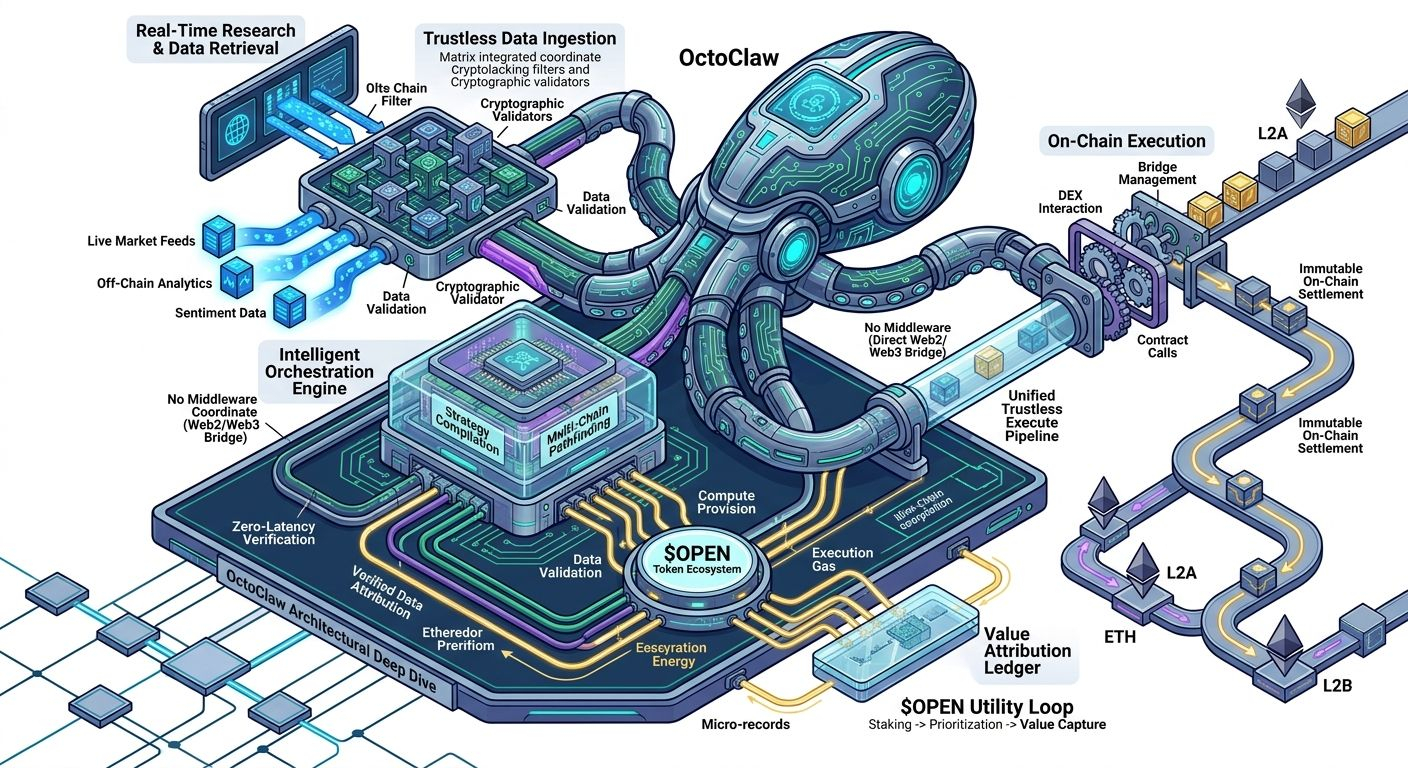
Crypto has a long history of taking a good moral argument and turning it into a messy incentive machine. I have watched it happen with gaming, storage, compute, social tokens, DeFi rewards, creator economies, data markets, all of it. The first wave always looks clean. Then the farmers arrive. Then the low-quality activity starts. Then everyone realizes that automated activity is not the same thing as actual utility.
That is one of the first things I would watch with OctoClaw.
Can it orchestrate useful workflows, or just noisy workflows?
Because there is a huge difference.
A script can create on-chain transactions. A simple bot can create wallet activity. None of that means the underlying agent architecture is valuable. None of that means builders are using its pipeline to deploy smarter automated strategies. None of that means users are willing to pay for what comes out the other side.
This is where the grind begins.
OctoClaw wants to make real-time AI execution more transparent and native. That includes trustless data ingestion, multi-step research compilation, smart contract interaction, and immediate on-chain settlement, all handled by a single intelligent agent. The idea is that an AI workflow should not live in some sealed box where it depends on web2 APIs to think and separate web3 bridges to act.
I like that direction.
I’m just tired enough to ask the boring questions first.
How does it pull real-time data without getting rate-limited or manipulated? How does it bypass the usual middleware tools without compromising security? How does the system stop latency from ruining execution? What happens when a workflow is highly complex but needs to remain gas-efficient? How does an enterprise trust an autonomous agent to handle its capital without manual oversight?
These are not side issues. They are the whole thing.
If OctoClaw cannot answer them in practice, the project becomes another strong thesis trapped inside weak execution. We have seen that movie too many times. A beautiful idea, a committed community, some early excitement, then months of updates that sound active but do not really move the market’s confidence.
The real test, though, is whether OctoClaw can create a working loop.
Real-time data enters the agent's pipeline. The agent processes it. Users deploy workflows they actually want. Trustless execution creates on-chain value. The $OPEN token has some reason to exist beyond being a bet on AI sentiment—acting as the core fuel that powers, secures, and prioritizes these automated AI workflows in real time.
That loop matters more than any slogan.
Without it, you get noise. With it, you might get infrastructure.
And yes, OctoClaw’s compatibility with Ethereum-style wallets, smart contracts, and L2 ecosystems helps. It lowers friction. That part is practical. Builders do not want to learn a completely foreign environment just to experiment with AI workflows. Users do not want strange wallet flows. Liquidity does not like isolated systems.
Still, compatibility is not adoption.
It just removes one excuse.
The harder part is behavior. Will developers actually build around OctoClaw because it gives them a cleaner architectural pipeline? Will capital allocators trust its autonomous execution enough to participate? Will AI agents need this kind of unified environment, or will most of them stay inside closed systems where the experience is smoother and the economics are easier to control?
That is where I’m looking for the moment this actually breaks open.
Not in a marketing line. Not in a price candle. Not in a loud announcement that gets recycled across social feeds for 48 hours.
I mean the point where OctoClaw starts showing that data can become actionable without becoming slow. That research can be comprehensive without requiring middleware bloat. That agents can operate on-chain without turning the user experience into a technical chore. That the $OPEN token can capture the economic value of these workflows without the whole system becoming a speculative farming ground.
That is a heavy lift.
And maybe that is why the project is worth watching.
Most of the AI crypto noise is too smooth. Too eager. Too clean. It talks like the future has already agreed to arrive. OctoClaw feels more interesting because the problem it is touching is genuinely uncomfortable. AI is creating enormous value, but the execution layer underneath it is still broken, trapped between siloed web2 data streams and rigid web3 smart contracts.
That cannot stay invisible forever.
Maybe OctoClaw becomes one of the projects that gives that invisible layer a market. Maybe it becomes part of the rails for real-time data attribution, agent-to-agent payments, and automated on-chain strategies. Maybe specialized workflows powered by $OPEN become a real category, not just another narrative thread.
Or maybe the whole thing gets buried under the usual crypto friction.
Bad incentives. Thin usage. Overcomplicated tooling. Token speculation running ahead of product reality. A community that wants price action faster than infrastructure can mature.
I don’t say that to be cynical for the sake of it. I say it because the market has trained us to ask harder questions. Every cycle leaves scars. Every failed project makes the next promise a little harder to believe.
OctoClaw’s strongest idea is also its biggest burden: if AI value is built from execution, then someone has to build the accounting and processing system for that execution. Someone has to prove the accuracy of real-time data. Someone has to make value flow back through the token instead of letting everything get absorbed at the platform level.
That is not a small job.
It is slow. It is technical. It is political in its own way. It touches automation, incentives, security, trust, and money. The kind of problem that does not get solved by branding.
I would not treat OctoClaw like a simple hype play. That feels lazy. I also would not treat it like a guaranteed architectural winner. That feels even lazier.
The honest view sits somewhere in the middle, which is always less exciting but usually closer to reality.
OctoClaw has a real thesis. AI needs better, more unified rails to research and execute on-chain. The network needs ways to sustain itself. Builders need open systems that do not trap everything inside closed platforms. The market needs to see whether an intelligent agent can handle the complete pipeline, not just the output.
But the project still has to prove that the system can survive contact with actual users.
That is where most projects fail.
Not in the idea.
In the grind after the idea.
So I’m watching OctoClaw with interest, but not with blind belief. I want to see the loop. I want to see real data, real builders, real agent activity, real reasons for $OPEN to matter when the AI narrative cools down again.
Because it will cool down.
Every narrative does.