
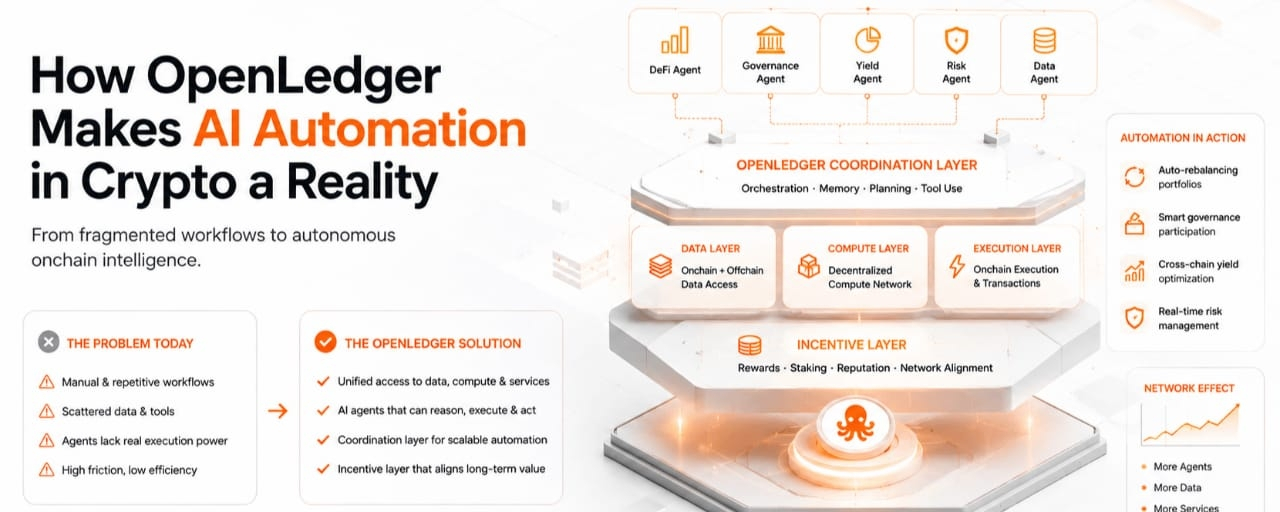
I’ve been seeing a flood of AI agents in crypto lately, and most of them feel pretty similar. Every week there’s a new dashboard or “AI-powered” tool, but in practice they rarely remove the real friction. Users still end up bridging assets, checking governance, tracking incentives, and jumping across multiple tabs just to understand what’s going on.
So a lot of what’s being called automation today feels more like surface-level abstraction. The interface gets smarter, the summaries get cleaner, but the underlying workflow is still manual. The system looks automated, but users are still doing most of the work step by step.
That’s been my main frustration with the AI narrative in crypto so far. It’s not that the technology is missing—it’s that it mostly stops at the presentation layer. Agents can respond, summarize, and simulate intelligence, but they don’t really execute across the full stack of crypto actions in a meaningful way. They sit alongside the user rather than actually replacing repetitive steps.
And that becomes more obvious when you think about how fragmented crypto already is: wallets, RPCs, approvals, liquidity moves, reward tracking, bridging, and network monitoring. Each step is small, but together they create a heavy cognitive load. Adding AI on top hasn’t really reduced that burden yet—it often just repackages it.
That’s why I started paying attention to OpenLedger. Not because of the general AI hype, but because they seem to be aiming at something lower-level and more structural: building AI agents that can actually interact with crypto systems as part of the infrastructure, not just as a front-end layer.
Instead of focusing on “AI personalities” or chat-based agents, the emphasis appears to be on coordination—how agents access data, use compute, execute actions, and operate across chains in a scalable way. In other words, treating agents as network components rather than standalone products.
This matters because most current systems are mismatched: too much complexity in some places, and not enough automation where it would actually help. Users still stitch together information manually, while AI tools remain disconnected from execution. The result is a halfway experience—neither fully manual nor truly automated.
What stands out in OpenLedger’s approach is the idea of an incentive-driven system behind these agents. In crypto, building tokens is easy, but sustaining real participation—developers building agents, contributors providing compute or data, and long-term network activity—is much harder. The incentive design is what ultimately determines whether the system becomes alive or stays theoretical.
The key questions are still open: will developers actually build on it, will contributors keep participating when rewards fluctuate, and will automation genuinely reduce user workload instead of adding another abstraction layer?
Right now, there’s no clear answer. Most AI-crypto systems still haven’t proven real usage beyond demos.
But OpenLedger’s direction feels more grounded than many others in the space. It’s less about selling a futuristic AI narrative and more about asking a practical question: what does real AI-driven automation in crypto actually need at the infrastructure level?
And that’s a much harder problem than building another chatbot that posts on crypto Twitter.
In the end, what the space really needs isn’t more AI branding. It needs systems people actually rely on because they reduce steps, save time, and remove friction from everyday crypto activity.
Whether OpenLedger succeeds or not is still uncertain. It really depends on whether the system works outside controlled demos—where real usage tends to expose all the gaps.
For now, I’m just watching how it develops.