
When I first saw OpenLedger choosing the OP Stack, I didn’t look at it as just another infrastructure announcement. In crypto, projects often present their chain decision like it is the main achievement, but the real question is always deeper than that. Why this stack? Why not another ecosystem? What does this choice actually fix, and who benefits from the direction it creates? That is where OpenLedger’s decision becomes interesting. The OP Stack is not just a trendy framework attached to Optimism’s name. It is an open-source development framework designed for building Ethereum Layer 2 networks, and it already powers major networks like Base. For a project like OpenLedger, which is trying to connect AI, blockchain infrastructure, attribution, and data markets, choosing proven Layer 2 infrastructure makes more sense than trying to build every technical layer from zero.
The clearest reason is scale. AI data markets are not built around one or two large transactions. They are built around constant activity: data submissions, training records, attestations, reward flows, contribution tracking, and ownership-related actions. If every small action had to settle directly on Ethereum mainnet, the cost would quickly become a major weakness. The system would become too expensive for normal users, especially smaller contributors who are supposed to benefit from attribution and reward mechanisms. This is where the OP Stack gives OpenLedger a practical foundation. By using rollup architecture, many transactions can be bundled and settled back to Ethereum in a more efficient way. That does not magically solve every problem, but it does make the economics more realistic. For an AI data marketplace to work, participation must not feel expensive or technically heavy. The infrastructure has to stay in the background and allow the actual market activity to move smoothly.
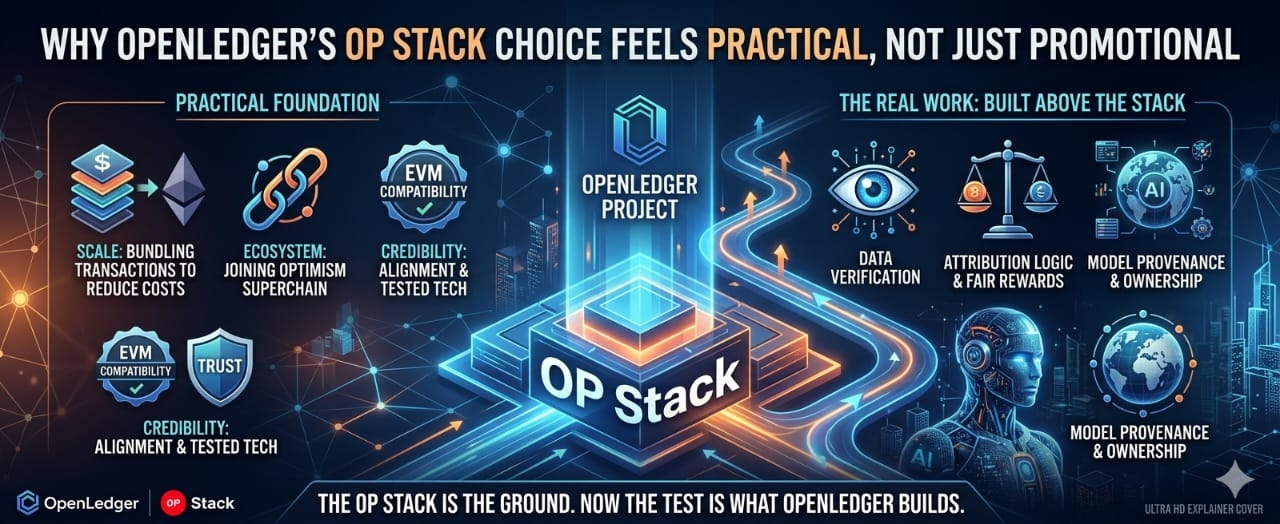
Another reason the choice matters is ecosystem positioning. Building with the OP Stack places OpenLedger closer to the Optimism Superchain environment, where different chains are designed to share standards, security assumptions, and future interoperability. That is not just a technical detail. It is also a strategic bet. OpenLedger is choosing to stand near an Ethereum-aligned ecosystem that already has developer attention, serious projects, and growing network effects. This does not mean Optimism automatically wins the future of multi-chain infrastructure, but it does mean OpenLedger is building in a place that already has momentum. For a project trying to gain trust in both AI and crypto circles, that matters. It shows the team is not simply chasing the loudest narrative or the easiest short-term incentive. It looks more like a calculated decision to use infrastructure that has already been tested by larger ecosystems.
There is also a credibility layer here. AI and blockchain together can be a powerful category, but it is also a category filled with overpromising. Many projects use the AI label without showing strong technical depth, and many blockchain projects talk about data ownership without proving how it works in practice. By building on the OP Stack, OpenLedger sends a signal that it wants to use infrastructure familiar to serious Ethereum developers. That signal does not guarantee success, but it does help reduce some of the early skepticism. Developers and users have seen enough weak AI-crypto narratives to know that strong marketing is not enough. A reliable settlement layer, Ethereum alignment, and a framework already used by major networks give OpenLedger a stronger starting position than a project building on vague promises alone.
Still, this is where the discussion needs to stay balanced. The OP Stack gives OpenLedger a capable foundation, but it does not automatically solve the hardest AI data problems. The framework was built for general-purpose Layer 2 execution, not specifically for verifying whether a data contributor provided legitimate data, whether a model training process used the correct datasets, or whether reward systems are truly measuring value fairly. Those problems sit above the infrastructure layer. They require OpenLedger’s own attribution logic, verification systems, incentive design, and marketplace mechanics. The OP Stack can help transactions move efficiently and settle securely, but the real challenge is proving that the AI data economy built on top of it is accurate, useful, and economically fair.
That is why I see OpenLedger’s OP Stack decision as important, but not the entire story. It is a strong infrastructure choice because it gives the project scalability, Ethereum alignment, ecosystem access, and developer credibility. But the future of OpenLedger will not be decided only by the stack it uses. It will be decided by whether its attribution layer actually works, whether data contributors can be rewarded fairly, whether developers find the system useful, and whether AI-related ownership can be tracked in a way that feels real rather than theoretical. The OP Stack gives OpenLedger solid ground to build on. Now the real test is what OpenLedger builds above that ground.